By FIW staff. Based on publicly available information reviewed by Film Industry Watch.
Editor’s Note:
This article examines publicly documented overlaps between private film-development programmes, public cultural funding, festival-market access, industry labs, festival advisory roles, and European film governance. No unlawful conduct is alleged.
Specifically, we examine whether European contemporary cinema has developed a concentrated system of cultural gatekeeping in which the same small professional class repeatedly occupies positions across development, funding, mentorship, market access, festival selection, academy governance, and cultural validation.
Power and access in the European film industry
Before examining the specific case study in this article, readers should understand a basic reality.
Despite what is often sold to the public, the film industry is not a meritocracy. Talent matters, but it is only one variable among many. Wherever status, money, public resources, and cultural influence are concentrated, systems inevitably emerge to control access to them.
If the industry truly operated on talent alone, power could not be accumulated, protected, and reproduced year after year. Yet this is precisely what we observe. The same individuals, institutions, and professional networks repeatedly appear in positions where they can influence who receives support, who receives visibility, who receives funding, and ultimately whose voice is heard.
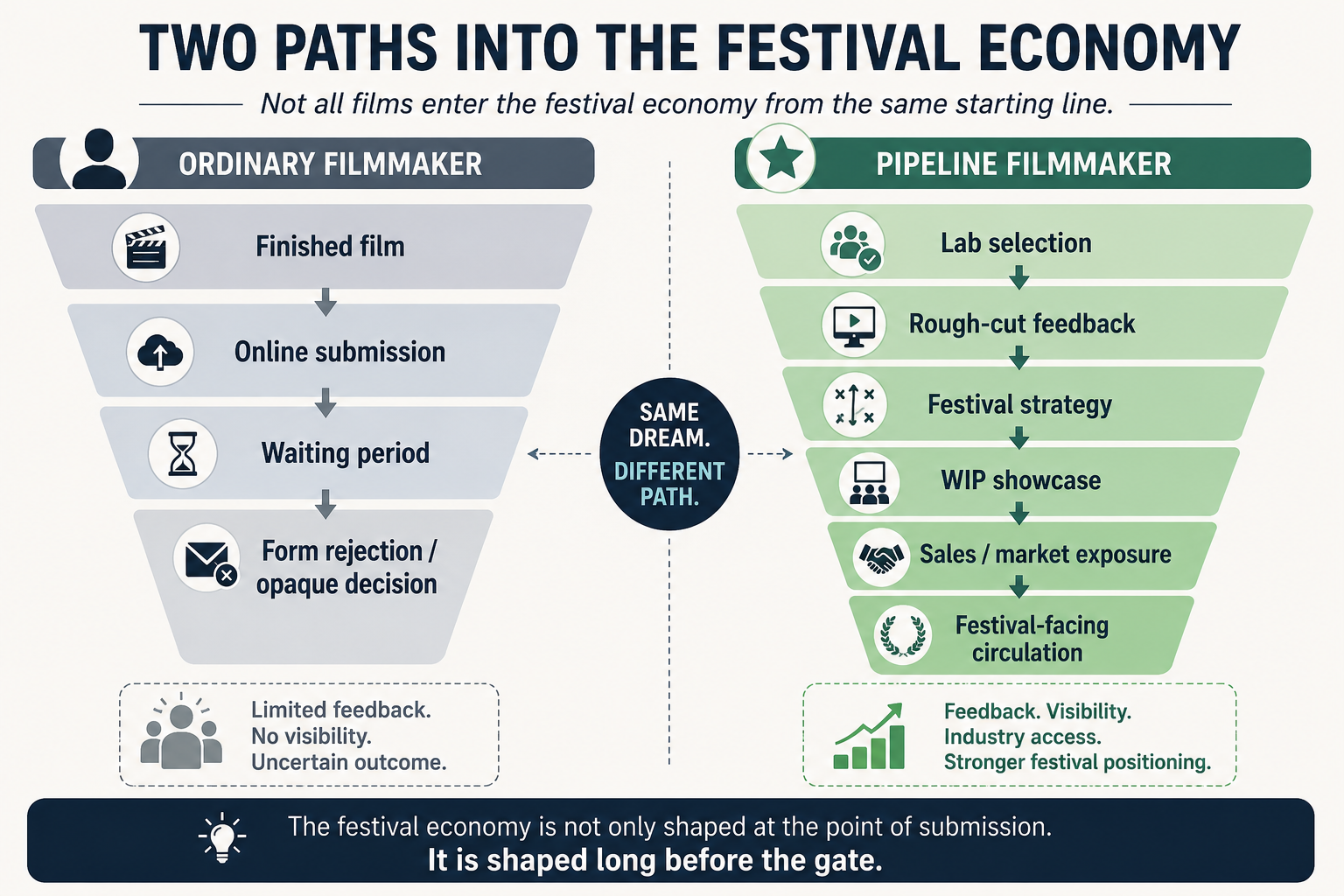
Filmmakers who enjoy proximity to those who hold positions of power enjoy advantages that those without access and connections simply do not. They gain access to information, mentorship, introductions, funding opportunities, festival strategies, market intelligence, and professional networks that remain largely invisible to outsiders.
The imbalance becomes even more pronounced when relationships break down. In a highly interconnected industry, filmmakers who find themselves in disagreement with influential individuals or institutions may discover that opportunities suddenly become harder to access. Whether real or perceived, the fear of professional exclusion creates powerful incentives for conformity. When access to funding, development programmes, festivals, markets, and recognition depends on a relatively small network of gatekeepers, independence carries a cost that not everyone can afford to pay.
This is not merely a question of who receives opportunities. It is also a question of who feels free to speak openly, challenge prevailing orthodoxies, pursue unconventional artistic paths, or criticize the institutions that shape their careers.
This reality is neither unique to cinema nor particularly surprising. Wherever power exists, incentives emerge to preserve it. The question is not whether such structures exist. The question is how concentrated they have become, who benefits from them, and what happens to artistic diversity when the same professional ecosystem repeatedly controls access to cultural legitimacy. Another question is whether public authorities have paid sufficient attention to the governance of the organizations they fund. If taxpayer money is intended to broaden access and support cultural diversity, at what point should regulators intervene when the same professional networks repeatedly occupy the institutions responsible for allocating opportunity, recognition, and public resources?
Why Concentration Emerges, And Why the Cultural Sector Is Different
Human beings do not simply acquire power, status, money, or influence. They seek to expand and preserve them.
Whenever valuable resources become scarce, competition emerges around access to them. Those who already possess access naturally acquire incentives to protect their position, increase their influence, and shape the rules governing entry into the system. This is observable throughout politics, business, academia, media, finance, and countless other sectors.
In sectors involving substantial economic interests, governments eventually responded by introducing transparency requirements, competition laws, anti-cartel regulations, conflict-of-interest frameworks, disclosure obligations, and governance safeguards. These protections did not emerge because concentration was impossible. They emerged precisely because concentration repeatedly occurred.
The cultural sector developed differently. Although enormous amounts of public funding, prestige, career opportunities, and cultural influence are allocated through film institutions, all of the governance principles that became standard elsewhere were never applied to the same extent.
There are no anti-trust rules limiting the accumulation of gatekeeping power across festivals, development labs, markets, academies, and funding bodies. There are no industry-wide cooling-off periods separating mentorship roles from selection roles. There are no comprehensive conflict-of-interest frameworks governing the movement of individuals between development programmes, festival selection committees, funding panels, and institutional leadership positions.
The reason is not necessarily malice or conspiracy. Rather, the cultural sector has largely escaped the scrutiny routinely applied to other domains of public life. These institutions are typically viewed as artistic, educational, or cultural rather than as mechanisms that allocate opportunity, influence, legitimacy, and vast sums of public money. As a result, structures that would attract significant governance attention elsewhere have often evolved without comparable oversight, transparency requirements, or safeguards against the concentration of influence.
The Emergence of a Cultural Oligopolies
Most people associate oligopolies with economics. A small number of firms dominate a market, control access to resources, and enjoy advantages that make meaningful competition increasingly difficult.
The contemporary film industry presents a different phenomenon. The product being allocated is not oil, telecommunications, banking services, or consumer goods. It is cultural legitimacy.
Funding, festival access, development opportunities, mentorship, market visibility, industry recognition, academy membership, awards, and professional advancement are all forms of cultural capital. Collectively, they determine which filmmakers are discovered, which projects are developed, which voices are amplified, and ultimately which stories reach audiences.
Unlike traditional oligopolies, this form of concentration does not necessarily require formal ownership, explicit agreements, or unlawful conduct. It emerges through networks, overlapping institutional roles, recurring professional relationships, and the repeated concentration of decision-making authority within a relatively small professional ecosystem.
This observation is consistent with a growing body of scholarship on film festivals and cultural gatekeeping. Researchers including Marijke de Valck (Film Festivals: From European Geopolitics to Global Cinephilia), Dina Iordanova (The Film Festival Reader), and Skadi Loist have examined how festivals, funds, markets, and development programmes operate as interconnected networks that allocate visibility, legitimacy, and professional opportunity. The present investigation builds upon that literature by focusing not on festivals alone, but on the accumulation of influence across multiple institutions and overlapping professional roles within the wider film-development ecosystem.
What makes this phenomenon particularly difficult to identify is that it presents itself as support rather than power. Development labs, mentorship programmes, residencies, workshops, markets, talent initiatives, festival platforms, and academy structures are generally viewed as mechanisms for helping filmmakers. Yet collectively they may also function as mechanisms for allocating money, status, access, opportunity, visibility, and legitimacy.
The result is what may be described as a cultural oligopoly: a system in which a relatively small and interconnected professional class acquires disproportionate influence over the institutions responsible for identifying, developing, evaluating, promoting, and legitimizing artistic work.
Case Study: Tatino Films as an Anatomy of Institutional Concentration
To understand how an oligopoly of cultural power, status, and legitimacy manifests in the contemporary film industry, one must trace how influence becomes concentrated within a single institutional architecture.
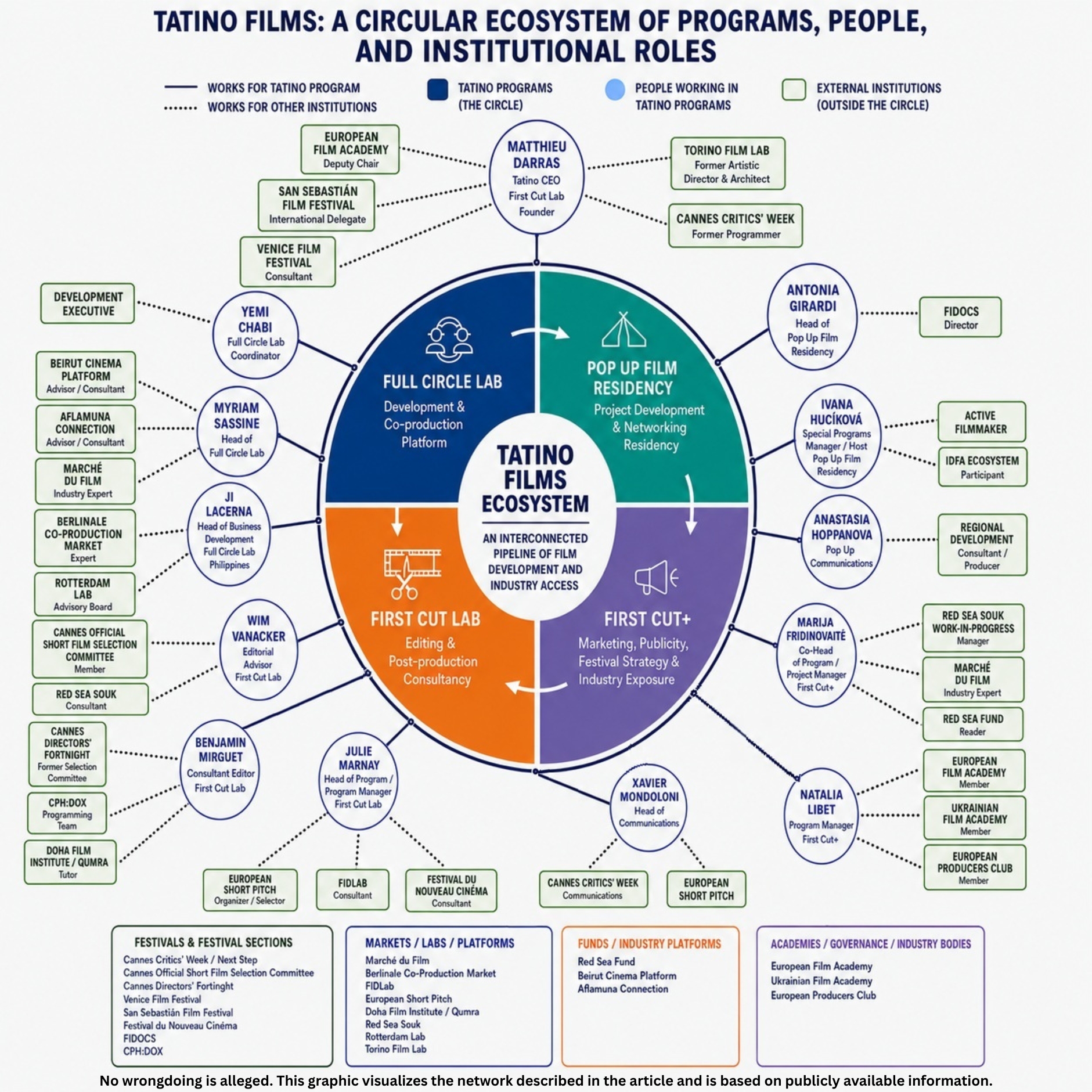
Tatino Films is a Paris-based company that operates several publicly funded film-development initiatives, including First Cut Lab, First Cut+, Full Circle Lab, and Pop Up Film Residency. Collectively, these programmes occupy a strategic position between filmmakers, festivals, film funds, markets, distributors, and other industry decision-makers.
This article argues that these organizations, while publicly presented as mechanisms for supporting filmmakers, mentoring projects, and expanding opportunity, also function as vehicles through which influence, access, and institutional legitimacy become concentrated within a relatively small professional ecosystem. The issue is not whether these programmes provide value to participating filmmakers. The issue is that they place the same networks, individuals, and institutions at multiple stages of the cultural pipeline, allowing influence to accumulate in ways that benefit insiders while leaving independent filmmakers to compete from outside the system.
Tatino is therefore examined here not as an isolated organization, but as a case study in how contemporary film-development infrastructures can evolve into mechanisms for concentrating cultural power.
The Problem Is Cumulative
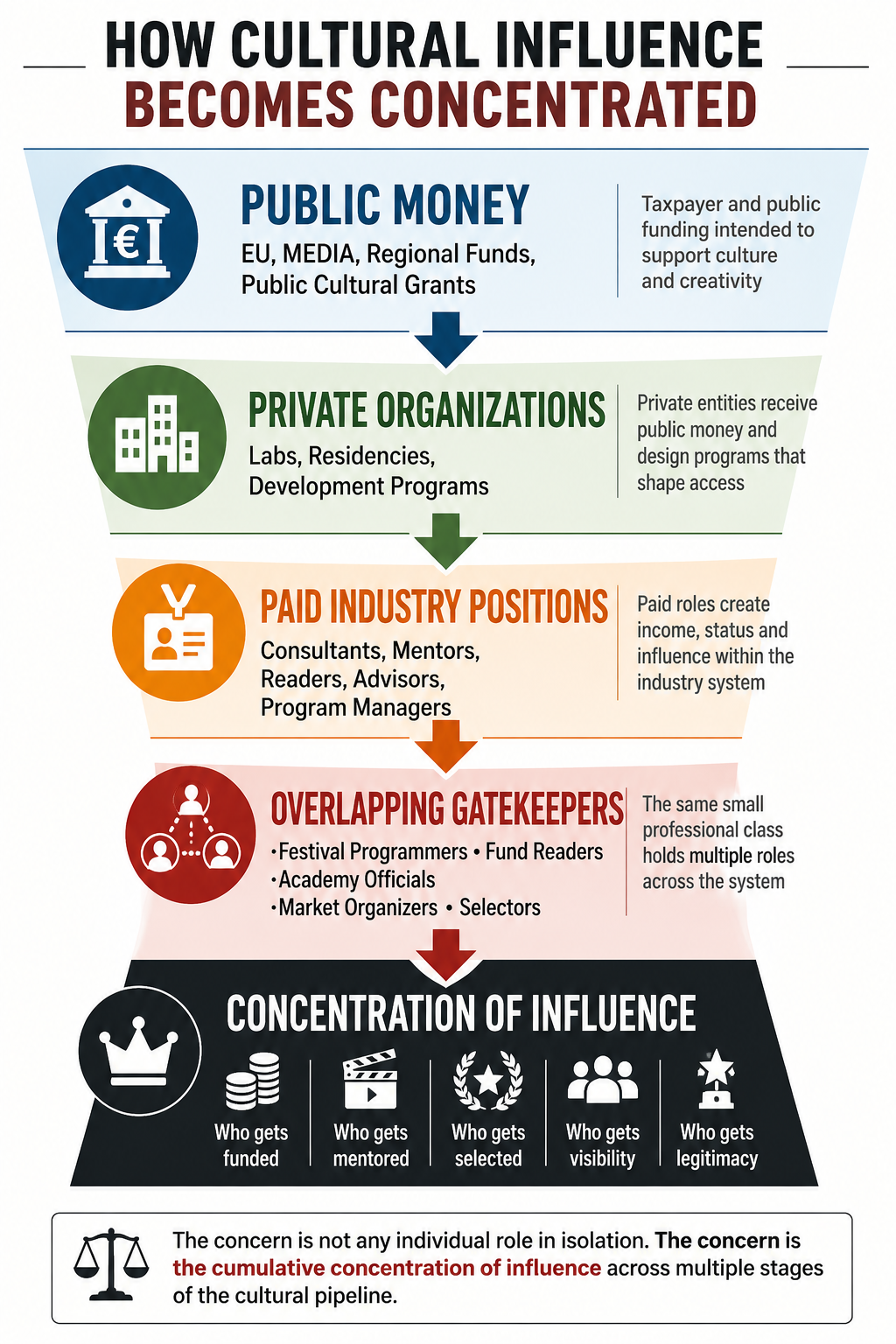
Any individual role of a single person described in this article is not inherently problematic in isolation. The concern emerges cumulatively. A mentor, programmer, consultant, fund reader, market organizer, and academy governor each exercise influence over different stages of a filmmaker’s career. When the same people, inside a single ecosystem, repeatedly occupies all of those positions simultaneously, influence accumulates into a system in ways that are only beneficial to those who hold these powers.
How Does The System Works?
Across First Cut Lab, First Cut+, Full Circle Lab, and related programmes, many of the individuals responsible for mentoring, advising, selecting, evaluating, and guiding projects simultaneously occupy influential positions elsewhere in the international film ecosystem. Festival programmers, market organizers, academy governors, fund readers, consultants, producers, and development executives appear throughout the network. They are the same people, on both sides.
This distinction is critical. The programmes do not exist in isolation from the institutions that allocate cultural legitimacy. Rather, they are operated by individuals who often participate directly in the wider systems of festival selection, market access, project evaluation, public funding, industry recognition, and academy governance.
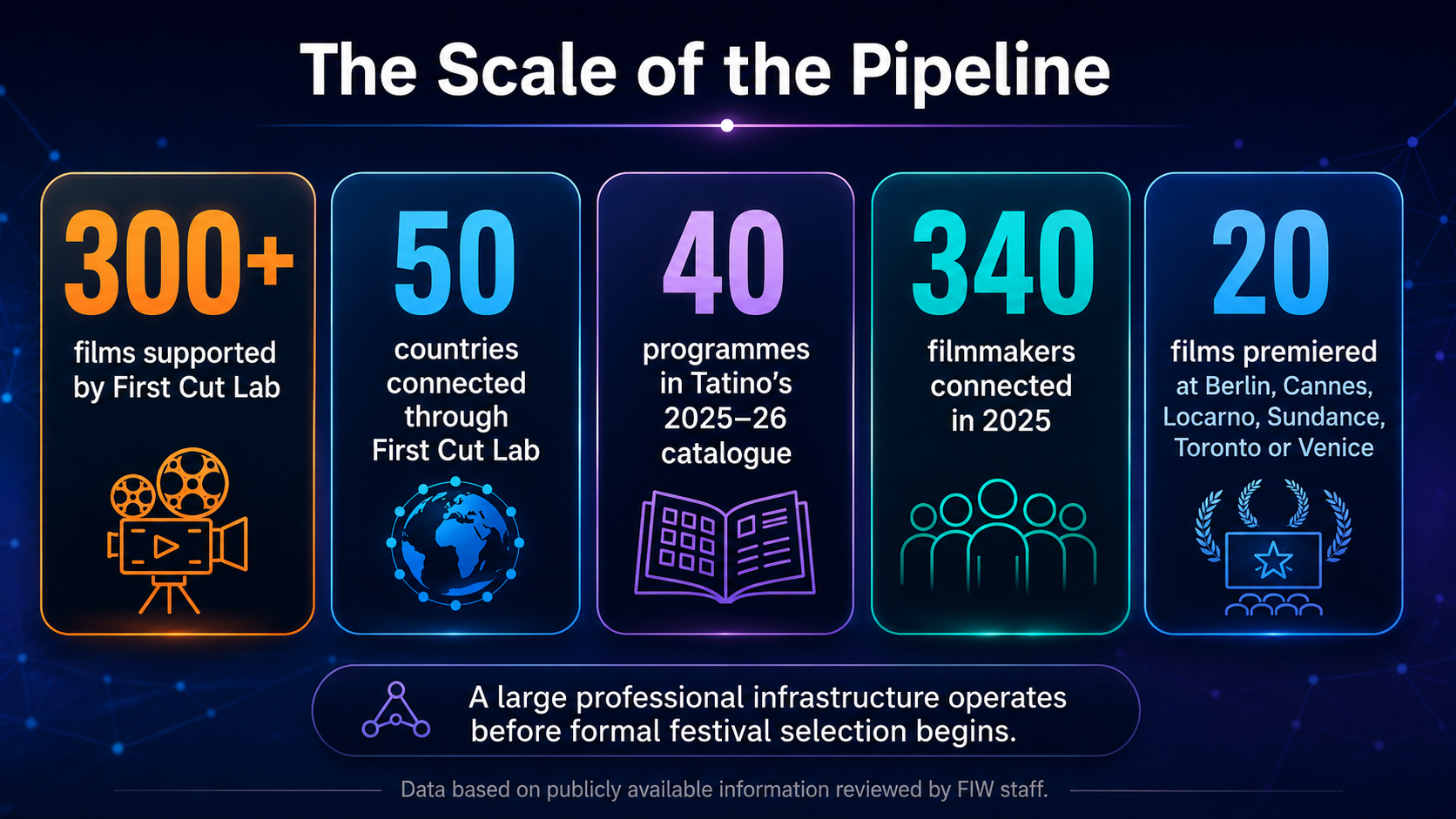
The Scale of the Pipeline
Before examining the individuals operating this ecosystem, it is important to understand the programmes themselves.
Tatino does not operate a single workshop, consultancy, or residency. It operates a network of interconnected initiatives that accompany selected filmmakers through multiple stages of development, from start to finish – script editing, market preparation, industry exposure, editing, and professional advancement.
Its principal programmes include:
First Cut Lab – an editing and consultancy initiative supporting feature films during post-production.
First Cut+ – a Creative Europe MEDIA-supported programme providing mentoring in marketing, publicity, festival strategy, sales positioning, and industry exposure.
Full Circle Lab – a development and co-production platform connecting filmmakers with advisors, producers, financiers, and industry professionals across multiple regions.
Pop Up Film Residency – an international residency programme bringing together filmmakers, mentors, consultants, and industry representatives for project development and networking.
Viewed collectively, these programmes form a continuous pipeline through which selected projects receive editorial guidance, mentoring, strategic positioning, market exposure, industry introductions, and institutional validation. This influence is amplified by the fact that many of the people operating these programmes simultaneously occupy influential positions elsewhere in the international film ecosystem, including festivals, film funds, markets, academies, and public cultural institutions.
The practical effect of these ecosystems is the emergence of two very different classes of filmmakers. Those selected to participate gain access to expertise, visibility, professional networks, strategic guidance, industry introductions, and institutional support across multiple stages of development. Those outside the network must compete for the same funding, festival slots, market attention, and cultural recognition without comparable access to these advantages. Because Tatino’s programmes are operated by a private organization rather than public bodies, they are under no obligation to disclose how participants are identified, recruited, recommended, or selected. The funding is public. The responsibility is not. As a result, outsiders have little ability to determine whether access is being distributed primarily on the basis of merit, professional relationships, institutional proximity, or some combination of all three.
The question is therefore not what any individual programme does in isolation. The question is what forms of influence emerge when the same ecosystem accompanies projects across multiple stages of their journey while simultaneously participating in the institutions that allocate cultural legitimacy.
The Central Node: Matthieu Darras
Before building First Cut Lab, First Cut+, Full Circle Lab, and Pop Up Film Residency, Matthieu Darras helped build the Torino Film Lab into one of Europe’s most influential talent-development infrastructures before later establishing another major ecosystem of his own.
His professional profile spans decades of influential industry positions: former Artistic Director of Torino Film Lab, former programmer for Cannes Critics’ Week, consultant for the Venice Film Festival, delegate for the San Sebastián Film Festival, director of the Bratislava Film Festival, and, by 2026, Deputy Chair of the European Film Academy.
Viewed individually, none of these positions is unusual. Senior film professionals frequently move between institutions throughout their careers. The significance lies in their accumulation.
Taken together, these roles place a single individual at multiple stages of the cultural pipeline. The same professional network that helps shape projects at an early stage also appears throughout the institutions responsible for evaluating, promoting, and legitimizing finished work.
Darras is therefore significant because he illustrates the broader pattern examined throughout this article: the concentration of influence that emerges when the same professional ecosystem repeatedly occupies positions across multiple stages of cultural validation, status and funding.
The Grid of Overlapping Roles
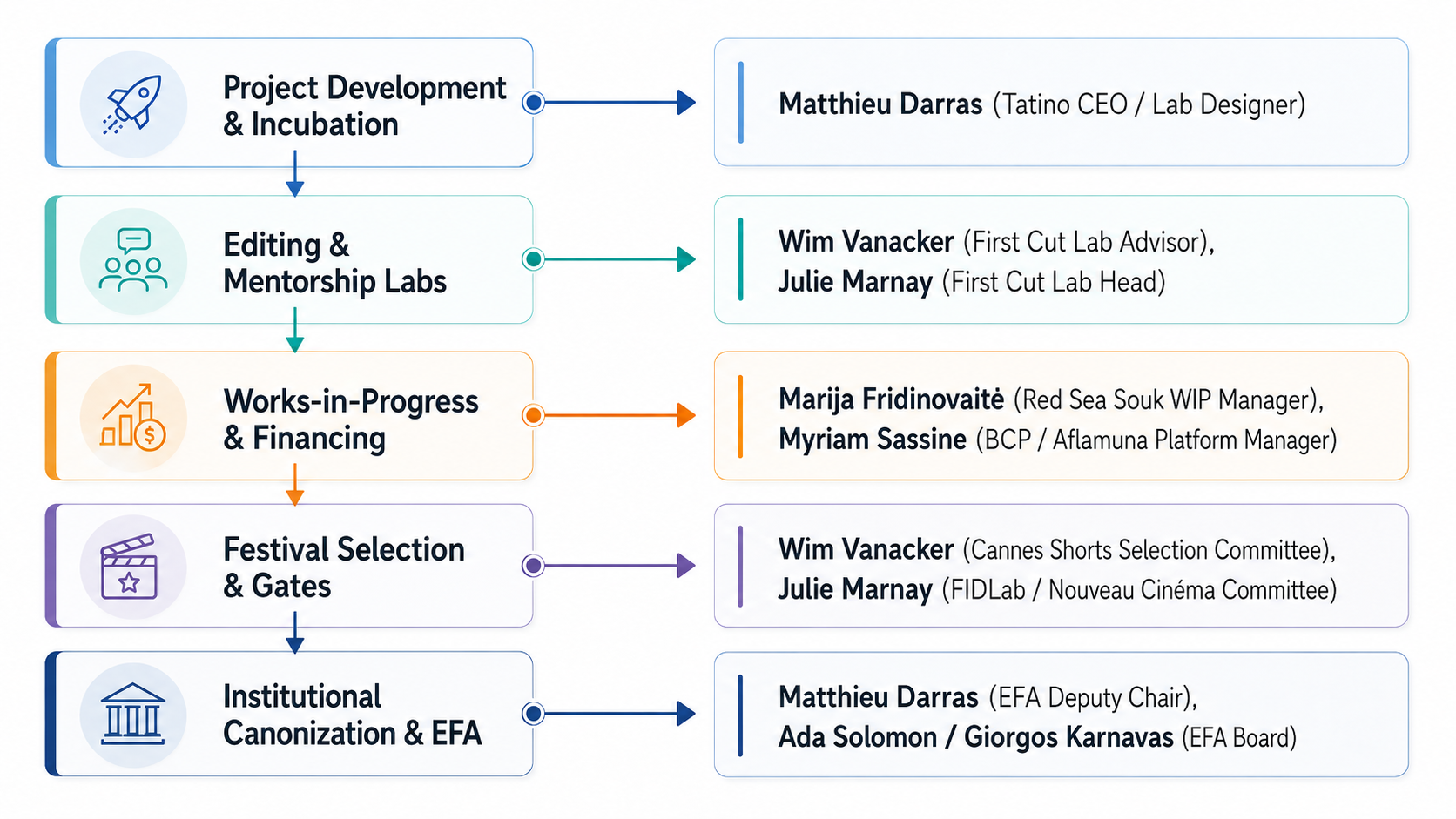
The infrastructure functions through a persistent density of cross-appointments, where the same individuals participate in multiple stages of the cultural pipeline. The people below illustrate how roles that are publicly presented as separate often overlap within the same ecosystem.
Wim Vanacker serves as an Editorial Advisor and Consultant for First Cut Lab while simultaneously sitting on the Selection Committee for the Official Short Film Competition at Cannes. He also served as Editorial Consultant on Renoir, a film that participated in First Cut Lab Japan before premiering in the Cannes Official Selection.
Julie Marnay, listed across First Cut Lab sources as Head of Program and Program Manager, has spent more than a decade at Cannes Critics’ Week managing short films and coordinating the Next Step initiative. She has also directed European Short Pitch, collaborated with Full Circle Lab Nouvelle-Aquitaine, and served as Industry Coordinator for FIDLab.
Marija Fridinovaitė, listed as Co-Head of Program and Project Manager across Tatino and First Cut Lab materials, simultaneously operates as Work-in-Progress Showcase Manager for the Red Sea Souk, a team member of the Marché du Film at Cannes, and a reader for the Red Sea Fund.
Myriam Sassine serves as Head of Program and Producer Consultant for Full Circle Lab Nouvelle-Aquitaine Hessen while actively producing films and participating in regional co-production and development initiatives, including Aflamuna Connection.
Antonia Girardi, Ji Lacerna, and Ivana Hucíková form part of the core leadership of Pop Up Film Residency while simultaneously maintaining roles across festivals, development labs, production, and industry infrastructure. Girardi serves as Director of FIDOCS. Lacerna previously managed film-lab initiatives in the Philippines before becoming Head of Business Development at Tatino Films. Hucíková combines her residency role with an active career as a writer and director.
The overlap extends beyond development programmes. Alongside Matthieu Darras’s election as Deputy Chair of the European Film Academy, Ada Solomon, Giorgos Karnavas, and Marija Razgutė also occupy governance positions within the Academy, including Chair and Board Member roles.
If there is any error in this section, the individuals mentioned are encouraged to contact us.
The Staff Is the Network
Festival programmers, academy officials, market organizers, fund readers, development consultants, producers, and residency managers appear throughout the network. What are often perceived as separate institutions are, in practice, linked by a recurring professional class that moves between them.
This concentration of relationships has implications that extend beyond formal job titles. When individuals spend years moving between the same festivals, labs, funds, markets, and academies, professional influence does not disappear when a position changes. Former colleagues remain connected, projects continue to circulate through the same networks, and institutional knowledge travels with the individuals involved. In such an environment, influence is often exercised through familiarity, reputation, and longstanding professional relationships rather than through formal authority alone. Friends help friends. People owe each other favors. These relationships matter, and if you and your project lack connection to these networks – you are greatly disadvantaged.
This is precisely why concentration matters. The issue is not that any individual acts improperly, but that informal influence becomes increasingly difficult to distinguish from formal decision-making. As the same networks repeatedly occupy positions throughout the cultural pipeline, opportunities are shaped not only by the merits of a project, but also by proximity to the ecosystem through which projects, information, and professional relationships circulate.
| Name | Tatino Role | Parallel Industry Roles |
|---|---|---|
| Matthieu Darras | • Tatino CEO • First Cut Lab founder • Full Circle Lab • Pop Up Film Residency |
• Former TorinoFilmLab architect and Artistic Director • Former Cannes Critics’ Week programmer • Venice consultant • San Sebastián delegate • European Film Academy Deputy Chair |
| Julie Marnay | • Listed by Tatino / First Cut Lab as Head of Program / Program Manager for First Cut Lab | • Cannes Critics’ Week / Next Step • European Short Pitch • FIDLab • Festival du Nouveau Cinéma |
| Marija Fridinovaitė | • Listed across Tatino / First Cut Lab pages as Co-Head of Program and Project Manager | • Red Sea Souk Work-in-Progress Manager • Marché du Film • Red Sea Fund Reader |
| Wim Vanacker | • Editorial Advisor | • Cannes Official Short Film Selection Committee • Red Sea Souk consultant |
| Benjamin Mirguet | • Consultant Editor | • Former Cannes Directors’ Fortnight Selection Committee • CPH:DOX programming team • Doha Film Institute Qumra tutor |
| Natalia Libet | • First Cut+ Program Manager | • European Film Academy member • Ukrainian Film Academy member • European Producers Club |
| Myriam Sassine | • Head of Full Circle Lab | • Producer • Beirut Cinema Platform • Aflamuna Connection • Regional co-production infrastructure |
| Antonia Girardi | • Head of Pop Up Film Residency | • Director of FIDOCS |
| Ji Lacerna | • Head of Business Development • Full Circle Lab Philippines |
• Marché du Film • Berlinale Co-Production Market • Rotterdam Lab • Former national film-agency functions |
| Xavier Mondoloni | • Head of Communications | • Cannes Critics’ Week communications • European Short Pitch |
| Ivana Hucíková | • Special Programs Manager, Pop Up Film Residency / Host (Bratislava) | • Active filmmaker • IDFA ecosystem participant |
| Anastasia Hoppanova | • Pop Up communications | • Regional development consultant and producer |
| Yemi Chabi | • Full Circle Lab coordinator | • Development executive |
Note: The roles listed are based on publicly available biographies and organizational profiles at the time of writing.
Public Money, Private Networks
More Questions Raised by the Mapping
The purpose of this investigation is not to criticize any individual professional, nor to suggest that the people identified throughout this article are unqualified for the positions they hold, or that they are involved in wrongdoing. The mapping does, however, raise a number of questions that deserve further examination.
Why are open calls considered essential for filmmakers, but not for gatekeepers?
Filmmakers are expected to compete openly for funding, residencies, labs, festival selections, and industry opportunities. Yet many of the influential positions that shape those outcomes – advisors, consultants, readers, programme managers, festival programmers, and governance roles – are often filled through appointments, invitations, recommendations, and existing professional networks. How are these positions filled, and who gets considered?
Why is the industry obsessed with discovering new filmmakers, but not new decision-makers?
The contemporary film industry constantly speaks about emerging voices, new talent, and discovering the next generation of filmmakers. Yet a review of the institutional landscape often reveals the same names recurring across festivals, film funds, development programmes, academies, markets, and cultural organizations. If renewal is considered essential for artists, should it not also be considered essential for the people responsible for evaluating, mentoring, selecting, and legitimizing them?
Why are there no meaningful term limits for many cultural gatekeeping positions?
In many sectors, societies impose limits on the concentration of authority through elections, retirement ages, board rotation requirements, or term limits. Within much of the film industry, however, influential positions can be occupied for decades, allowing networks, relationships, and institutional influence to accumulate over time. Should cultural gatekeeping roles be subject to similar principles of rotation and renewal?
These questions are not unique to Tatino. They extend far beyond any single organization. The significance of Tatino as a case study is that it makes these wider structural dynamics visible.
Recurring Gatekeepers Across Multiple FIW articles
It is interesting to note that both Matthieu Darras and Wim Vanacker have appeared in previous FIW investigations involving different festival, market, and development structures.
Vanacker’s presence is particularly notable because he has appeared repeatedly across several previous FIW investigations involving European film institutions. One investigation examined the relationship between Vanacker and Cannes Short Film Palme d’Or winner Vasilis Kekatos. In 2018, Kekatos invited Vanacker to serve on the jury of his SeaNema Open Air Film Festival in Greece. During the same period, Kekatos participated in NISI MASA, where Vanacker served as Artistic Director. A year later, Kekatos’s film The Distance Between Us and the Sky was selected for Cannes and won the Short Film Palme d’Or, while Vanacker served on the Cannes Short Film Selection Committee. The case attracted additional scrutiny because one of the members of the Short Film Jury, filmmaker Panos H. Koutras, had a longstanding professional relationship with the film’s producer, Eleni Kossyfidou, who had produced several of his feature films. FIW previously reported allegations from members of the Greek film community that Koutras had openly discussed influencing the jury process with respect to other competing films, while his professional relationship with Kossyfidou was not publicly disclosed during the festival. The controversy became a recurring example in discussions about transparency, disclosure, and conflict-of-interest standards within festival governance.
Another FIW investigation examined recurring overlaps within NISI MASA (later European Short Pitch), where Vanacker held senior positions. That investigation identified multiple instances in which consultants, jury members, producers, distributors, award sponsors, and selected projects appeared within the same professional network, often occupying multiple roles simultaneously.
Darras’s presence is similarly notable because he has appeared in previous FIW investigations involving European film-development structures. One such investigation examined his tenure as Artistic Director of the Torino Film Lab, where his sister, Isabelle Collombat, participated in the Torino Film Lab programmes, not once, but twice. The same investigation also reported allegations from industry sources that established producers were sometimes personally encouraged to apply to the lab and, in certain cases, received accommodations such as extended application deadlines.
Whether viewed through Torino Film Lab or Tatino, the recurring theme is not any individual appointment or relationship considered in isolation. Rather, it is the tendency of the same professional networks to reappear across institutions that are publicly presented as mechanisms for discovering and supporting new talent.
Downstream Recognition: Tracing the Flow of Cultural Legitimacy
The following table illustrates a clear concentration of legitimacy and status, mapping how a closed ecosystem continuously feeds projects directly into the highest tiers of international prestige.
The Concentration of Visibility
10 documented film trajectories linked to a single network
4 Venice selections/winners
3 Berlinale selections/winners
1 Cannes Competition title
1 Toronto Platform title
1 Torino Best Film winner
| Film | Director | Documented Tatino Pathway | Festival Outcome |
|---|---|---|---|
| Listen | Ana Rocha de Sousa | First Cut Lab On Demand → First Cut+ Trieste | Venice 2020 – Lion of the Future |
| Immaculate | Monica Stan & George Chiper-Lillemark | First Cut Lab Trieste → First Cut+ Karlovy Vary | Venice 2021 – Lion of the Future |
| 107 Mothers | Peter Kerekes | First Cut Lab On Demand → First Cut+ Trieste | Venice Orizzonti Best Screenplay 2021 |
| A Piece of Sky | Michael Koch | First Cut Lab Switzerland → First Cut+ Karlovy Vary | Berlinale 2022 – Silver Bear Special Mention |
| Charcoal | Carolina Markowicz | First Cut Lab Brazil → First Cut+ | Toronto Platform Competition 2022 |
| Sea Sparkle | Domien Huyghe | First Cut Lab Belgium → First Cut+ | Berlinale Generation Kplus – Crystal Bear Special Mention |
| Explanation for Everything | Gábor Reisz | First Cut Lab Hungary → First Cut+ | Venice Orizzonti Best Film 2023 |
| Renoir | Chie Hayakawa | First Cut Lab Japan | Selected for Cannes Competition / Competed for Palme d’Or |
| The Garden of Earthly Delights | Morgan Knibbe | First Cut Lab Netherlands → First Cut+ | Torino Film Festival Best Film |
| Our Secret | Grace Passô | First Cut Lab Brazil → First Cut+ | Berlinale |
No claim is made that these outcomes were caused by participation in Tatino programmes. However, when a relatively small development infrastructure appears repeatedly upstream of some of the most prestigious forms of international cultural recognition, in the context of overlapping roles in the ecosystem, this raises questions.
The recurring factor across these trajectories is not geography, language, or local funding structures; it is participation in a shared development infrastructure. This concentration demonstrates an ecosystem pathway rather than single programme participation, showing that the relevant unit of analysis might be a transnational, closed-circuit ecosystem of talent processing.
Renoir: A Substantive Stage in the Production Process
The trajectory of Renoir provides a direct example of how these labs operate as active interventions rather than passive accelerators. The director herself noted:
“When we thought Renoir was nearly finished, I showed it at First Cut Lab Japan and realized it needed much more work. I expected small tweaks, but the feedback called for major changes.”
The relevance of this example is not that editorial feedback occurred. Development labs exist to provide editorial feedback. The relevance is that the film’s development passed through a stage operated by individuals who simultaneously occupy positions elsewhere in the ecosystem of festival selection, market access, project evaluation, and institutional governance. The same people who control the gates, or who are very close to these gates, are the people work on the film in an active way. If you are an independent filmmaker who is not part of this network, which is funded largely with public money, is private, not transparent, and which you have no access to – how does this make you feel? And if the people who make this network decide for whatever reason to block your progress within the ecosystem, what chances do you have?
Artistic Diversity at the Center: The Closed Circuit of Taste
The deepest risk posed by institutional concentration is not corruption, but conformity. When the same ecosystem repeatedly defines, evaluates, and rewards artistic quality, it inevitably gains influence over which stories are developed, financed, promoted, and legitimized.
Over time, this can narrow the range of voices, aesthetics, and perspectives that reach audiences—not through censorship, but through the cumulative effect of thousands of decisions made by the same interconnected professional network.
This dynamic raises a number of important structural questions:
-
- Which voices are systematically absent? Filmmakers who lack the relational capital to enter these pipelines face significant structural disadvantages long before their films are even made.
-
- Which aesthetics become dominant? A landscape is created where artistic paths are cleared primarily for those whose narratives and formal styles align with the institutional expectations of the circuit, while non-aligned creators may struggle to access the same pathways to visibility and institutional recognition.
-
- How does a closed circuit shape taste? It creates an insular loop where today’s curated selections directly determine tomorrow’s selectors. Future festival programmers and fund jurors are recruited from the very same pool of talent validated by the network, permanently reproducing its own parameters and pushing experimental, genre, or politically heterodox voices to the margins.
The EU Regulatory Void: Why Cultural Gatekeeping Escapes the Safeguards Applied Elsewhere
The film industry operates on massive allocations of public money, yet its gatekeeping mechanisms exist in a profound regulatory void.
Across public procurement, financial services, competition regulation, public research, state-aid administration, and numerous other publicly funded activities, the European Union has adopted extensive legal frameworks requiring disclosure, recusal, separation of functions, cooling-off periods, transparency obligations, and active conflict management.
The underlying principle is simple: whenever the same individuals acquire influence over the allocation of public resources, public opportunities, or public trust, safeguards become necessary.
The cultural sector is a striking exception. While hundreds of millions of euros in public money flow annually through film funds, festivals, training schemes, development programmes, and market-access initiatives, no comparable sector-wide framework exists to address concentrations of gatekeeping power across the cultural pipeline. The issue is therefore not a lack of legal precedent. The precedent already exists throughout European governance. The issue is that these principles have largely never been applied to the institutions responsible for allocating cultural legitimacy. Why is cinema exempt from governance principles Europe already applies elsewhere?
The stark contrast with other fields highlights how Europe has already concluded that concentrated evaluative power creates risks, making the cultural pipeline a glaring anomaly:
-
- Public Procurement: Article 24 of Directive 2014/24/EU strictly requires Member States to ensure measures are taken to prevent, identify, and remedy conflicts of interest to ensure equal treatment and prevent the distortion of competition. This safeguard offers a useful governance analogy: when the same individuals influence access to publicly supported opportunities, transparency, disclosure, and recusal mechanisms may be necessary to protect institutional trust. The question is whether similar transparency principles should be applied more consistently within publicly supported film institutions.
-
- Financial Services: Article 23 of MiFID II mandates that firms actively maintain conflict-of-interest, disclosure, recusal, transparency and governance frameworks to protect market integrity before conducting business with clients.
-
- Public Health: NIH-funded research requires rigorous, transparent reporting, multi-tier reviews, and the formal management of any overlapping interest that could potentially bias the design, conduct, or reporting of a project.
Other sectors developed these safeguards because history proves that concentrated power creates predictable, systemic risks. The cultural arts sector, however, remains insulated from these standard administrative checks. It is not an issue of illegality; it is that cinema has normalized an extreme concentration of influence that would be flagged as an immediate structural risk anywhere else in public life.
Actionable Structural Remedies
To dismantle these bottlenecks and protect the integrity of public cultural funding, the international film community must implement enforceable conflict-of-interest, disclosure, recusal, transparency and governance frameworks:
-
- Public Annual Conflict Registers: Every festival, public fund, and publicly supported lab must maintain an open online registry. All selectors, readers, and consultants must declare any prior professional, financial, or consultative relationship with an applying project.
- Mandatory Disclosures on Selection: Whenever a film is selected for a festival or awarded public funding, the institution must explicitly disclose if the project participated in an affiliated development lab, residency, or rough-cut workshop.
- Strict Cooling-Off Periods: A mandatory 24-month cooling-off period must prohibit any individual from serving on a festival selection committee or public fund panel if they have worked as a paid consultant, editor, or mentor for an active pipeline lab.
- Selection Committee Term Limits: Individuals must be limited to a maximum of three consecutive years on any festival selection committee, public fund panel, or academy board to break up permanent inner circles.
- Anonymized Reader Audits: Public funds (such as Creative Europe MEDIA and Eurimages) must mandate that initial project reading rounds are fully anonymized and evaluated by independent panels whose identities are published at the end of each funding cycle.
- Public Annual Conflict Registers: Every festival, public fund, and publicly supported lab must maintain an open online registry. All selectors, readers, and consultants must declare any prior professional, financial, or consultative relationship with an applying project.
The Reality of the Film Industry
The concern is not that people work across multiple institutions. Expertise is valuable, and cultural sectors inevitably rely on experienced professionals.
The concern is what happens when the same professional ecosystem repeatedly occupies positions responsible for identifying talent, developing projects, allocating funding, providing mentorship, organizing markets, selecting festivals, granting awards, and conferring institutional legitimacy.
In virtually every other publicly funded sector, such concentrations of evaluative power would trigger questions about transparency, governance, conflicts of interest, term limits, and the distribution of opportunity. The cultural sector remains a remarkable exception.
Tatino is not important because it is unique. It is important because it makes visible a broader structural reality that usually remains hidden behind the language of mentorship, development, support, and cultural exchange.
The central question raised by this investigation is therefore not whether any individual acted improperly. It is whether a democratic society should allow the institutions responsible for allocating cultural legitimacy to operate under standards of transparency and governance that would be considered inadequate almost anywhere else in public life.
Inside Kosovo’s Film Funding Loop
For readers looking to see how these dynamics manifest within smaller, hyper-localized ecosystems, Film Industry Watch’s investigation, “Inside Kosovo’s Film Funding Loop: The Same People Train, Curate, Judge – and Win,” serves as an essential companion piece. The article maps an insular “festival-training-funding loop” involving the Kosovo Cinematography Center (KCC) and the prominent documentary festival DokuFest (alongside its training arm, DokuLab). Just as Tatino Films illustrates a transnational oligopoly of cultural validation, the Kosovo case study exposes how a compact domestic network can allow the exact same individuals to simultaneously occupy positions as state board members, festival programmers, and lab lecturers. This institutional convergence creates a self-perpetuating pipeline where a concentrated cluster of repeat beneficiaries routinely secures public funding, effectively squeezing out independent voices and narrowing the region’s creative pluralism. It is highly recommended as further reading for anyone analyzing how unchecked structural overlaps erode public trust in cultural governance.
Inside Cannes Critics’ Week’s Next Step Studio Indonesia: Network Concentration and the Closed Loop of Opportunity
For readers interested in how concentrated influence can emerge even without formal institutional overlap, Film Industry Watch’s investigation, “I Am Scared for My Life and My Career”: Cannes Critics’ Week’s Next Step Studio Indonesia and the Same Closed Loop FIW Has Been Talking About, offers a revealing companion case study. Whereas the Tatino ecosystem demonstrates how influence can accumulate through overlapping positions across film labs, festivals, markets, academies, and funding bodies, the Indonesia case illustrates a different mechanism: the repeated circulation of opportunities within an already interconnected professional network. The investigation documents multiple publicly verifiable professional ties between selected participants and one of the programme’s co-producers, raising questions about transparency, selection procedures, disclosure practices, and safeguards in a publicly supported Cannes-linked talent initiative. The significance of the case lies not in any proven misconduct, but in how it demonstrates the broader phenomenon of network concentration: the conversion of institutional legitimacy, public funding, festival prestige, and career-development infrastructure into recurring opportunities for the same interconnected circles. It is recommended reading for anyone seeking to understand how influence can become concentrated not only through overlapping institutional roles, but also through the repeated selection and promotion of existing professional networks.
Right of Reply
Film Industry Watch welcomes responses from Tatino Films, First Cut Lab, First Cut+, Full Circle Lab, Pop Up Film Residency, the individuals named in this article, and any other organizations or persons referenced herein.
This investigation is based exclusively on publicly available information, organizational biographies, programme materials, institutional records, and other publicly accessible sources. No allegation of unlawful conduct is made.
If any factual inaccuracies are identified, if additional context is available, or if any individual or organization wishes to respond to the issues raised, Film Industry Watch will review all submissions in good faith and publish substantive corrections, clarifications, or responses where appropriate.
The purpose of this article is not to attack individuals, but to examine broader questions of governance, transparency, institutional concentration, and cultural gatekeeping within publicly supported film ecosystems. Constructive engagement, additional information, and alternative perspectives are therefore welcomed.
Responses may be submitted through the Film Industry Watch contact page or by email.
Sources
1.Tatino Films. “Tatino Encounters: Chie Hayakawa.”
https://www.tatinofilms.com/post/tatino-encounters-chie-hayakawa
2. Pop Up Film Residency – Office/Staff page (confirms both titles and bios): https://popupfilmresidency.org/people/office/
3. First Cut Lab – First Cut+ official page: https://firstcutlab.eu/first-cut-plus/
4. FilmNewEurope – “First Cut Lab program to be enriched with MEDIA supported First Cut+”: https://www.filmneweurope.com/press-releases/item/119286-first-cut-lab-program-to-be-enriched-with-media-supported-first-cut
5. European Commission – Creative Europe 2021–2027 (€2.44 billion total; ≥58% to the MEDIA strand): https://culture.ec.europa.eu/news/creative-europe-2021-2027-programme-launch
6. Council of Europe – Eurimages, What We Do (annual co-production budget ~€27.5M): https://www.coe.int/en/web/eurimages/what-we-do-
7. Tatino Films — First Cut Lab
https://www.tatinofilms.com/firstcutlab
8. Tatino Films — The TATINO Catalogue 2025–26 is out
https://www.tatinofilms.com/post/tatino-catalogue2025-26-is-out
9. First Cut Lab — First Cut Lab launches a record number of 6 new labs
https://firstcutlab.eu/2022/11/02/first-cut-lab-launches-a-record-number-of-6-new-labs/
Each film links to (a) proof it took part in First Cut Lab / First Cut+, and (b) the festival result.
10. Listen — Ana Rocha de Sousa
Lab participation: https://firstcutlab.eu/project/listen/
Lab participation (First Cut+ Trieste): https://cineuropa.org/en/newsdetail/436065/
Festival result (Venice 2020 – Lion of the Future): https://www.ewawomen.com/film-industry-articles/listen-by-ana-rocha-de-sousa-lion-of-the-future-award-and-special-orizzonti-jury-prize-at-la-biennale/
11. Immaculate — Monica Stan & George Chiper-Lillemark
Lab participation (First Cut+ Works in Progress, Karlovy Vary): https://www.filmneweurope.com/news/romania-news/item/120238-production-immaculate-at-first-cut-works-in-progress
Festival result (Venice 2021 – Lion of the Future): https://en.wikipedia.org/wiki/Immaculate_(2021_film)
Festival result (Giornate degli Autori selection): https://cineuropa.org/en/newsdetail/408894
12. 107 Mothers — Peter Kerekes
Lab participation (First Cut Lab + First Cut+): https://firstcutlab.eu/project/peter-kerekes-director-producer-2/
Festival result (Venice Orizzonti Best Screenplay 2021): https://en.wikipedia.org/wiki/107_Mothers
13. A Piece of Sky — Michael Koch
Lab participation (First Cut+ Summer 2021 award): https://firstcutlab.eu/2021/08/18/first-cut-the-hatcher-a-piece-of-sky-win-summer-2021-first-cut/
Festival result (Berlinale 2022 – Silver Bear Special Mention): https://en.wikipedia.org/wiki/A_Piece_of_Sky_(2022_film)
Festival result (Berlinale programme page): https://www.berlinale.de/en/archive-selection/archive-2022/programme/detail/202206230.html
14. Charcoal — Carolina Markowicz
Lab participation (First Cut Lab project page): https://firstcutlab.eu/project/charcoal/
Lab participation (First Cut+ Karlovy Vary 2022): http://firstcutlab.eu/project/first-cut-karlovy-vary-2022/
Festival result (Toronto Platform Competition 2022): https://variety.com/2022/film/global/carolina-markowicz-charcoal-toronto-san-sebastian-1235393090/
15. Sea Sparkle — Domien Huyghe
Lab participation (First Cut Lab project page): https://firstcutlab.eu/project/sea-sparkle/
Festival result (Berlinale Generation Kplus – Crystal Bear Special Mention): https://cineuropa.org/en/newsdetail/439246/
Festival result (Berlinale programme page): https://www.berlinale.de/en/2023/programme/202306940.html
16. Explanation for Everything — Gábor Reisz
Lab participation (First Cut Lab / First Cut+ producer page): http://firstcutlab.eu/project/julia-berkes-producer/
Lab participation (First Cut+ Trieste selection): https://cineuropa.org/en/newsdetail/436065/
Festival result (Venice Orizzonti Best Film 2023): https://en.wikipedia.org/wiki/Explanation_for_Everything
17. Renoir — Chie Hayakawa
Lab participation (First Cut Lab Japan project page): https://firstcutlab.eu/project/renoir/
Festival result (Cannes 2025 Competition / Palme d’Or): https://www.festival-cannes.com/en/f/renoir-2/
Festival result (film overview): https://en.wikipedia.org/wiki/Renoir_(2025_film)
18. The Garden of Earthly Delights — Morgan Knibbe
Lab participation (First Cut+ Karlovy Vary 2023): http://firstcutlab.eu/project/first-cut-karlovy-vary-2023/
Festival result (Torino Film Festival Best Film): https://variety.com/2025/film/global/the-garden-of-earthly-delights-torino-film-festival-1236595345/
Festival result (Torino official film page): https://www.torinofilmfest.org/en/43-torino-film-festival/film/the-garden-of-earthly-delights/57262/
19. Our Secret — Grace Passô
Lab participation (First Cut Lab Paradiso Brazil program): https://www.projetoparadiso.org.br/cursos-e-seminarios/first-cut-lab-paradiso-brazil-2023/
Lab participation (development credited to the program): https://variety.com/2026/film/global/our-secret-trailer-grace-passo-berlin-festival-1236658281/
Festival result (Berlinale Perspectives premiere): https://www.screendaily.com/news/open-reel-takes-on-sales-for-grace-passos-berlinale-perspectives-premiere-our-secret/5212816.article