

A Documented Network of Overlapping Roles Between KCC, DokuFest and a Cluster of Repeat Beneficiaries (2024–2025)
By Film Industry Watch and Kosovar Film Industry Insiders
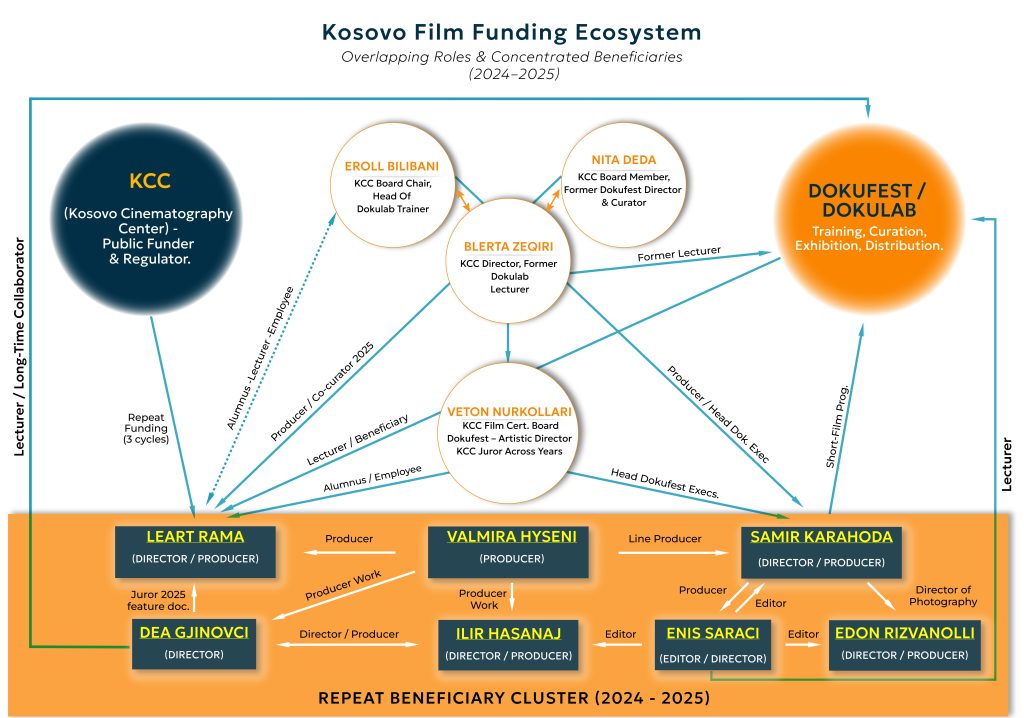
For years, Kosovo’s film sector has celebrated rapid international success. That rise is funded in large part by public money administered by the Kosovo Cinematography Center (KCC). At the same time, DokuFest, the country’s most prominent festival, has evolved beyond curation into training and production through DokuLab.
Taken together, public records show a tight professional network in which festival leaders also appear in KCC decision-making roles while DokuFest-linked filmmakers receive KCC support. None of this is unusual in small markets. The question is transparency: when roles converge inside a publicly funded ecosystem, how are conflicts identified, managed and disclosed?
Since 2023, Kosovo’s publicly funded film sector has experienced substantial shifts. Under new leadership at the Kosovo Cinematography Center (KCC), the country has issued three major funding cycles: Spring 2024, an unprecedented Feature-Only call in December 2024, and a full Spring 2025 call.
All three took place within a compressed regulatory period and under the same leadership.
Across these cycles, public records show a constellation of relationships between KCC decision-makers, DokuFest/DokuLab leadership, and a group of repeat beneficiaries whose collaborations, training roles, and festival ties significantly overlap.
None of these connections imply wrongdoing. But the patterns raise structural governance questions familiar to FIW readers: issues of transparency, recusal, and the management of alleged or perceived conflicts of interest in public funding. Similar dynamics have surfaced in FIW’s reporting on Greece’s Film Center, the Cannes Factory model, and governance disputes tied to London and Sundance, where reputational damage and creative stagnation often follow opaque decision-making.
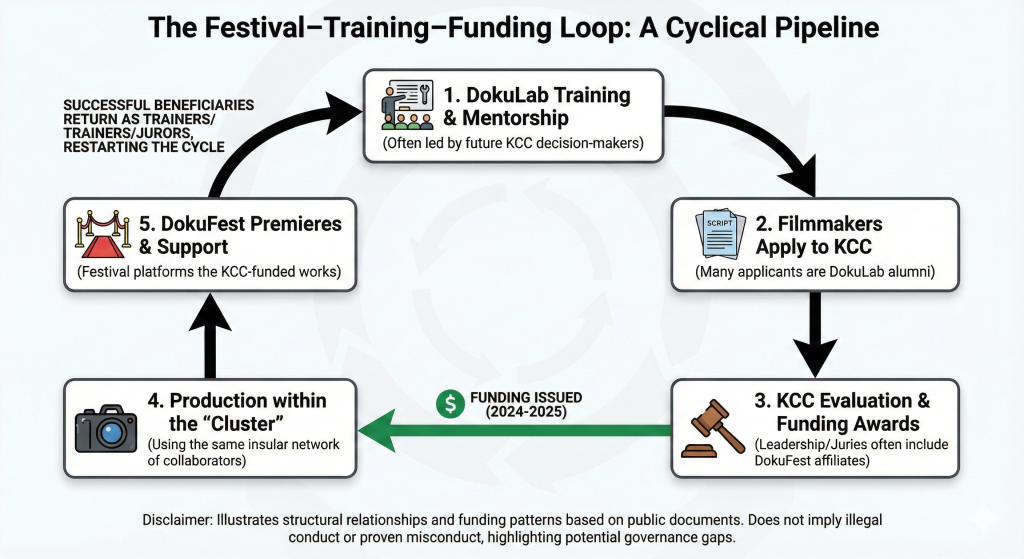
1. KCC leadership and DokuFest/DokuLab: overlapping institutional roles:
Based on official KCC publications, DokuFest/DokuLab materials, and training program listings, the following overlaps are publicly documented:
Eroll Bilibani
- Chair of the KCC Board (appointed 2025)
- Long-time DokuFest executive
- Head of DokuLab
- Trainer in multiple DokuLab programs
- Several filmmakers he trained or collaborated with are beneficiaries in the 2024–2025 cycles
Nita Deda
- Member of the KCC Board (appointed 2025)
- Director of DokuFest (2016–2020)
- Co-curator of DokuNights 2025 with filmmaker Leart Rama, a four-time beneficiary
- Former producer of a short film by Rama
Blerta Zeqiri
- Director of KCC (appointed 2023)
- Former DokuLab lecturer whose training cohorts include multiple later KCC-funded filmmakers
- Entered office before the regulatory changes governing the 2024–2025 calls
Veton NurkollarI
- Artistic Director of DokuFest
- Member, KCC Film Certification Board
- Past juror on KCC feature-film panels
- Professionally overlaps with several funded filmmakers
These overlaps do not imply misconduct. However, as FIW has noted in similar cases involving public film bodies problems arise when roles converge without published recusal procedures.
2. Repeat beneficiaries across 2024–2025: a concentrated cluster
Across Spring 2024, the Dec 2024 Feature-Only call, and Spring 2025, KCC’s own lists show that a small, interconnected group of filmmakers appear repeatedly as winners-often in collaboration with each other, often tied to DokuFest/DokuLab, and often working with the same producers, editors, or crew.
Below is a non-exhaustive summary based on public documents.
A. Leart Rama – director/producer
- Spring 2024: Short Film + Post-production
- Dec 2024: Feature Film
- Spring 2025: Feature Documentary
Documented ties: - DokuLab alumnus → later lecturer
- Seasonal collaborator with DokuFest
- Earlier short produced by Nita Deda (now KCC board member)
- Co-curator of DokuNights 2025 with Deda
B. Samir Karahoda – director/producer
- Spring 2024: Project Development
- Spring 2025: Feature Film
- Spring 2025: Short Film (producer)
Ties: - Short Film Programmer at DokuFest
- Collaborates repeatedly with beneficiaries in cinematography, editing, and production
- DP or collaborator on multiple cluster films
C. Valmira Hyseni – producer
- Spring 2024: Post-production
- Dec 2024: Feature Film
- Spring 2025: Script Development
Ties: - Line producer for Karahoda
- Producer for Rama’s Dec 2024 feature
- Production involvement with Gjinovci, Hasanaj and others
D. Ilir Hasanaj – producer/director
- Spring 2024: Feature Documentary
- Spring 2025: Avant-garde Feature Film
Ties: - Collaboration with Dea Gjinovci
- Member of the same production cluster
E. Dea Gjinovci – director / KCC jury member
- Spring 2024: Feature Documentary
Ties: - Lecturer at DokuLab
- Juror in 2025 for Short Film & Feature Documentary
- Worked with Karahoda, Hasanaj, and others
F. Edon Rizvanolli – Director/producer
- Spring 2024: Short Documentary
- Spring 2025: Feature Film
Ties: - DP work by Karahoda
- Film edited by Enis Saraci
G. Enis Saraci – Editor / Director
- Spring 2025: Short Film (director)
Ties: - Editor for all Karahoda films
- Editor for Rizvanolli
- Lecturer at DokuLab
Such concentrated clusters resemble patterns FIW has documented in other countries where mentorship pipelines, festival platforms and public funding bodies merge into a single influence sphere, often reducing diversity of artistic voices.
3. The institutional → beneficiary → collaborator pipeline
Public documents and the Interconnection Matrix provided by sources illustrate a repeating cycle:
- DokuLab trains filmmakers (often taught by individuals later involved in KCC governance or juries)
- Filmmakers apply to KCC
- KCC leadership includes DokuFest/DokuLab executives
- Filmmakers with prior ties to the festival/lab become repeat beneficiaries
- Their collaborators (producers, editors, DPs) also become beneficiaries
- Films are supported or platformed by DokuFest
FIW has reported similar dynamics in other European markets where a “festival–training–funding loop” results in structural barriers for outsiders and lowers creative pluralism-a concern echoed in FIW’s analyses of Cannes Factory, Cannes Critics’ Week pipelines, and several CI-cluster cases in Central Europe.
4. Public posts reinforce the perception of a close ecosystem
Public posts show:
- Nita Deda (KCC board) co-curating DokuNights 2025 with Leart Rama (four-time beneficiary)
- KCC posting promotional content for films made by cluster collaborators
- DokuFest providing support for films whose crew also secured KCC funds
- Overlapping appearances of the same individuals across premieres, labs, workshops, and festival side-events
These public interactions do not imply misconduct. However such overlaps can erode public trust even when all actions are lawful.
5. Core governance questions
The concerns raised here are structural, not personal. They reflect patterns FIW has documented across Europe, where revolving doors, lack of recusal transparency, and insular influence networks can contribute to declining industry credibility and narrower artistic output.
Key public-interest questions include:
1. Recusal & disclosure
• Were alleged conflicts of interest recorded when board members or jurors evaluated submissions from collaborators, trainees, or festival colleagues?
• Are recusal logs published?
2. Transparency of evaluation
• Does KCC publish full applicant lists, jury rosters, scoring sheets, evaluation comments, and rationale for funding decisions?
3. Cooling-off periods
• Should individuals with active festival, training, or production roles be temporarily restricted from evaluating or awarding funds to recent collaborators?
4. Institutional firewalls
• What safeguards ensure that festival involvement does not create preferential treatment for certain applicants?
6. What would clarify the situation immediately
To shift discussion from perception to verification, FIW recommends that KCC publish the following for each call (2024–2025):
- Signed conflict-of-interest declarations
- Full juror and committee lists, with appointment dates
- Recusal logs and meeting minutes
- Complete applicant lists
- Scores, comments, and written rationales
- Grant amounts and final decisions
- Annual festival-support contracts, including DokuFest partnerships
Right of Reply
KCC, DokuFest, and all named individuals or companies are invited to reply. FIW will publish corrections, clarifications, or full statements in full or in relevant part. If any information is incomplete or inaccurate, we welcome official documentation and will amend the article promptly.
Share documents securely
FIW accepts confidential submissions, including:
- recusal logs
- jury score sheets
- meeting minutes
- internal correspondence
- festival partnership contracts
Legal Notice:
This article is based solely on publicly available information and documents provided by sources.
It reports verifiable facts and raises questions of alleged structural or perceived conflicts of interest in a publicly funded environment.
No allegation of illegal conduct is made. All persons and institutions are presumed to have acted lawfully and in good faith unless shown otherwise. FIW will update this report if credible corrections or official statements are provided.
Sources:
(All sources are public and were used to verify names, roles, film credits, funding results and institutional links.)
- KCC official funding results (Spring 2024)
- KCC Feature-Only call results (Dec 2024)
- KCC funding results (Spring 2025)
- Interconnection Matrix (DokuFest/KCC links)
- DokuFest “People” pages & DokuLab training program listings
- Public Instagram posts documenting DokuNights co-curation
- KCC Facebook communications regarding film premieres and festival support
- Public statements, festival credits, and press releases
FIW prior reports on:


Related Posts

4 Comments
-
Anon
Thanks for this. It feels the same here in Australia and to some extent back in South Africa. It has always felt like an elite backslapping club with an agenda for specific kind of movies and narrative. We feel less alone knowing this. Thanks
-
Clare
I would love to see a report like this for Wales, Uk. I totally recognise the pattern - we have it too, in spades!
-
Steve
Very similar in Australia, with government favourites having the inside running through both the National Broadcaster and funded bodies like Screen Australia.


Senzo Zindela
Same happens in South African film industry, innovation and commercially viability is blackballed. Most same people thinking inside the box are all over, sitting as board members in all the government film development agencies, keeping the industry practitioners towing the line on non -creative storyline. I am going independent, getting my private funds from private sources and exploring new opportunities.