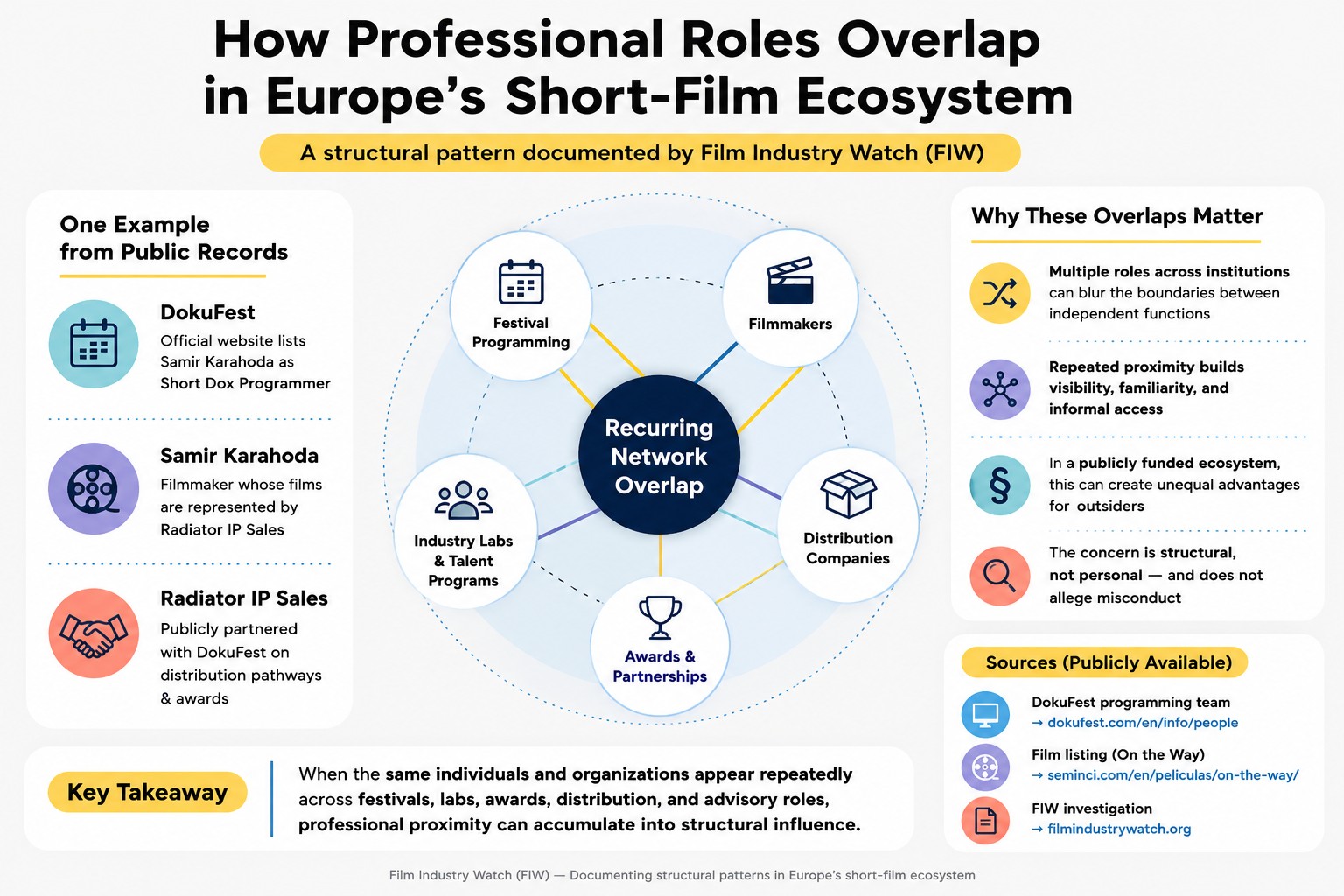
A publicly documented overlap involving DokuFest, Radiator IP Sales, and filmmaker-programmer Samir Karahoda raises broader questions about reciprocal professional incentives, distribution pathways, and institutional access in Europe’s publicly funded short-film ecosystem.
By FIW staff
Based on publicly available information and industry records reviewed by Film Industry Watch.
Editor’s note
This article examines publicly documented professional overlaps between film festival programming, filmmaking, and film distribution. No unlawful conduct is alleged. The article does not claim that any individual or organisation acted improperly, influenced a selection, or breached any specific rule.
Instead, it analyses the structural incentives and perception risks that can arise when the same individuals and organisations occupy multiple positions within a subjective, publicly supported cultural ecosystem.
The Same Names Keep Coming Up
One of the most common responses Film Industry Watch receives after publishing investigations into Europe’s short-film ecosystem is remarkably consistent:
“You should look at who appears in multiple roles.”
“The same names keep coming up.”
“Once you start mapping the connections, you can’t unsee them.”
Following FIW’s recent article examining how young filmmakers can become financially exposed within Europe’s publicly funded short-film ecosystem, a reader pointed to another example of institutional overlap involving DokuFest and Radiator IP Sales.
The observation was straightforward:
Samir Karahoda, whose films have been represented internationally by Radiator IP Sales, is also listed by DokuFest as part of its short-film programming team.
Publicly available information appears to support this. DokuFest’s official website identifies Karahoda as “Short Dox Programmer” and lists him as part of its programming team. Separately, publicly available distribution materials for Karahoda’s film On the Way identify Radiator IP Sales as the international sales representative.
Viewed in isolation, there is nothing inherently improper about a filmmaker having international representation while also working in festival programming. Cinema is a relationship-driven field, and professionals frequently occupy more than one role.
But the relevance of this example lies in the wider structure around it.
The DokuFest–Radiator Connection
As previously reported by Film Industry Watch, DokuFest has publicly announced a collaboration with Radiator IP Sales regarding international distribution pathways for films within its ecosystem. In public statements, DokuFest has described Radiator as a partner helping address “the challenge of international distribution” for Kosovo-produced films, while also associating the company with its Distribution Award framework.
FIW previously examined these relationships here: https://filmindustrywatch.org/the-price-of-access-in-europes-short-film-system/
This latest overlap therefore does not stand alone.
It sits inside a broader pattern in which Radiator IP Sales appears not only as a distributor operating in the marketplace, but also as a recurring presence near festival partnerships, awards, distribution pathways, and institutional access points.
That distinction matters.
A distributor outside the gate is one thing.
A distributor repeatedly positioned near the gate is another.
The Closed-Loop Economy of Short Film
The short-film world is not a normal market.
Most short films do not generate significant revenue through theatrical release, streaming, or traditional sales. Their value is usually created through visibility: festival selections, awards, industry attention, lab invitations, public funding, and future career opportunities.
In short film, selection itself is a form of currency. There is usually no meaningful box office, no wide commercial release, and often no direct revenue stream. A major festival selection, award, or branded institutional endorsement can become the asset that unlocks the next grant, the next lab, the next producer, the next distributor, the next residency, or the first feature opportunity. In that environment, prestige does not merely decorate a film’s career. It helps finance the next stage of it.
That makes the festival circuit a prestige economy. In such a system, symbolic value and economic value are deeply connected. A film’s artistic reputation can increase its market value. A distributor’s festival success can attract more filmmakers. A filmmaker’s festival record can improve their chances of future funding. A festival’s association with successful filmmakers and distributors can strengthen its own institutional status.
This is where overlapping roles become important.
When a festival programmer is also a filmmaker whose own work is represented by a distributor active around that same festival ecosystem, the concern is not necessarily direct favouritism. The concern is reciprocal professional incentive.
A distributor benefits when its films are selected, awarded, discussed, and institutionally validated. A filmmaker-programmer benefits when their own films are represented by a distributor with strong festival access and industry credibility. A festival benefits when it is associated with successful filmmakers, distributors, awards, and international circulation.
Each party may be acting legitimately. Each relationship may be explainable. But the structure can still become mutually reinforcing.
That is the closed-loop problem.
Not a proven quid pro quo.
Not a claim of corruption.
But a system in which the same organisations and individuals can repeatedly appear on both the cultural and commercial sides of the gate.
From Independent Selection to Reciprocal Advantage
In theory, festivals, distributors, programmers, and filmmakers occupy different roles.
- The festival selects.
- The distributor represents.
- The filmmaker creates.
- The award recognises.
- The public fund supports.
- The lab develops.
- The market circulates.
In practice, these roles can overlap.
- A programmer may also be a filmmaker.
- A filmmaker may be represented by a distributor.
- The same distributor may be linked to a festival partnership or award.
- The festival may be publicly funded.
- The distributor may benefit from festival prestige.
- The filmmaker may benefit from the distributor’s access.
- The institution may benefit from the appearance of international circulation and professional development.
None of this automatically proves misconduct.
But it raises a serious governance question: How does the system prevent professional proximity from becoming structural advantage?
This is particularly important in short film because selection itself often creates value. A distributor does not need a formal guarantee to benefit from proximity to festivals. The value lies in being close to the institutions that decide what becomes visible.
Likewise, a programmer-filmmaker does not need to do anything improper to benefit from close alignment with a distributor that can help their own work travel internationally.
The concern is not necessarily intentional exchange. The concern is incentive alignment.
When the same ecosystem rewards the same proximity again and again, independent selection can begin to look like reciprocal validation.
Mapping the Incentives
The problem can be understood through three overlapping incentives:
| Actor | Role in the ecosystem | Potential benefit |
|---|---|---|
| Distributor / sales agent | Represents films and helps them circulate through festivals, markets, broadcasters, and institutional channels | Gains prestige, catalogue value, commissions, visibility, and credibility when represented films are selected or awarded |
| Programmer-filmmaker | Participates in festival selection while also needing their own films to circulate internationally | Gains career visibility, representation, access to festivals, and symbolic capital for their own work |
| Festival / institution | Provides the platform, award structure, public legitimacy, and professional network | Gains status as a regional or international hub connected to recognised filmmakers, distributors, and circulation pathways |
The risk is not that any one actor necessarily behaves improperly.
The risk is that the incentives can become aligned in ways the public cannot properly evaluate.
If a distributor represents the work of a programmer, and that distributor is also positioned near the programmer’s festival ecosystem, the public needs to know what safeguards exist. Are there recusal rules? Are award decisions separated from programming relationships? Are commercial ties disclosed internally? Are represented films or distributor-linked films handled differently? Are conflicts recorded?
Without answers, the system asks filmmakers and the public simply to trust it.
That is not enough.
When the Curator Is Also Part of the Market
In a fair ecosystem, the curator is expected to act as a filter for artistic quality. The distributor is expected to act as a market representative. The filmmaker is expected to compete on the strength of the work.
But when these functions overlap repeatedly, the filter can begin to resemble a funnel.
This does not mean that weak films are selected. It does not mean that strong outsiders never break through. It does not mean that represented films are undeserving.
It means that some films may arrive with accumulated advantages before the selection process even begins: representation, institutional familiarity, festival relationships, lab history, market visibility, public funding, and personal trust.
In a subjective field, those advantages matter.
The question is therefore not only whether a film is good. The question is how it became visible, who already knew about it, which networks carried it, and whether outsiders had a comparable pathway.
This is the deeper issue behind the repeated claim that “the same names keep coming up.”
The recurrence may not be accidental. It may be the predictable result of a system where symbolic capital circulates among people and organisations already close to the gate.
Public Funding Raises the Standard
This becomes especially important within Europe’s publicly funded cultural sector.
When taxpayer money, EU cultural grants, national cinema funds, and publicly supported talent initiatives are involved, the expectation is not merely that misconduct be avoided. The expectation is that institutions maintain transparency, separation of roles, fairness, and public confidence.
Public funding gives cultural systems legitimacy. It tells filmmakers that the field is open. It tells the public that access is being administered in the name of culture, diversity, discovery, and merit.
But when the same networks repeatedly surface around both cultural prestige and economic opportunity, difficult questions naturally arise about how open the system truly is.
This also has consequences for diversity and access. Publicly funded cultural systems often justify themselves through commitments to emerging voices, regional representation, underrepresented filmmakers, and open access. But if informal proximity becomes one of the main routes to visibility, those least likely to possess inherited networks, festival literacy, elite-school access, or industry mentors may be disadvantaged before their work is even evaluated.
A system can promote diversity rhetorically while still reproducing insider advantage structurally.
If publicly supported festivals, awards, labs, and distribution pathways repeatedly strengthen the same professional circuits, then public money may end up reinforcing private proximity.
That does not mean public money was misused. It does mean public funders should ask sharper governance questions.
The Questions DokuFest and Radiator Should Answer
This article does not allege wrongdoing by DokuFest, Radiator IP Sales, Samir Karahoda, or any other individual or organisation.
But the publicly visible overlap raises reasonable questions of public interest:
- Does DokuFest have a written conflict-of-interest policy for programmers whose own films are represented by companies connected to the festival ecosystem?
- Are programmers required to declare sales, distribution, representation, or consultancy relationships?
- If a distributor represents the personal work of a festival programmer, is that distributor still eligible for festival-linked awards, partnerships, or privileged access within the same institutional environment?
- Are programming, award, and distribution-partnership decisions separated internally?
- Are recusals recorded when programmers have professional relationships with distributors, producers, sales agents, or filmmakers under consideration?
- Are filmmakers submitting through open calls informed how many selected films come through open submissions versus distributor relationships, invitations, labs, scouting, or institutional partnerships?
- If public funding supports any part of this ecosystem, are funders provided with conflict-of-interest declarations or network-concentration data?
These are not accusations.
They are governance questions.
And they are precisely the kind of questions publicly supported cultural institutions should be able to answer.
Informal Power Is Still Power
People outside the industry often imagine corruption as a direct transaction: money changing hands, explicit promises, formal exclusion.
But cultural industries often operate through softer mechanisms.
- A recommendation here.
- A familiar name there.
- A distributor attached to an award.
- A programmer connected to a sales company.
- A consultant sitting inside a talent pipeline.
- A quiet exclusion elsewhere.
- The same people recurring across festivals, labs, panels, funding environments, and industry programmes.
No single element necessarily proves misconduct.
But over time, the accumulation can produce a system in which insiders are more visible, more familiar, and more trusted, while outsiders are left trying to understand rules that are never formally written down.
For early-career filmmakers, especially those without institutional connections, money, or access to the right social networks, this can create a structurally uneven environment. The work itself may still matter, but proximity begins to matter too.
That is precisely the problem.
A Visible Network Structure
At a certain point, the overlaps stop appearing isolated.
They begin to reveal a recurring institutional structure.
A distributor connected to a festival award.
A filmmaker represented by that distributor also working inside festival programming.
A publicly funded ecosystem designed to support emerging talent.
The same names appearing across labs, panels, juries, consulting roles, and distribution pathways.
This does not prove wrongdoing.
But it does raise legitimate public-interest questions about transparency, independence, and access.
And because much of this ecosystem is publicly funded, those questions should not be dismissed as gossip, resentment, or misunderstanding. They are governance questions.
- Who has access?
- Who benefits from proximity?
- Who gets seen?
- Who pays to enter from the outside?
- Who is already inside the room?
That structure, rather than any single individual, is what Film Industry Watch continues to document.
Conclusion: The System Does Not Need a Smoking Gun to Need Reform
The DokuFest–Radiator example is not important because it proves misconduct. It does not.
It is important because it illustrates how Europe’s short-film ecosystem can produce overlapping roles, reciprocal incentives, and recurring proximity between festivals, distributors, filmmakers, programmers, awards, and publicly supported development pathways.
The question is not whether one filmmaker can also be a programmer. Many can, and many do.
The question is whether festivals and funders have built systems strong enough to manage the conflicts, incentives, and perceptions created by those overlapping roles.
In a subjective cultural field, transparency is not a bureaucratic luxury. It is the condition of trust.
Until festivals publish clear conflict-of-interest policies, recusal procedures, distributor-partnership rules, award-separation safeguards, and submission-pathway data, the central concern will remain:
Not that the system is necessarily corrupt.
But that it is too opaque to prove that it is fair.
Call for information
Film Industry Watch is continuing to examine the relationship between festival programming, distribution, sales, festival strategy, awards, submission fees, lab pipelines, screener practices, and conflict-of-interest safeguards.
Filmmakers, producers, programmers, screeners, festival workers, distributors, and industry professionals are invited to share documented experiences, including:
– films represented by companies linked to festival programmers;
– submission-fee disparities or fee-waiver practices;
– examples of films reaching senior programmers through non-open-call pathways;
– lab-to-festival pipelines involving the same individuals or institutions;
– undisclosed professional relationships between programmers, distributors, producers, mentors, or sales agents;
– internal festival conflict-of-interest policies;
– screener, preselector, intern, or volunteer viewing practices;
– correspondence, screenshots, catalogues, contracts, public bios, fee receipts, waiver evidence, or other verifiable material.
FIW welcomes both named and confidential submissions. Anonymous claims should be supported by documents wherever possible. FIW will not publish unsupported allegations as fact and will seek comment where appropriate.
Right of reply
The individuals, festivals, and organisations mentioned in this article, including Samir Karahoda, DokuFest, and Radiator IP Sales, are invited to respond. Any substantive response providing clarity on how these overlaps are managed will be published or reflected where appropriate.
Sources
DokuFest programming team:
https://dokufest.com/en/info/people
Distribution materials identifying Radiator IP Sales:
https://www.seminci.com/en/peliculas/on-the-way/
Related FIW investigation:
https://filmindustrywatch.org/the-price-of-access-in-europes-short-film-system/