

By FIW staff
Film Industry Watch recently received the following account from a producer responding to our reporting on how public film funding in Europe is actually decided.
It is one testimony, not a court ruling. But it is also the kind of testimony we keep hearing, from different countries, in different forms, with the same basic architecture underneath: the same names, the same insiders, the same production companies, the same festivals, the same boards, and the same contempt for anyone who asks how the machine actually works.
According to the producer, the experience began in Cannes around nine years ago, after the release of an independent film in New Zealand. That release made them eligible to join a producers program. What followed, they say, was not an introduction to a merit-based cultural system, but to something far more revealing.
“In the daily round table conversations with the industry it soon became clear: indie film uses schemes. That’s what they actually teach you and call it.”
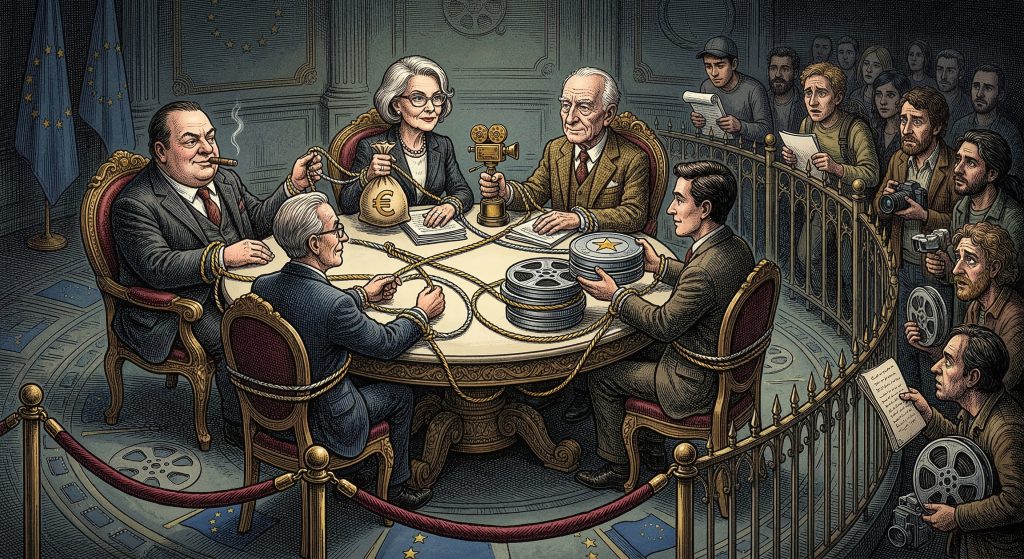
That line is worth pausing on. Publicly, European film funding is sold as cultural stewardship, support for talent, and the protection of artistic diversity. Privately, what many filmmakers encounter is something else: an insider structure dressed up as public service.
The producer says the atmosphere in Cannes was unmistakable.
“What struck me was the fact, everyone knew eachother. Like true buddies sharing a secret.”
That is a familiar description. One of the recurring problems in European film culture is that a closed circle is endlessly rebranded as an “ecosystem.” A network of recurring decision-makers is presented as a community. Structural concentration is reframed as professional trust.
And if you point out that the same people seem to rotate between funding bodies, festivals, production companies, juries, labs, and advisory positions, you are treated not as someone asking an obvious public-interest question, but as someone violating the etiquette of the room.
That is precisely what the producer describes. According to the email, things became tense when they asked why funding seemed to keep going to the same production companies, including companies connected to people sitting on boards and festivals.
“It became weird when I started asking questions about how funding always went to the same production companies that also sit in boards, festivals and are often producers them selves.”
The response, they say, was not transparency. It was deferral. A short, vague answer, followed by a suggestion that the matter be discussed privately at a Dutch Film Fund drinks event later that week.
“A fluffy 30 second answer ended by stating we should talk about this separately on the Dutch FilmFund drinks night.”
That detail says plenty on its own. Public money. Public institutions. Public-interest questions. Private drinks.
According to the producer, when they arrived at the event, they were not on the guest list and were treated like people trying to crash an important industry gathering. The same person who was supposed to explain the details allegedly passed by the entrance, did not acknowledge them, and offered no real answer once inside.
“But if I wanted I could come in and drink a free Heineken dutch beer.”
The image is almost too perfect: not an explanation, not accountability, not openness, just a free beer and a social brush-off. Later, the producer says, when they tried again to start the conversation, the woman in question “rolled her eyes and walked away.”
Then comes the central allegation in the email: that behind the soft language of industry development lies a much narrower production bottleneck.
“It’s like an oldfashion guild: you need to be able to work with one of the 3 production companies before applying for funding. If they don’t go along with it, no funding.”
That is the heart of it. If true, it means the issue is not merely favoritism at the margins. It means access itself is structured through a narrow gate. You are not really applying into an open field. You are being filtered through a small number of approved channels.
The producer goes further:
“The funding can only go through these companies, so they decide what is being produced.”
And then further still:
“The money is simply being shared between these companies and they roll the dice who is to win a price at what event.”
That is the producer’s allegation, and it should be read as such. But it lands because it fits a broader pattern many filmmakers already recognize: when funding, prestige, festival circulation, and institutional reputation all pass through overlapping networks, the claim that outcomes are purely artistic becomes harder and harder to take seriously.
The email also argues that the system’s influence does not stop at production.
“Next to that they fully control what’s playing in the film theaters since they do the funding. Hence we all get to see the same films in the whole of Europe.”
Again, the language is blunt. But the underlying point is hard to dismiss. If the same ecosystem shapes development, production, festival legitimacy, and distribution pathways, then what audiences see is not simply “the best work.” It is often the work that passed through the approved loop.
That has cultural consequences. The public is told it is being offered diversity, while in practice it is often being handed variation within a controlled range. Different countries, similar aesthetics. Different languages, similar ideological packaging. Endless talk of risk-taking from institutions built to minimize actual risk.
The producer’s description of how young talent is absorbed into this structure is particularly bleak.
“If you are talented you might end up at one of these 3 companies as a junior, sucked dry for great ideas and once your puppy trained and know the system you might be eligible to become a producer after 10 – 15 years and share in the revenue. A groom system at best.”
It is ugly language, but it captures a reality many emerging filmmakers describe more politely: semi-permanent apprenticeship, slow permission, endless gatekeeping, and a career ladder that often seems to reward compliance as much as talent. Public funding is meant to widen access. Too often, it appears to formalize dependence.
The producer ultimately decided to step back from the system altogether.
“So, after that experience we were taking 10 steps back from the industry.”
Instead of continuing to chase institutional approval, they say they turned toward direct audience access.
“Luckily YouTube is a great way to play your material we recently found out.”
After ten years behind a paywall, they put their film online. Their conclusion is striking not because it is idealistic, but because it is disillusioned.
“We decided that filmmaking is a passion and will never pay for our mortgage.”
That sentence alone says more about the actual economics of “supported cinema” than most industry panels do in an hour.
The email ends with the line that probably explains why so many institutions fear independent distribution, direct access, and voices that refuse to play along:
“I will never try and get funding anymore. I’m not a beggar that can’t choose. I’m a chooser that refuses to beg.”
There it is. The real insult to the system is not criticism. It is refusal.
Because systems like this do not merely run on money. They run on prestige hunger, dependency, and the belief that legitimacy lives inside the maze. The lab. The market badge. The drinks list. The closed-door panel. The nod from the people who already know each other.
The moment filmmakers stop believing that, the spell starts to weaken.
Not every funded film is corrupt. Not every producer inside the system is compromised. Not every institution operates in exactly the same way. But the pattern is now too familiar, and the testimonies too consistent, to dismiss as bitterness or misunderstanding.
Across Europe, the public is told it is funding artistic openness. Too often, it seems to be funding managed circulation within a narrow class of insiders.
The public pays for pluralism. It keeps getting repetition.
If you have seen similar patterns in film funds, festival programs, training labs, or public funding bodies, contact Film Industry Watch confidentially.


Related Posts


3 Comments
-
Pete Conrad
I feel like my own story as a writer is every writer's story to an extent. I write novels and adapt them to screenplays. I've gotten pretty good at it. Self-published, I've sold (or given away via Amazon) well over 30k books. Each have about 4.5 stars. I'm proud of them. The first screenplay I wrote got me an agent. It was called The Suicide Flowers. (A rockstar on his way down. A devoted fan. A connection). I flew out to LA. We partied. Started attaching people and bands. Created a marketing plan. Things were moving. This was it! Then I had this "brilliant" idea to cast Corey Feldman and Corey Haim in opposing roles. Their manager loved it. As we began pitching, Haim died, RIP, and the film lost its momentum. My agent quit and I was left scrambling. I finally gave up on that film, though I wrote a prequel novel and screenplay of their teen years. Nothing. I wrote several more novels and adapted them. One, Survival of the Sparrows, was gathering momentum. It's the story of an elderly Black couple as they try to survive an invasion on American soil. My readers love it. It's relatable and I kinda predicted Trump, nationalism, and the fall of America. This is the meat of my story. I started pitching it. In 2018, I pitched The Blacklist. It scored an 8. The reviewer really thought it would be an award-winning film. I did, too. Then, it was Stage 32, Inktip, et al. These efforts and moneys landed me net zero, though I used every bit of input I received. 20 rewrites later and who comes along? Scripthop and its gauntlet. Finally, a proper screenwriting vetting machine comes to Hollywood, I thought. The goal is to get through 3 "stages." My first run garnered a lowly score of 38 and didn't get past stage 1. But I took every bit of advice given and rewrote it and resubmitted it. My score jumped to 51, but still stage 1. Again, more rewrites and my next score ... 55. Stage 2! A little disappointed, but I thought about the direction, the actual real producers giving me invaluable input ... (mind you, this costs $380 every time you submit) and then created a screenplay I, myself, truly loved. I resubmitted it. This time, I hit Stage 3 with 10 producers giving me recommends with a score of 71. But I didn't "beat the gauntlet," which is the goal. I missed it by one recommend. No producers have called. No writing assignments have landed in my inbox. No producers have reached out and said, "Hey, we can make this story work." I've done everything I've been being told I had to do to make it this industry, proving myself, my work ethic, my willingness to bend. And so I quit. Moved out of the US. I barely even write anymore because Amazon makes it impossible for an author to make money and writing for the intrinsic value just isn't enough for me. Thank you.
-
Film Industry Watch
Dear Pete, Thank you for your comment. Beyond concerns about corruption and nepotism, many people today feel that identity increasingly matters more than character, merit, or talent. If you are perceived as a white, able-bodied man, some assume you represent a category that is no longer considered valuable or marketable in certain cultural spaces. Martin Luther King Jr. spoke decades ago about judging people by the content of their character rather than the color of their skin. Ironically, parts of society now seem to be moving back toward defining people primarily through identity categories rather than individual merit. Thank you for sharing your perspective.
-


Gerald Martin Davenport
This article touches on so many branches of entertainment from a viewer and creator's point of view. As I a viewer in my youth, I sensed the entertainment we were fed changed in the late 70s to early 80s and more so in 2000. Shows and films looked similar to each other as though there was a formula they used to rehash what we already seen. As though they were afraid to try something new, different, and unknown about its popularity metrics. Elliot Grove wrote: "The film industry is all run by the conglomerates and studios who hatch small boutique companies to trade on the name “independent.” These production companies are run by the same moguls as their bigger budget Hollywood counterparts. In this corporate realm, moguls offer actors scale work on the promise that the cool films and directors they work with will enhance their careers. The producers of these lower budget films are offered elusive back end deals based on the success of the distribution process. Of course, any profit is gobbled up by expenses." From his article https://www.raindance.org/10-dirty-secrets-of-independent-film/ As a creator, I have experience knowing that they, the conglomerates, do not fear trying something new, different, and without data metrics, because It is not in their vocabulary, thoughts, or interest -- they avoid it at all cost. As I have written: https://ariapictures.com/weblog/2025/independent-film-festivals-driven-by-big-money/, I have experienced in my 25+ years as a creator, and a few of them in the industry before I ran away to a clearer piece of mind with moral grounds, I know the difficulties it is to try and break into their exclusive group. I get frustrated, depressed, angered, and motivated when I see a film or a television show that is a rehash of something, the story is weak, the acting is horrendous, and/or it has the same group of investors and people manipulating the puppet strings. But, does the audience care? They are too stupid to even know it is happening, even when they see it happening, because they are caught up in their own, "I want to be entertained" world they do not care if it is a cat doing something stupid to a couple having an argument. There is no accounting for taste. Most importantly when there are "Reality Shows" that have no reality to them. People want to watch fake drama that has not plot. And the conglomerates take advantage of this by creating these programs on the cheap. There is a group of independent creators working on bringing back creativity in art, film, and tv, the only problem is the venues to showcase the work are small, not well attended, and are sabotaged by the conglomerates. They do not want to share any of the pie. And if you eventually do get a piece of the pie, it is so small you cannot live on let alone keep creating. It is hard to fight the big conglomerates in their own pool. They have the keys, they make the rules, and they have the minions who do their bidding to keep you out.