

More conflicts of interest and financial scandal emerges – filmmakers who reviewed and evaluated proposals for the Greek Film Center, received financial support in the same call & other scandals in the Greek film industry spanning 2020 to 2024
By Hector Alejandro Morales, Film Industry Watch contributor and Greek industry insider.
A longer, full and much more detailed version of this article is available here.
In October 2021, acclaimed director Kostas Ferris, Silver Bear winner at Berlinale for Rembetiko and former Vice President of the Greek Film Center (GFC), testified at the Court of First Instance in Athens. Ferris, a key figure in Greek cinema, took the stand to address the ongoing issues of alleged corruption within the GFC. He served under Panos Loukakos, the GFC president at the time, and together they resisted pressures from deputy minister Nikolas Giatromanolakis, who was allegedly connected to author/director Apostolos Doxiadis. Doxiadis, from a wealthy family, exerted significant influence over the GFC’s operations, often behind the scenes, using his connections to right-wing Prime Minister Kyriakos Mitsotakis.
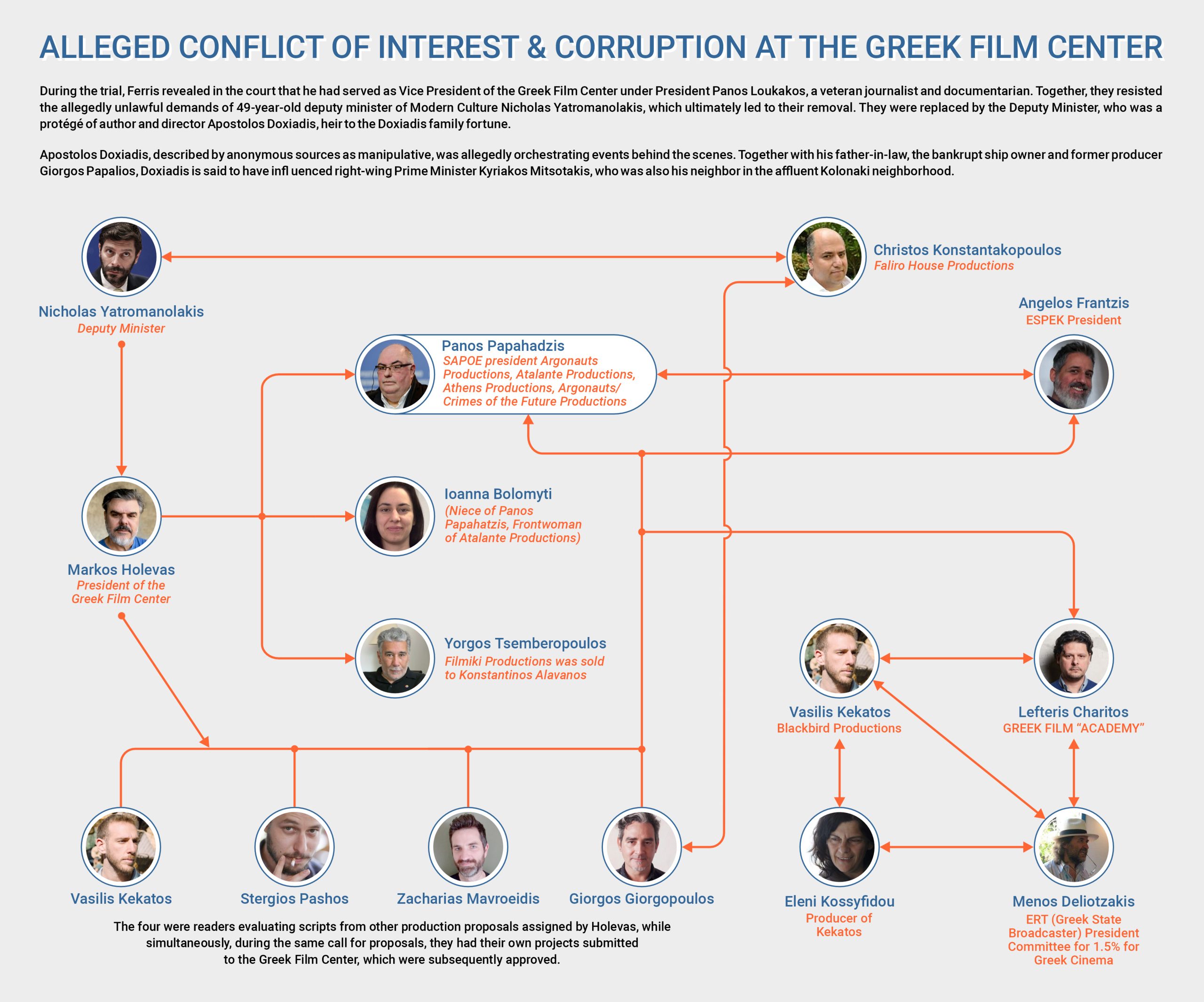
One key figure absent from the trial was Greek Film Center president Markos Holevas. Despite having a legal department, Holevas spent over €16,000 of public money on an external law firm to defend himself. Lawyers from various producers’ associations, including SAPOE and Tanweer Productions, attended the trial, as they had a vested interest in the outcome. For years, producers had been profiting handsomely from state subsidies before films were even produced, exploiting loopholes in the system to minimize payments to directors and screenwriters.
Ferris’s testimony shed light on the opaque practices of the Greek Film Center, which operates under Greek law as a publicly funded organization. According to Ferris, the GFC has consistently been criticized for inappropriate personnel decisions and non-transparent procedures regarding the allocation of film funding. Despite public claims that its processes followed European Union guidelines, Ferris disputed this, saying that GFC’s practices deviated significantly from those of other European film organizations.
In a complaint filed in May 2021, independent producers and directors demanded the GFC release the names of its evaluators, accusing them of using their positions to fund their own projects. The complaint cited several projects, including the animated short Kolokotronis, the Old Man of Moria, the Holocaust-themed docudrama Don’t Forget Me, and the short fiction film The Boat. Despite the high-quality proposals, they were given low scores, while evaluators granted themselves awards ranging from €2,500 to €200,000.
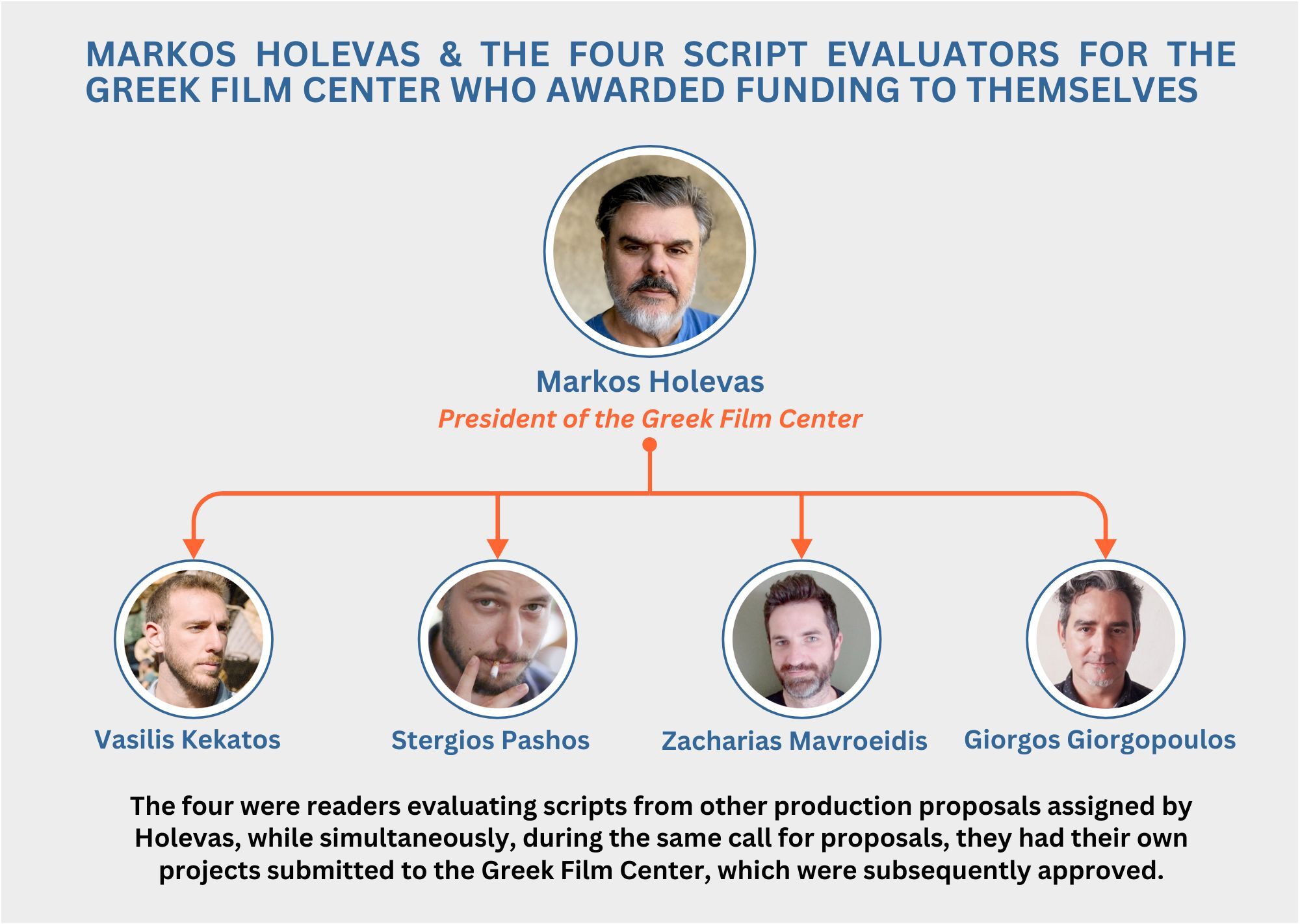
In a ruling that sparked outrage, the District Attorney ordered GFC president Pandelis Mitropoulos to release the names of the evaluators. The results revealed that four evaluators had clandestinely awarded themselves nearly half a million euros in state funding.
Among the projects that received controversial pre-approval were:
- Very Girlish Name Patty by George Georgopoulos (€200,000)
- Carmen’s Summer by Zacharias Mavroeidis (€190,000)
- Our Wild Days by Vasilios Kekatos (€2,500)
- The Last Taxi Driver by Stergios Paschos (€130,000)
In June 2021, Ferris exposed further mismanagement at the Greek Film Centers in interviews, accusing Holevas and his board of cronyism. Holevas had claimed a lack of qualified evaluators within the unions, which Ferris refuted, citing the thousands of active members in various Greek unions. Despite these accusations, Holevas and key figures in SAPOE, a small association of producers and directors, continued to dominate the funding process, enriching themselves at the expense of the wider film industry.
Several SAPOE members, including president Panos Papahatzis, received substantial funding for their projects. Papahatzis himself received €370,000 for three approvals, while other board members and their companies also benefited significantly. In total, SAPOE members were granted over €1.8 million out of the €4.45 million allocated by the GFC in two rounds of decisions.
The influence of SAPOE extended beyond the funding process, as evaluators were often assessing projects submitted by their collaborators. For instance, evaluator Stergios Paschos received funding for a feature-length project while a colleague of his was involved in another project funded by the GFC.
In February 2022, the Hellenic National Transparency Authority released a report on the GFC’s pre-approval process, highlighting the lack of transparency and the presence of conflicts of interest. The report recommended reforms to the selection process, including the creation of an Evaluators’ Registry and more detailed criteria for selection, to prevent future conflicts of interest.
In August 2024 yet another financial scandal by Kekatos and advertising/production company Foss Productions, owned by the Kotionis brothers, in the tune of approximately 1M euros
The board of directors of EKOME (The HELLENIC CASH BACK INITIATIVE) decided to cancel the prior approval of the series “Milky Way”, by Vassilis Kekatos, executive produced by Foss Productions and Stelios Koionis, and financed by MEGA TV channel, and the benefits granted from the tax incentive scheme (CASH REBATE) of article 71E of Law No. 4172/2013 (A’ 167), as in force, “because the completeness of the auditor’s report was not established, according to article 30 of the law. 4487/2017”.
The reason for this decision was that “the start of the investment project took place before the date of submission of the application for inclusion, in accordance with para. 5 of article 20 of Law no. 4487/2017”. The withdrawal was made one year after the investment has been certified. The budget approved amounted to EUR 2,252,435 and the withdrawn subsidy to EUR 900,974. Both Stelios Kotionis, as executive producer, and Vasilios Kekatos, as director, submitted declarations of honor to EKOME when Milky Way was entered into the cash-back incentive scheme, affirming that production had not yet started.
The alleged corruption at the Greek Film Center reached a breaking point in 2024 when a scandal erupted over Greece’s Oscar submission process. A committee, chosen by the Hellenic Film Academy (a private society) in collaboration with the GFC, was tasked with selecting the film to represent Greece at the Oscars. However, allegations of bias and favoritism arose, particularly concerning the selection of Kekatos, who had primarily directed short films, to lead the committee. The Ministry of Culture intervened, replacing certain members of the committee.
Furthermore, it is important to emphasize that the Ministry of Culture’s approach to replacing the committee members – originally appointed by a ministry employee while she was on vacation – lacked both transparency and the level of professionalism expected from such a key institution. The untransparent process, combined with the absence of communication regarding the criteria for selecting the replacements, has sparked serious concerns within the Greek film community, further eroding trust in the system. These failures highlight the broader issues of mismanagement and opacity that have troubled the Greek Film Center for years. Clearly, the internal investigation initiated by the Ministry of Culture is an attempt to address these insecurities and fears.
These scandals have exposed a deeply flawed system, where a small group of insiders has monopolized state film funding, marginalized many filmmakers, and eroded public trust in the Greek film industry. Calls for reform have intensified, with demands for greater transparency, meritocracy, and accountability in the film funding process.
For those who follow our website, the events detailed above are eerily similar to the ones we’ve previously reported concerning the Israeli Film Funds and are inline with how the European film ecosystem is organized, with a complete lack of transparency and proper guardrails against corruption and conflict of interests.
LINKS AND SOURCES:
https://www.efsyn.gr/tehnes/sinema/114454_sinema-o-paradeisos-tis-kakodiaheirisis
(Cinema paradiso of…. mismanagement).
(“Greek Film Academy: They took the bread out of their mouths, and now they are cursing… everyone else.” )
https://www.efsyn.gr/politiki/synenteyxeis/297119_antro-kakoyrgimaton-elliniko-kentro-kinimatografoy(‘The Greek Film Center is a den of felonies. “)
In an interview with the Greek daily EFSYN, Kostas Ferris stated: “What is certain is that Mr. Holevas failed to forward the findings to the appropriate prosecutor, as required by the report from the General Accounting Office of the State and as ordered by the Minister. Instead, he handed the two evaluation reports to a lawyer of his own choosing, Mr. Alexandros Christidis, for re-evaluation. Moreover, he did not inform the Minister that in the Asprogerakas complaint, as well as in reports by certified public accountants Batsoulis, Androutsos, and Triantafyllou, his name was mentioned (please see page with arrow–Georgios Papalios, father-in-law of Apostolos Doxiadis name appears first) in connection with felonious activities. Therefore, he should have immediately resigned to allow for a proper investigation and the necessary cleansing of the Greek Film Center (GFC).
Numbers of Police IDs and passports on the legal complaint of Asprogerlas-Grivas have been erased because it violates Greek GDPR law about personal data.
Below is a report by certified public accountants from the accounting firm Sol found that the film ALPS by Yorgos Lanthimos, executive produced by Athena Rachel Tsangari, unlawfully received €300,000 instead of the €150,000 approved by the Board of Directors. GFC general manager Grigoris Karantinakis made this decision independently, without board approval, and drafted a private agreement between the GFC and Tsangari without consulting the GFC’s Legal Department. As a result, Karantinakis has been accused of a felony and bad faith in a complaint filed by the well-known lawyer Asprogerakas-Grivas. Markos Holevas is listed as number two on the first page of the complaint, which is 130 pages long. Identifying details such as IDs and passports have been omitted.



Pingback: Alleged Corruption and Decadence at the Greek Film Center – Short version – De-normalizing nepotism in the film industry. – Kon/Spira[l]