More conflicts of interest and financial scandal emerges – filmmakers who reviewed and evaluated proposals for the Greek Film Center, received financial support in the same call & other scandals in the Greek film industry spanning 2020 to 2024
By Hector Alejandro Morales, Film Industry Watch contributor and Greek industry insider. A shorter version of this article is available here.
A shocking new conflict of interest and financial scandal has surfaced at the Greek Film Center (GFC), involving film director Vasilios Kekatos and others, who served as evaluators for film funding proposals but also received substantial financial awards for their own projects, in the same call.
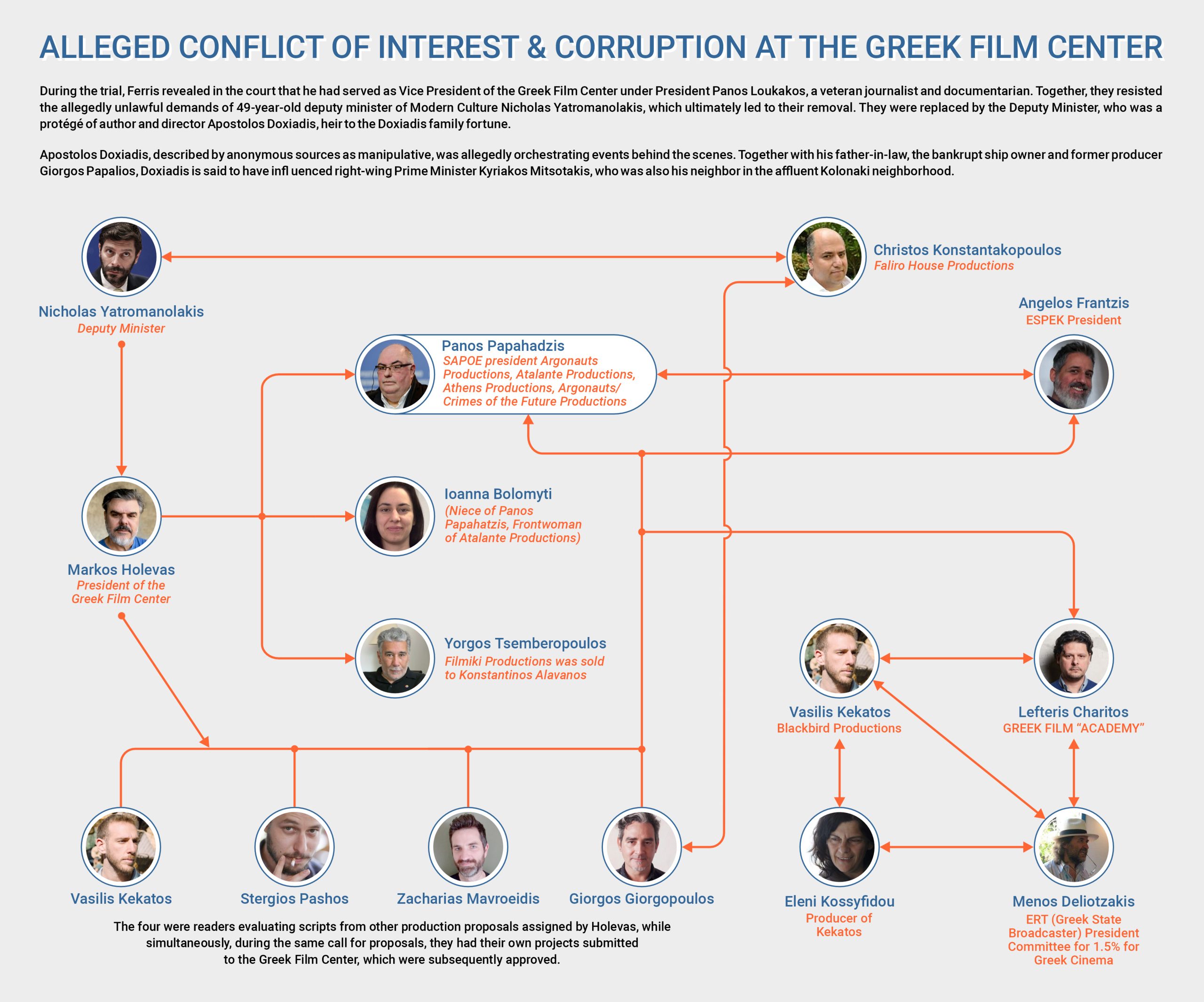
OCTOBER 18, 2021: At approximately 1:30 PM on October 18, 2021, celebrated Greek film director Kostas Ferris, Silver Bear winner at Berlinale for the feature film “Rembetiko”, former Vice President of the Greek Film Center, and a highly respected director, screenwriter, and lyricist, with over 10 feature films, 20 TV series, and numerous lifetime achievement awards to his name, including his role as lyricist for the iconic Aphrodite’s Child (the Vangelis band) album “666”, took the witness stand at the Court of First Instance in Athens, Greece. Ferris was also a founding member of FERA (the Federation of European Directors). Among others Ferris mentioned that he was a Vice President until recently at Greek Film Center under GFC president Panos Loukakos, a journalist/documentarian, where they refused to cave in to the illegal demands of 44 year-old minster Nikolas Giatromanolakis (Former Deputy Minister of Culture and Sports of Greece) so they were subsequently replaced by the deputy minister, who was a protege of author/director Apostolos Doxiadis, heir to the Doxiadis family fortune.
According to sources within the Greek production industry, Apostolos Doxiadis, was allegedly manipulative and acted as a secret advisor, influencing decisions behind the scenes alongside his father-in-law, bankrupt shipowner Giorgos Papalios. Both were closely tied to the right-wing current Prime Minister of Greece, Kyriakos Mitsotakis, with the Mitsotakis family also being their neighbors in the upscale Kolonaki neighborhood.
Markos Holevas, the president of Greek Film Center was nowhere to be seen at the trial but he had hired a law firm outside GFC, paying them over 16.000 euros plus VAT from public money at the time to defend himself (despite the fact that GFC had its own legal department). Lawyers from SAPOE (one of the five producers associations), and ESPEK ( the small association of producers-directors) and Tanweer Productions (owned by Lebanese distributor Joseph Samaan and headed by Dionysios Samiotis) were also present. What was at stake was the pre-approval of their state-owned subsidies. Allegedly for years middle men that called themselves “producers” (in reality they were line producers who were not risking any of their money, or property), made millions well in advance before a film, or a documentary was produced. The cheaper they could make a film, the better. The less they had to pay directors and screenwriters—or even nothing at all—the more ideal it was for them.
Ferris testified under oath: “…In the context of the dispute that arose within the Greek film community and the publicity it garnered in the print and electronic media for many weeks, I was informed that the Greek Film Center, a private legal entity under the supervision of the Ministry of Culture (ΥΠΠΟΑ), that operates under Law 3905/2010 and is therefore a public organization (funded by the Greek taxpayers). It is funded more than 80% by the public budget and is thus subject to specific operating conditions, transparency, and financial and administrative accountability. The organization has been under attack from both the print and electronic press, as well as the majority of the film community, for inappropriate personnel choices and non-transparent procedures regarding the pre-approval of funding for films, which do not exclude conflicts of interest.“
In an attempt to justify these procedures after the fact, the Greek Film Center extensively explained in press releases and via its website the procedures it followed. It publicly stated that the methods it used are the same as those followed by institutions responsible for audiovisual matters and funding in the European Union (27 Member States), namely the MEDIA DESK (now Creative Europe) program (headquartered in Brussels), and by the Council of Europe (based in Strasbourg with the participation of the 39 “Member States) through its European film co-production funding program EURIMAGES.
The Greek Film Center’s positions on these issues—regarding the selection of evaluators/readers, the staffing of committees, and the evaluation procedures for the pre-approval of funding of films and production plans related to Creative Europe and EURIMAGES—are not accurate. “In fact, they are entirely false and inaccurate, and they directly contradict everything I know and have experienced in my collaborations with these European institutions…”
In a ten-page complaint submitted to the Athens District Attorney in early May 2021, three independent producers and directors requested that the Greek Film Center disclose the names of the evaluators/readers.
In their sworn statement, they asserted:
…three projects were submitted to the GFC – 1 feature-length documentary, 1 short fiction film, and 1 short length animated film:
- “KOLOKOTRONIS, THE OLD MAN OF MORIA” Protocol Number 9193, dated 26/11/2020, was a 2D animation film project approximately 6 minutes in length, with screenplay and direction by me, and character design and illustrations by Nassos Vakalis (Emmy award winner, with 78 international awards and 270 festival participations for the short film Dinner for Few). The proposal was 112 pages long.
- “DON’T FORGET ME, JEWISH MOTHERS WRITE TO THEIR CHILDREN FROM THE GHETTO OF THESSALONIKI” Protocol Number 7380/30-9-2020, a feature-length docudrama, focusing on the Salonica Holocaust where 59.000 Jews perished, starring the well-known film and television actress Maria Nafpliotou, based on the book of the same name by historian/researcher Dr. Leon Saltiel, under the auspices of the Central Board of Jewish Communities in Greece, the Jewish Museum of Greece, and the Chair of Jewish Studies at Aristotle University of Thessaloniki. The proposal was about 100 pages long.
- “THE BOAT,” A.P. 6025/3.8.2020, a short fiction film, 15 minutes long, with a screenplay by Aphrodite Vakalis and Nassos Vakalis, and directed by Nassos Vakalis, featuring well-known actors Christos Antoniou and Dimitris Piatas. The proposal was about 70 pages long.
In the announcement of the results on 30.3.2021 and 28.4.2021, we realized that the evaluators had awarded themselves amounts of €2,500, €130,000, €170,000, €190,000, and €200,000 respectively , in addition to the €5,000 compensation fee they received as readers (script evaluators), while they ensured, in absolute collaboration with the president of the Board who had appointed them, to give low scores (in order) to “cut out” their competitors!
These actions, ratified by the Board of the Greek Film Centre (GFC), are illegal, abusive, unethical, unprofessional, and caused a national and international uproar both on social media and among journalists, with publications in the print and electronic press. They are unprecedented globally, as even in the most underdeveloped countries, evaluators are expected to declare conflicts of interest and request recusal, not to self-award funding!”
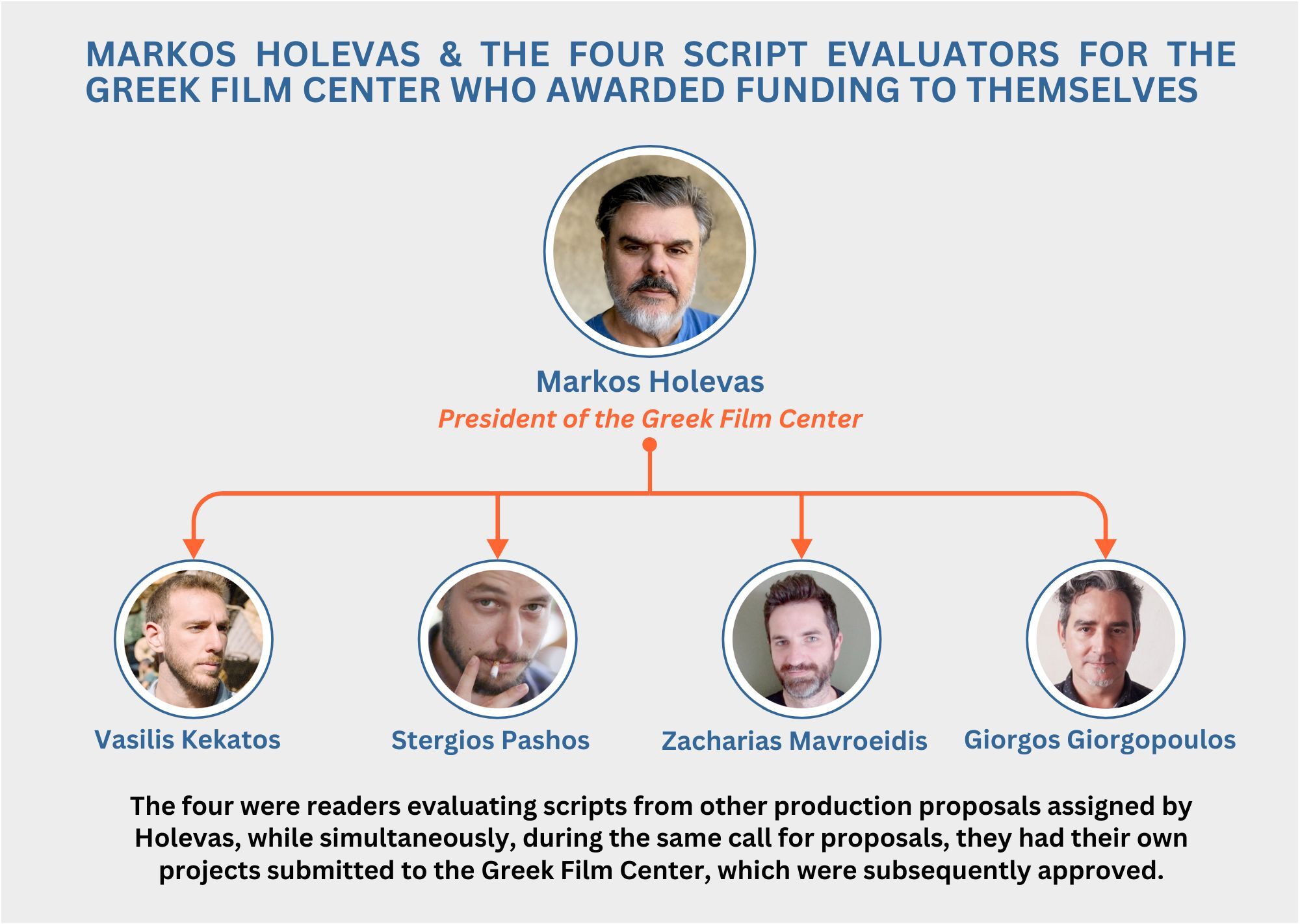
The District Attorney ordered the president of the Greek Film Center and its managing director, Pandelis Mitropoulos, to release the names of the evaluators, the scores given to each project, and other relevant documents that Holevas withheld. It was uncovered that four evaluators had secretly competed against the other submitted projects and were awarded (awarded to themselves) half a million euros.
- VERY GIRLISH NAME PATTY
Screenplay: GEORGE GEORGOPOULOS
Direction: GEORGE GEORGOPOULOS
Production: FALIRO HOUSE PRODUCTIONS
Pre-approval funding amount: €200,000 - CARMEN’S SUMMER
Screenplay: ZACHARIAS MAVROEIDIS, XENOPHON HALATSIS
Direction: ZACHARIAS MAVROEIDIS
Production: ATALANTE PRODUCTIONS (headed by the niece of Panos Papahatzis)
Pre-approval funding amount: €190,000 - OUR WILD DAYS
Screenplay: VASSILIS KEKATOS
Direction: VASSILIS KEKATOS
Production: BLACKBIRD PRODUCTION
Funding amount: €2,500 - THE LAST TAXI DRIVER
Screenplay: STERGIOS PASCHOS
Direction: STERGIOS PASCHOS
Production: FILMIKI PRODUCTIONS
Pre-approval funding amount: €130,000
(Note: THE LAST TAXI DRIVER had an abysmal box-office of 2.111 tickets when it was distributed in the spring of 2024, and CARMEN’S SUMMER followed suit with 9.500 tickets at the box office).
Background: Outrage and Injunction Against the Greek Film Center
Three independent directors-producers (Leonidas Vardaros, Dimitrios Vorris, Georgios Keramidiotis that were later blacklisted by Holevas and his board of directors) have filed a class action demanding an injunction against the Greek Film Center supported by the Directors Guild of Greece and 600 signatures of filmmakers. The injunction request concerned the recent pre-approval decisions made by the Board of Directors of the Greek Film Center on March 30 and April 28, 2021, where four evaluators/readers (Vasilios Kekatos, Stergios Pashos, Zacharias Mavroeidis, Georgios Georgopoulos) had also submitted in the same categories and were granted approval for themselves for projects worth up to €522.500
The directors-producers sought the temporary suspension of the Greek Film Center’s decisions from March 30 and April 28, 2021, concerning the “Pre-approvals of Short Films, Feature Films, and Documentaries,” claiming these decisions were illegal and violated local law, EU directives, and constitutional principles. They also requested a halt to any disbursement of funds or, alternatively, the suspension of the projects approved for Vasilios Kekatos, Stergios Pashos, Zacharias Mavroeidis, and Georgios Georgopoulos until a final ruling was made by the judge.
JUNE 2021: The blatant falsehoods of Markos Holevas and company
Markos Holevas, then president of the Greek Film Center (GFC), who was forced to resign in July 2024 by the minister of culture Lina Mendoni, claimed in the media that he was unable to find evaluators active in the fields of screenwriting, directing, and producing because the unions lacked sufficient members. And that’s why he picked evaluators from ESPEK only, the small association of producers-directors where he was a member. This couldn’t be further from the truth: The Greek Actors’ Union (SEI) has approximately 4,000 members, while the three relevant unions have around 40 active members in SAPOE, about 70-80 in ESPΕΚ (the Association of Producers-Directors), and approximately 130 in the Greek Documentary Association (EEN), many of whom are also members of ESPΕΚ. The Greek Directors’ Guild (EES) 1.200 members, and the Greek Film TV Technicians’ Union (ΕΤΕΚΤ) had 300 members, totalling 1,700 members. The Hellenic Screenwriters Guild has 330 members, and the Greek Producers’ Union (founded by respected producer Geiorgos Sgourakis) includes around 40-50 producers. Therefore, the combined membership of all these three unions exceeded 6,500 members.
As for Panos Papahatzis, president of SAPOE back then and owner of Argonauts Productions-he received three approvals amounting to €370,000 (€170,000, €70,000, and €130,000, respectively).
The SAPOE Board consisted of the following members:
- Panos Papahatzis, President of SAPOE, received €370,000 through three funding approvals.
- Fenia Kosovica, Vice President of SAPOE, received €400,000 through her company, Blonde Films (€200,000 + €200,000).
- Konstantinos Kontovrakis, General Secretary, received €228,000 through his company, Heretic Films, across three approvals (€150,000, €60,000, €18,000).
- Amanda Livanou, Treasurer of SAPOE.
- Maria Drandaki, Board Member, received €250,500 through five approvals with her company, Homemade Films (€2,500, €6,000, €12,000, €200,000, €30,000).
- Konstantinos Vasilaros, Alternate Board Member.
- Eleni Afentaki, Alternate Board Member.
The SAPOE Audit Committee received the following amounts:
- Ioanna Bolomyti (Papahatzis’ niece, working under the same roof with Argonauts Productions, Athens Productions, and Argonauts Crimes of the Future Productions) received €18,000 for script approval.
- Giorgos Karnavas, a partner in Heretic Films alongside SAPOE’S General Secretary Konstantinos Kontovrakis.
- Yiannis Iakovidis, owner of Black and Orange Films.
In total, the aforementioned SAPOE board members received €1,266,500 through what has been described as an illegal process of Greek Film Center funding that lacked transparency and accountability.
Additionally:
- Eleni Kossyfidou, a former SAPOE President and producer for director Vasilis Kekatos (Blackbird Productions), received €20,500 (€2,500 for scriptwriting and €18,000 for a script). Kossyfidou and Kekatos, along with director Panos H. Koutras, were involved in the conflict of interest scandal exposed by filmindustrywatch.org regarding Kekatos’ short film award at Cannes.
- Giorgos Tsourgiannis, another SAPOE member, received €156,000 (€6,000 and €150,000).
- Giorgos Tseberopoulos, another SAPOE member, received €151,500 through his company Filmiki Productions (later sold to Konstantinos Alavanos), along with his partner, Efstathios Mourdoukoutas (€2,500, €130,000, and €19,000).
- Faidra Vokali, another SAPOE member (Marni Films), received €132,000 through four approvals (€70,000, €17,000, €20,000, €25,000).
- Modiano S.A., owned by Micky Modiano, another SAPOE member, received €90,000 through two approvals (€60,000, €30,000).
- Stefi/Lynx Films, another SAPOE member, received €2,500.
It was alleged that the SAPOE regular members received an additional €552,500 through the same questionable EKK funding process. This brings the total sum awarded to SAPOE members to €1,819,000 out of the €4,450,000 allocated by the EKK in two rounds of decisions. However, it is important to note that the identities behind all the companies listed in the two GFC pre-approval funding lists have not yet been fully identified. Further investigation may reveal that more SAPOE members benefited from this funding.There was and also concern about potential conflicts of interest, where evaluators may have been assessing proposals submitted by their collaborators, such as producers. For example, Filmiki Productions received funding for both a feature-length project (directed by evaluator Stergios Pashos, The Last Taxi Driver) and a short film (Roger), where, according to GFC statements, a collaborator of the evaluator may have been involved.
When director Costas Ferris publicly exposed the chaotic mismanagement and alleged corruption at the Greek Film Center in an interview with the daily newspaper EFSYN, he faced a wave of legal threats from SAPOE members. Over the course of seven consecutive days, he received cease-and-desist letters from each member of the SAPOE board, along with a defamation lawsuit from producer and president Panos Papahatzis. Ultimately, the Athens Multi-Member Court acquitted Ferris of all charges.
(Note: In 2023 Papahatzis officially joined forces with Κostas Sakkaris, who, allegedly, has strong connection to the Greek prime minister’s office. His daughter tennis champion Angeliki Sakkari is in a relationship with the prime minister’s son).
FEBRUARY 2022: The Hellenic National Transparency Authority’s findings are a blow for Greek Film Center’s practices and especially present Markos Holevas and Vasilios Kekatos
After nine months, in md-February 2022, the National Transparency Authority’s published an audit report on the pre-approval decisions of the Board of Directors of the Greek Film Center, on March 30 and April 28, 2021, totaling 4.550.000 euros, has been completed.
In these specific decisions, the projects of four readers, who were simultaneously competitors, were approved, thus abolishing any notion of impartiality, transparency, and equality.
The multi-page report from the National Transparency Authority concludes:
“…with the aim of ensuring the best safeguarding of the principles of transparency and impartiality in the operation of the organization, it is recommended to the Board of Directors of the Greek Film Center:
- Prior to the selection process, there should be a public call for expression of interest or a related posting on the Greek Film Center’s website, or other measures (e.g., the creation of an Evaluators’ Registry) should be adopted, which could ensure an increase in the number of the most suitable candidates and, consequently, the best possible selection of Readers. Furthermore, the designation of the decision-making body (possibly a collective one) and a more detailed description of the selection criteria would contribute to enhancing the transparency and objectivity of the process.
- It should consider the possibility of requiring each Reader to confirm, for each proposal being evaluated, that there is no incompatibility or conflict of interest in their case, with a corresponding declaration on the electronic platform through which the evaluation process now takes place, taking into account the evaluators’ code of conduct model included in the EU Grants – Model contract for EU Experts by the European Commission.”
It is noted that the Film Center had falsely claimed to the Greek press that “…it follows the best practices of European programs (Creative Europe, Eurimages),” where it is widely, and internationally, known and posted on the web that cross-paneling (an evaluator being simultaneously a competitor and judging a candidate film, even in a different category), conflict of interest, and generally any relationship up to first-degree relatives with candidate production companies and projects over the past 18 months are prohibited, under penalty of funding cancellation.
AUGUST-SEPTEMBER 2024: The corrupt world of the “academy” mafia is falling apart… Greece’s Oscar submission exposed a broken system devoid of transparency and meritocracy
An irregular, illegal, and evidently corrupt action by a Ministry of Culture employee forced the Deputy Minister to partially replace certain members of the proposed Oscar nomination committee, which had been suggested by the misnamed Hellenic Film “…academy,” a private, not-for-profit society, in order to meet the deadlines.
Furthermore, it is important to emphasize that the Ministry of Culture’s approach to replacing the committee members – originally appointed by a ministry employee while she was on vacation – lacked both transparency and the level of professionalism expected from such a key institution. The untransparent process, combined with the absence of communication regarding the criteria for selecting the replacements, has sparked serious concerns within the Greek film community, further eroding trust in the system. These failures highlight the broader issues of mismanagement and opacity that have troubled the Greek Film Center for years. Clearly, the internal investigation initiated by the Ministry of Culture is an attempt to address these insecurities and fears.
A major scandal erupted, with press releases published in outlets owned by Penske Media Group (Deadline, Hollywood Reporter, Variety), led by a small but well-organized minority of privileged individuals. These individuals hurled insults and slander at both the ministry and the vast majority of the film industry’s creators, who had long been marginalized. This might have gone unnoticed if certain political parties — particularly those in opposition — hadn’t uncritically aligned themselves with the protests of this corrupt group, thereby insulting the entire community of Greek filmmakers.
To understand the full picture, we must start from the very beginning. It all started with the “Fog Movement,” which splintered directors and the rest of the film industry into small, competing groups with conflicting interests. This was followed by the hasty establishment of the opaque Hellenic Film Academy, lacking qualitative criteria, and the introduction of the destructive Law 3905/2010 (the Geroulanos Film Law). This law effectively dismantled the Greek Film Center for a decade, resulting in mismanagement and a series of administrative and financial scandals, as confirmed by auditing authorities. The law enabled the rise of the corrupt “Fog” group, which exploited its vagueness and the turnover of Greek Film Center Boards to monopolize the film market and secure state subsidies, excluding many of the key figures in Greek cinema and leading to the industry’s overall decline.
It’s no coincidence that during the 14 years of Law 3905/2010 — a law brought into being by the manipulations of the Fog group and the “Academy” in 2009 and 2010 — at least 10 presidents, 7 managing directors, and more than 70 members of the seven-member Boards of Directors at the Greek Film Center were appointed, dismissed, or resigned, often due to administrative or financial scandals. What do all these unprecedented personnel changes, unparalleled in any similar organization worldwide, signify? They illustrate the corrupt influence of the Fog group and the Hellenic Film “Academy” over Greek cinema.
Two small associations (one of Directors-Producers, ESPEK, and one of the five producer associations, SAPOE), backed by the “Academy’s” board and capitalizing on their close relationship with the Greek Film Center and former president Markos Holevas (who was forced to resign on July 2024), monopolized state film production funds. They excluded as many “outsider” directors as possible, dismissing them as “outdated.”
A series of scandals, abuses, and illegal decisions even led to lawsuits, in which the wronged parties were vindicated. Yet, the Film Center’s Board continued its biased practices, making only superficial adjustments.
It was never made clear by what logic the infamous “….academy’ was given the right to nominate the committee and the methods for selecting the film that would represent the country at the American Academy Awards (Oscars) each year, without even defining objective criteria, similar to the opaque selection process for funding Greek films, which has caused us so many problems, lawsuits and legal battles.
The “excessive zeal” of a Culture ministry employee, evidently corrupt and in cahoots with the group of insiders, triggered the scandal’s explosion and prompted Deputy Minister of Culture Jason Fotilas to restore legality. And suddenly, those caught with their hands in the cookie jar erupted with insults, protests, and pressure on participants to support their illegal actions!
Ordinary members and Board members of the Hellenic Academy (some prominent, others not) launched an unprecedented campaign to discredit the process, slander competitors, and pressure filmmakers to withdraw their entries. They presented only a partial version of the truth, concealing key facts—including their collusion with certain ministry employees to manipulate the ministry’s leadership.
One by one, the corrupt insiders emerged from their hideouts, revealing themselves through insults and offenses, convinced they could regain their lost influence as they had in their years of dominance. But the facade crumbled, and their claim to represent the entire industry—while dismissing their critics as “outdated”—fell apart.
The urgency to revise the outdated Geroulanos Film Law has now become evident. As for the Academy members, if they genuinely wish to protect the reputation of Greek filmmakers, they must amend their bylaws, implement democratic procedures, focus the Academy solely on cultural activities without drifting into syndicalist or guild-like distortions, oversee the Board of Directors, and, above all, restore the integrity that true artists should uphold.
The Hellenic Film “..academy” is a private society that operates under different bylaws and statutes than the American Academy. The Ministry of Culture’s decision is therefore justified; it is reasonable that a filmmaker known primarily for short films, like Kekatos, should not be in charge of a committee selecting a feature-length film to represent Greece. Moreover, aside from Fonissa/Murderess, many of the other films are arthouse projects funded by Greek taxpayers, yet they face significant shortcomings in acting, screenplay, and direction. Most of the 23 films, excluding Fonissa, have sold between 400 and 16,000 tickets at the local box office.
AUGUST 2024: Another financial scandal by Kekatos and advertising/production company Foss Productions, owned by the Kotionis brothers, in the tune of approximately 1M euros
The board of directors of EKOME (HELLENIC CASH BACK INITIATIVE) decided to cancel the approval of the series “Milky Way”, by Vassilis Kekatos, executive produced by Foss Productions and Stelios Koionis, and financed by MEGA TV channel, and the benefits granted from the tax incentive scheme (CASH REBATE) of article 71E of Law No. 4172/2013 (A’ 167), as in force, “because the completeness of the auditor’s report was not established, according to article 30 of the law. 4487/2017”.
The reason for this decision was that “the start of the investment project took place before the date of submission of the application for inclusion, in accordance with para. 5 of article 20 of Law no. 4487/2017″. The withdrawal was made one year after the investment had been certified. The budget approved amounted to EUR 2,252,435 and the withdrawn subsidy to EUR 900,974.
Both Stelios Kotionis, as executive producer, and Vasilios Kekatos, as director, submitted declarations of honor to EKOME when Milky Way was entered into the cash-back incentive scheme, affirming that production had not yet started.
Many in the industry are left questioning: What is happening to Greece, now the poorest country in the EU? Who is protecting those involved in this web of alleged corruption that continues to siphon funds from the Greek Film Center, Eurimages, the Recovery and Resilience Fund of the European Union and Creative Europe? Why are the District Attorney of the Supreme Court and the European Prosecutor turning a blind eye while European subsidies flow into the pockets of a select few, forming what appears to be a cartel?
In other EU countries, such scandals would trigger swift action—investigations, resignations, and even ministers stepping down from their positions. But not in Greece. Corruption runs so deep that it has earned the nickname “the Colombia of the Balkans,” highlighting the pervasive judicial and political corruption. Despite mounting evidence and public outcry, those in power remain largely untouched, and the system continues to protect the few at the expense of the many.
The failure of authorities to address these issues raises serious concerns about governance, transparency, and accountability, especially as public funds meant to support culture and the arts are funneled into the hands of a privileged elite. It begs the question: How long can this go on before the EU or other oversight bodies step in to hold those responsible accountable?
For those who follow our website, the events detailed above are eerily similar to the ones we’ve previously reported concerning the Israeli Film Funds and are inline with how the European film ecosystem is organized, with a complete lack of transparency and proper guardrails against corruption and conflict of interests.
LINKS AND SOURCES:
https://www.efsyn.gr/tehnes/sinema/114454_sinema-o-paradeisos-tis-kakodiaheirisis
(Cinema paradiso of…. mismanagement).
(“Greek Film Academy: They took the bread out of their mouths, and now they are cursing… everyone else.” )
https://www.efsyn.gr/politiki/synenteyxeis/297119_antro-kakoyrgimaton-elliniko-kentro-kinimatografoy(‘The Greek Film Center is a den of felonies. “)
(Kostas Ferris is acquitted for defamation of producer Panos Papahatzis after judgement of the Multi Member Court of First Instance of Athens).
https://www.efsyn.gr/stiles/apopseis/298945_oi-pseytes-kai-oi-kleftes-ton-proto-hrono-hairontai
(The Greek Film Center has seized and transported to unknown destination 2,500 film prints and negatives, previously held by the former FINOS FILMS/ACCELERE labs, without the knowledge or consent of their rightful owners).
(The €900,000 EKOME cash-back subsidy for Vasilios Kekatos’ limited series “MILKY WAY” has been revoked due to legal violations).
(300 filmmakers sign against the evaluation process of the Greek Film Center)
Below is a report by certified public accountants from the accounting firm Sol found that the film ALPS by Yorgos Lanthimos, executive produced by Athena Rachel Tsangari, unlawfully received €300,000 instead of the €150,000 approved by the Board of Directors. GFC general manager Grigoris Karantinakis made this decision independently, without board approval, and drafted a private agreement between the GFC and Tsangari without consulting the GFC’s Legal Department. As a result, Karantinakis has been accused of a felony and bad faith in a complaint filed by the well-known lawyer Asprogerakas-Grivas. Markos Holevas is listed as number two on the first page of the complaint, which is 130 pages long. Identifying details such as IDs and passports have been omitted.