By Eugenio R. Bergman, a Film Industry Watch contributor and Greek film industry insider.
| TL;DR version – The ethical issue at hand is that a committee member involved in voting for the Oscars submission had previously worked for a fee with the company behind one of the nominees, which ultimately became the selected submission. This individual should have recused themselves from the entire process, as their involvement represents a clear conflict of interest. |
As wildfires scorch Los Angeles, leaving entire neighborhoods in ruin and the global film industry bracing for aftershocks, across the Atlantic, Greece presents its own brand of chaos. The state-run EKOMMED-Creative Greece, in a move as audacious as it is absurd, has just announced its financial co-sponsorship of the 2027 European Film Awards. The news lands like a bitter joke among film industry insiders—a press release dressed in grandeur while the foundation rots beneath.
Here’s the harsh reality: Creative Greece is broke. Its coffers are empty, unable to pay producers for completed TV shows and films, let alone provide the necessary pre-approvals for the 100-plus projects languishing in limbo. Yet, somehow, they have the gall to promise a glittering event for 2027, one they claim will be broadcast by the state network ERT and the European Broadcasting Union. Never mind that since May 2024, the platform for new project submissions has been shut down, a quiet admission that there’s no money for 2024 or 2025. But 2027? Wow! Miraculously, the funds will appear. Like magic.
By then, Leonidas Christopoulos, the ineffectual president of Creative Greece, will likely be long gone, as will the right-wing government of Kyriakos Mitsotakis. They’ll leave behind a legacy of empty promises and a film industry they turned into a hollow shell.
Standing beside Christopoulos in this farcical press announcement is Harris Doukas, the mayor of Athens. Once hailed as a progressive leader, Doukas now presides over a capital drowning in garbage, earning its reputation as one of Europe’s filthiest cities. And yet, here he is, beaming with delusion. He welcomes an event he claims will attract more productions to Athens, championed by the city’s so-called Film Office . But he’s blind to the obvious: serious producers won’t gamble their time or resources on a country that offers no financial stability, no infrastructure, and no guarantee of support. The reality on the ground is grim—Athens isn’t a hub for filmmaking; it’s a mirage.
This isn’t just incompetence; it’s theater. A performance designed to distract from the dysfunction beneath. But as the flames of mismanagement burn brighter, even this illusion is beginning to crumble.
MORE THAN A SHEER COINCIDENCE?
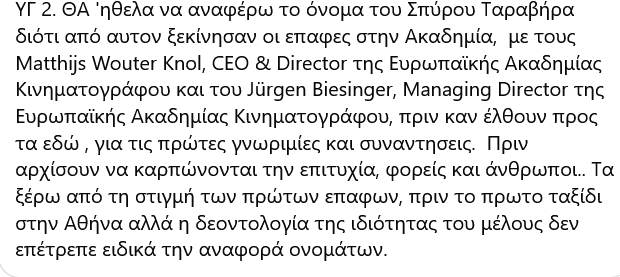
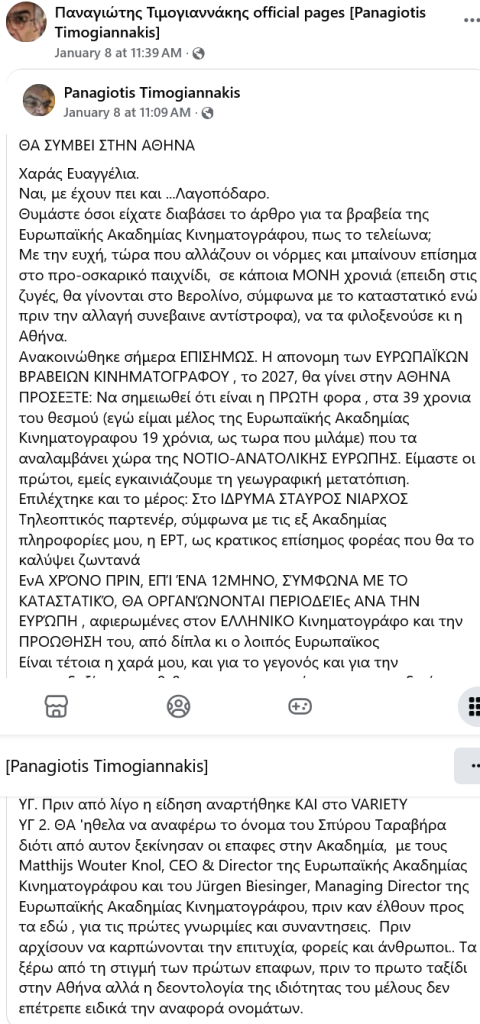
In the shadowy depths of Greek cinema politics, where ambition and influence collide, a tangled web of alliances and secretive deals is beginning to unravel. The stage was set when veteran film critic, and EFA member, Panagiotis Timogiannakis posted on his Facebook on January 8, 2025 at 11:09 am local time) revealing exclusive details about Spiros Taraviras—an Athens-based director—who allegedly played a key role in securing Athens as the host city for the 2027 European Film Awards (EFA).
Taraviras wasn’t just a behind-the-scenes operator; he served on a committee, in August 2024, handpicked by none other than Minister of Culture Iason Fotilas, the same Fotilas whose ministry approved Murderess (Fonissa), a Tanweer production, as Greece’s official entry for the Best International Picture Oscar. A connection? A coincidence? Or something more deliberate lurking behind the curtain?
But this is only the surface of a much deeper, darker story.
According to industry sources who wish to remain anonymous —hallmarks of a system shrouded in secrecy—Taraviras initially pitched the EFA event directly to Tanweer, attempting to link it to the company behind Murderess. When the proposal failed, despite Tanweer reportedly funding Taraviras’ “negotiations” across Europe, the narrative shifted. Enter, months later, Minister Fotilas, stepping in after the Oscars fiasco like a deus ex machina. Suddenly, the EFA event shifted from a private venture to a state-sponsored spectacle. The ruling party’s golden boys were positioned to amass millions and run, bolstered by the official seal of the Ministry of Culture and the unwavering support of the state-controlled broadcaster, ERT.
The ethical concerns here are undeniable. How can a director, serving on a committee appointed by the Minister of Modern Culture, engage in negotiations with a company whose production he actively influenced during the selection process—without disclosing such a clear conflict of interest to Ministry officials? The situation becomes even more alarming when we learn that this same committee member, who cast a vote for the Oscars submission, had previously worked for the nominee company, earning a fee of thousands of euros before the voting took place. Shouldn’t he have stepped aside from the entire process? Is this a case of diplomacy or outright duplicity? A conflict of interest or blatant misconduct?
The 2027 EFA event may glitter on the surface, but beneath lies the unmistakable stench of a system built on favors, influence, and backroom deals. This is not just about cinema and art—it’s about politics, control, and the bonfire of the vanities…