By Film Industry Watch
Why Festival Gatekeepers Remain Unchecked Despite Alleged Conflicts of Interest
Over the past few years, Film Industry Watch has reported on what appear to be alleged structural conflicts of interest inside major international film-festival and talent-development programs. Several figures – including Dominique Welinski and, more recently, Yulia Evina Bhara – have been repeatedly referenced in public discussions about overlapping roles across curation, mentorship, jury role, production, and festival governance.
Despite these concerns, the individuals involved continue to hold influential positions. This article does not allege wrongdoing. Instead, it seeks to examine what it means for the film-festival ecosystem when publicly raised concerns about systemic conflicts seemingly result in little or no corrective action.
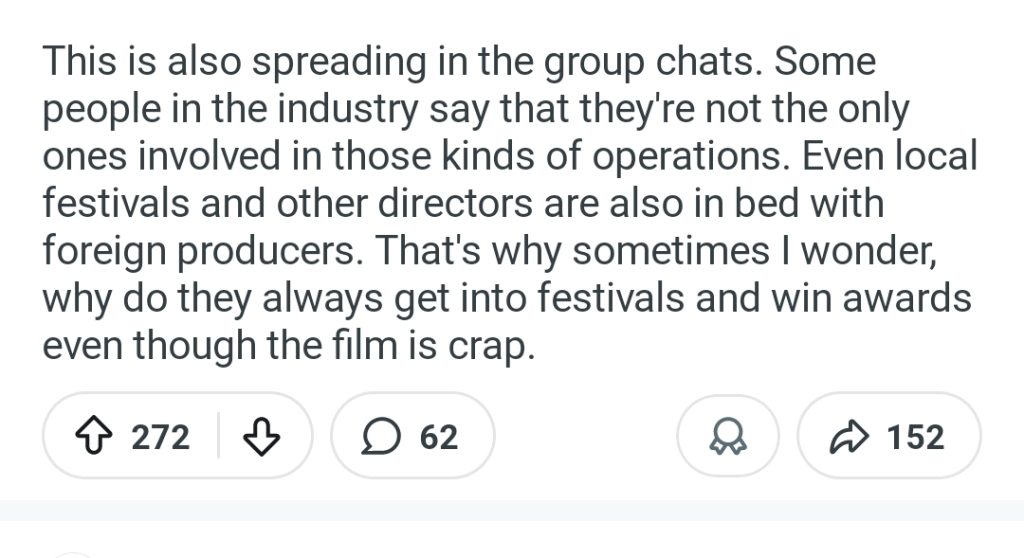
A Pattern Documented Through Public Records and Industry Testimonies
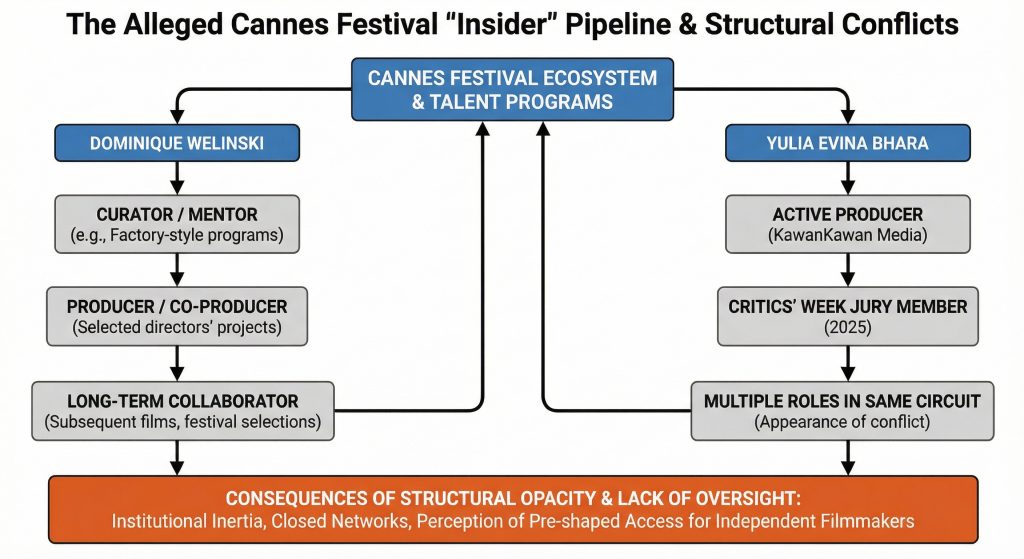
Film Industry Watch articles have previously outlined alleged overlaps in professional roles within the Cannes ecosystem. These include:
- Participation in festival-adjacent talent programs,
- Engagement as producers or co-producers on selected directors’ projects, and
- Ongoing long-term collaborations that continue across multiple films.
In “Cannes 2025: Anonymous Source(s) Reveal New Conflict of Interest at Cannes,” public credit sheets appeared to show that certain individuals maintained simultaneous roles as program architects, mentors, and producers.
These observations were based on publicly available information and anonymous testimonies from filmmakers. They do not imply unlawful conduct. They illustrate how festival-related power structures may become tightly interconnected.
Long-Term Producer–Director Pipelines
One recurring concern raised by filmmakers is that certain figures may not only produce shorts created inside curated programs but continue producing or collaborating on the same directors’ later projects. For example, public records indicate:
- Arvin Belarmino was involved in a Factory-style program curated by Welinski, after which she was credited on subsequent projects selected at Cannes.
- Yona Rozenkier appears in a similar pattern, collaborating across multiple films connected to festival-linked structures where Welinski has been publicly reported to hold advisory or curatorial roles.
These examples do not establish unethical behavior. They do, however, highlight alleged structural overlaps that may create the appearance of preferential pathways for certain filmmakers, with financial potential to the producers involved, which extends beyond the original curated / produced program, which some critics see as a problem in itself. The concern raised by some observers is that such collaboration can appear intertwined with festival selection environments, especially when those environments lack formal oversight or transparency mechanisms.
Yulia Evina Bhara: Producer and Jury Member
Public information confirms that Yulia Evina Bhara, founder of KawanKawan Media, served as a Critics’ Week jury member in 2025 while also being an active film producer.
This dual presence does not violate any published regulations. Many festivals appoint active producers as jurors.
However, when a producer is involved in multiple companies or collaborators operating inside the same festival ecosystem, some observers believe this could create the appearance of a conflict, even in the absence of misconduct. The dual roles have been questioned by filmmakers who believe that festival jurors should ideally be insulated from ongoing production relationships that intersect with the same institutional circuits.
Why Do Individuals Retain Their Positions Despite Concerns?
Several structural factors may explain the persistence of these arrangements:
1. Institutional Inertia and Mutual Dependence
Festivals often rely on experienced producers and curators who maintain international networks. Removing or replacing them could create operational instability.
2. Lack of Formal Definitions for “Conflict of Interest”
Many festivals do not maintain the kind of formalized ethics policies found in other industries. The absence of strict recusal protocols means that apparent conflicts may not be treated as actionable.
3. Closed Professional Networks
The system appears to rely heavily on long-standing relationships and recurring collaborations. Such patterns are not inherently unethical, but they can reduce the space for independent filmmakers outside these networks.
4. No External Oversight
There is no independent regulatory body for festival ethics. Accountability mechanisms are largely internal, informal, or non-existent.
For these reasons, even widely circulated concerns may not lead to meaningful structural change.
The Impact on Independent Filmmakers
For filmmakers without institutional backing or established industry relationships, these structural overlaps can contribute to a feeling that:
- Festival access is pre-shaped,
- Selection pipelines may be influenced by long-term relationships, and
- Formal transparency is limited.
Even if no legal wrongdoing occurs, the perception of limited access can have real consequences for emerging talent.
What Would Improve Transparency?
Our question to the film industry is this: aren’t enough people in the industry to jury or curate these programs OTHER than the producers who also produce the films and gain from them financially? Who are not ALSO working for the festival in multiple roles? Is the entire film industry the SAME 10-20 people?
Several non-punitive reforms could strengthen trust in festival systems:
- Clear disclosure of jury members’ and curators’ production partnerships;
- Formal recusal rules for evaluators with ongoing collaborations;
- Separation of festival-curated production programs from guaranteed premieres;
- Third-party oversight, even in voluntary form;
- Annual public reports on selection processes.
These steps promote transparency and fairness.
Conclusion: A System Resistant to Structural Change
The ongoing presence of individuals whose roles have been publicly questioned – not just in Film Industry Watch but across filmmaker communities – suggests that the broader system may prioritize continuity over introspection. The issue is not any one person. The issue is structural opacity, making it difficult for filmmakers and audiences to understand how decisions are made, how programs are linked, and how influence circulates. Film Industry Watch remains committed to reporting on such patterns – respectfully, factually, and with an emphasis on industry structures rather than personal accusation.
CALL FOR INFORMATION
If you are a filmmaker, industry worker, programmer, jury member, staffer, intern, or collaborator who has information, concerns, or documentation relating to alleged conflicts of interest or structural issues within film festivals, labs, agencies or production programs. you may contact Film Industry Watch anonymously. Encrypted / anonymous communication are available, your privacy and safety are our highest priority.
DISCLAIMER
Please report any error in the article. This article is based on publicly available information, filmmaker testimonies, and previously published reporting. It does not allege wrongdoing, illegal activity, or unethical conduct by any named individual or institution. All references to conflicts of interest refer to alleged or potential structural overlaps, not proven violations. The intention of this article is to encourage transparency and discussion within the film industry.
Sources:
https://variety.com/2025/film/festivals/cannes-critics-week-next-step-studio-indonesia-1236558526/
https://variety.com/t/yulia-evina-bhara/
https://filmindustrywatch.org/cannes-2025-strikes-again/
https://filmindustrywatch.org/is-canness-factory-a-pay%E2%80%91to%E2%80%91play-scheme/