By FIW staff, thanks to readers contribution.
Popular YouTube channel Film Threat recently covered our article “Sundance’s Little Dirty Secret: How NYU’s Elite Grip is Crushing Indie Dreams” and added their analysis to the growing body of evidence that Sundance, while still claiming to champion “independent cinema” and underprivileged voices, is anything but. The Sundance Film Festival has long billed itself as the premier stage for fresh, diverse storytelling. But as our investigation revealed, that image may be a “glaring farce” – Sundance’s lineups are overwhelmingly dominated by alumni of NYU’s Tisch School of the Arts, one of the priciest and most elite film programs in the country. Film Threat’s commentary emphatically reinforced this point, with hosts Chris Gore and Alan Ng slamming Sundance for perpetuating an insider pipeline that “filters out” true indie voices. The picture that emerges is damning: Sundance appears less a democratic showcase of unknown talent and more an exclusive club reunion for those with the right connections and credentials.
An Elite Pipeline Exposed
Our original report laid out stunning statistics. In 2025, 143 NYU Tisch-affiliated filmmakers swarmed 39% of all Sundance projects – including half of the films in the U.S. Dramatic and Documentary Competition. By contrast, graduates of other top film schools like UCLA and USC were attached to far fewer entries. This lopsided representation is “not organic success, it’s systemic favoritism” as we wrote. Sundance’s vaunted labs and development programs have been similarly skewed. Five out of the 2025 Sundance Screenwriters Lab participants came from NYU, reinforcing what critics call a “networking on steroids” effect that turns Sundance into “an extension of NYU’s campus”. Such concentration of power in one school’s hands is unprecedented given the 1,300+ film programs across the United States. It’s “downright laughable,” we noted, that a single Manhattan-based institution could monopolize opportunities meant for a nation’s worth of diverse creators.
Even more troubling are allegations about how Sundance selects its films. The festival reportedly receives 14,000–16,000 submissions each year (with entry fees up to $125 per film), yet fewer than 1% are accepted. Insiders whisper that not every submission even gets a complete viewing – many entries may be unwatched or only partially viewed, while films with backdoor recommendations from elite circles get fast-tracked. As our article quipped, believing every film is fairly considered is “as naive as believing a lunar real estate scheme”. The result is an illusion of meritocracy: Sundance touts surface-level diversity stats (over 40% women directors, many filmmakers of color), but beneath that lies a “skin-deep” diversity. The same coastal, well-heeled enclave is producing those “diverse” voices, meaning indie has become “institutionally approved” rather than truly independent.
Film Threat’s hosts seized on these findings, expressing little surprise but plenty of frustration. “Does this surprise anybody?” Chris Gore asked rhetorically, noting that Sundance has always favored insiders to some extent – but it’s gotten far worse. “You always had to have an ‘in’, but there was a chance a random movie could make it through the process. [Now] it’s gotten more exclusionary,” Gore explained. The festival pumps out press releases about inclusion, yet “while they tout terms like diversity, there’s truly no content diversity, there’s no diversity of points of view,” he said pointedly. In Gore’s view, Sundance’s supposed independent selection is largely a sham – a curated showcase of the well-connected. He and his co-host agreed this insider game isn’t just unfair, it’s also hurting the art: “They’re being so exclusionary, only letting in people from NYU or people they know or based on the identity of the person who made the movie. And what ends up [happening] is the movies are not very good,” Gore observed bluntly. Sundance champions identity and pedigree over originality, and accordingly, “the movies at Sundance are underwhelming… They’re just not good movies because of favoritism”.
Quality Control: “Underwhelming” Films and Frustrated Filmmakers
One of the most striking critiques from the Film Threat discussion was how mediocre the Sundance slate has become in recent years, in the eyes of seasoned reviewers. “Every year you comment [that] I was whelmed,” Gore teased Alan Ng, referring to the forgettable quality of Sundance selections. Alan concurred: he shared that during the last festival, “I didn’t review a single film from Sundance ’cause… I was barely whelmed by anything I saw”. Comedies, he noted, had devolved into trivial silly fare, and nothing left a strong impression. When the supposedly best indie festival in the world consistently delivers lukewarm lineups, it raises serious questions about how those films got there in the first place. Gore and Ng’s answer? Favoritism and a closed feedback loop of elite tastes picking films that cater to the same. As Gore put it, the lack of genuine diversity of perspective means “the festival circuit is [no longer] where the best movies bubble to the surface. It’s just not.” In other words, truly innovative independent cinema isn’t getting a fair shot at Sundance – and perhaps is finding alternate paths outside the traditional festival gatekeepers.
The frustration among filmmakers is palpable. If Sundance is essentially pre-selecting films from its pet sources, what hope does a truly independent outsider have? Many in the film community have suspected this for years, and our exposé along with Film Threat’s coverage seems to validate those suspicions. On Reddit, one filmmaker reacted to the NYU revelation by writing: “The hard lesson was learning that the major festivals are 90% pre-programmed. Long gone are the days of movies like Napoleon Dynamite getting plucked from the middle of nowhere and starting a billion dollar career.” In other words, the era when an unknown could submit a brilliant film and launch a dream career at Sundance is effectively over. Another commenter didn’t mince words about the statistical improbability of Sundance’s NYU fixation: “Yeah, it’s beyond fishy. It’s statistically impossible. And it’s been an open secret for a long time. Every time I ask older filmmakers about Sundance, they all say not to bother, because you have to know somebody to get serious consideration.” This sentiment – that without connections “you have to know somebody” on the inside – reflects a growing cynicism among creators. Many now view Sundance as a pay-to-play illusion, where who you know (or where you studied) matters far more than raw talent.
Indeed, the Film Threat hosts raised the same concern. Alan Ng mused that Sundance’s submission process might even warrant legal scrutiny. “I smell… a class action lawsuit,” he said only half-jokingly. Filmmakers are paying hefty entry fees (often $80–$125 per under the assumption of a fighting chance. If, as alleged, thousands of those submissions aren’t truly given full consideration, that could be a serious breach of trust. “It feels like… you’re giving them $80 and your movie is not being seen,” Ng remarked in disbelief. With 16,000 hopefuls submitting each year, the idea that only NYU’s circle consistently produces all the “worthy” films is, frankly, absurd. “Is it possible that only [one] school is making the elite of the elite movies out of these 16,000?” Ng asked pointedly, before answering his own question: obviously not. Something is clearly wrong when Sundance’s selection shenanigans (as we dubbed them) allow such a skewed outcome.
Sundance’s Shrinking Relevance?
A powerful takeaway from Film Threat’s analysis is that Sundance may be undermining its own relevance through these practices. Gore argued that the festival circuit in general “is not as important as it used to be” for discovering great films. Part of the reason is technological and cultural shifts – filmmakers can self-distribute online or find audiences through smaller regional festivals. But another reason is self-inflicted: by narrowing the pipeline and uplifting what Gore called “bad indie movies because of favoritism and identity”, Sundance is “doing damage to their brand”. The hosts noted that high-profile festivals like Sundance, Toronto, Cannes, and SXSW still draw attention, but if they keep picking lackluster films from the same incestuous circle, filmmakers and cinephiles will simply look elsewhere. “The good news is you don’t need festivals,” Gore emphasized. Great films can and will find their way to audiences without passing through Park City’s elitist filter. In fact, many truly independent creators are already bypassing Sundance, opting for direct digital releases or alternative festivals rather than subjecting themselves to a rigged game.
The core issue, as summarized by our original piece and echoed by Film Threat, is one of credibility. Can Sundance continue to pretend it’s a champion of all indie voices when insiders see it as “a rigged game… propping up a privileged few”? The chorus of critics is growing louder. What was once whispered as an “open secret” is now shouted from YouTube shows and Reddit threads. Even industry veterans like Gore (who literally wrote the book on film festivals) concede that sending your film to Sundance blindly is naive. Unless Sundance undergoes a radical shake-up – “dismantle its elite dependencies… publish full selection stats… scout beyond NYC networks,” as our article implored– it risks losing the very thing that made it iconic: the independent spirit. For now, Sundance’s claim of being a meritocratic launchpad for all creatives rings hollow. In the words of one Reddit user, aimed at any hopeful without an NYU degree: “Good luck.”
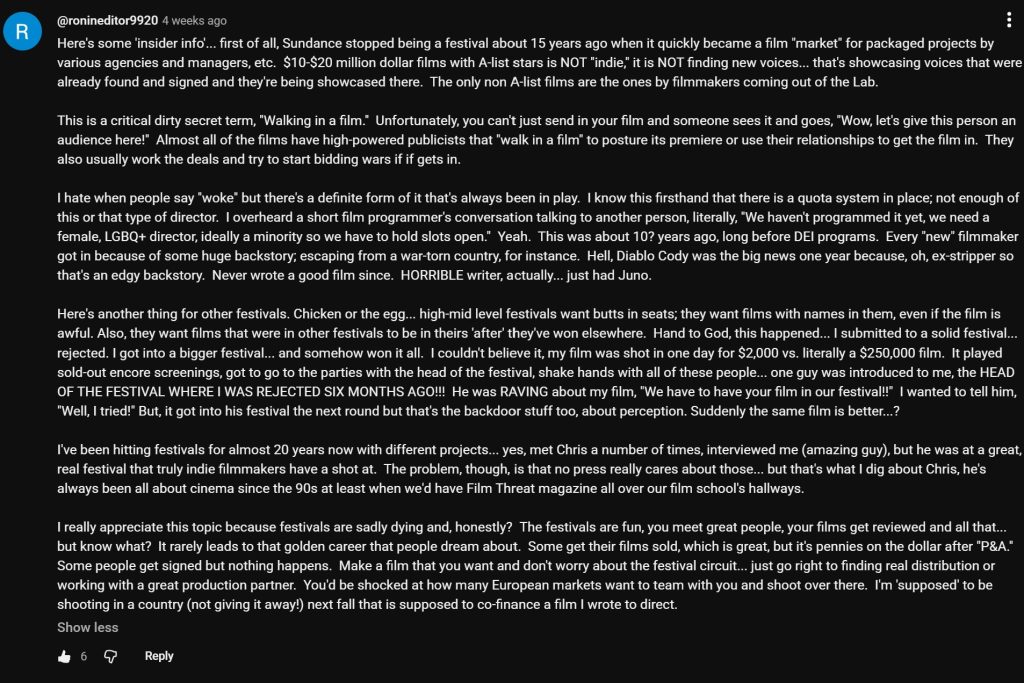
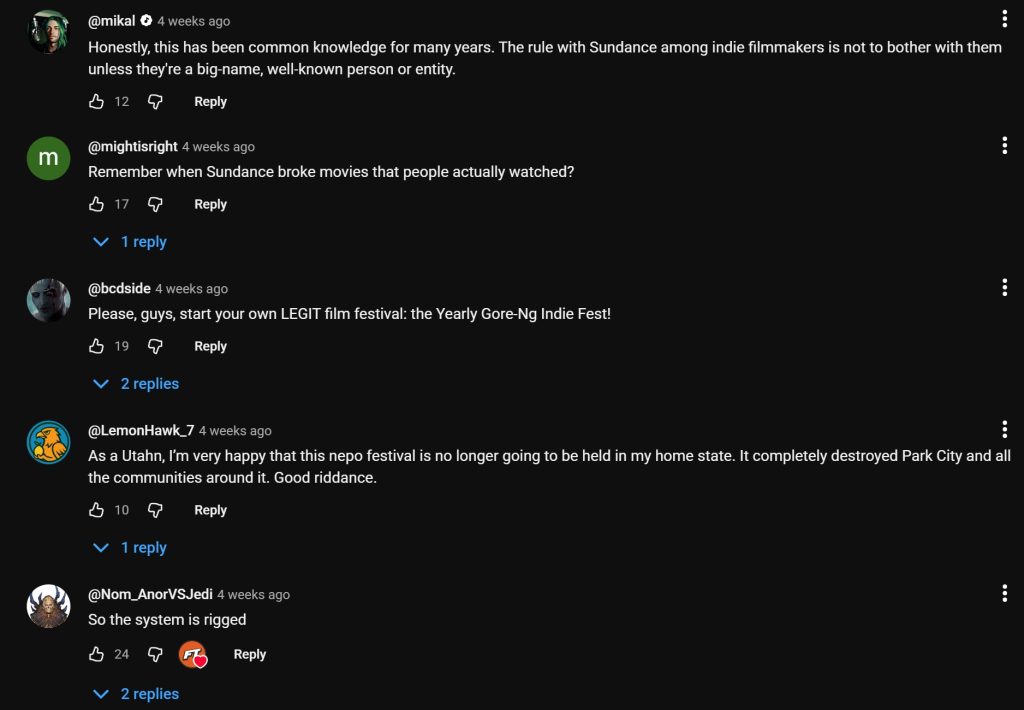
Sources
- Film Industry Watch – “Sundance’s Little Dirty Secret: How NYU’s Elite Grip is Crushing Indie Dreams” (July 25, 2025). Film Industry Watch’s investigative article that first exposed the disproportionate presence of NYU Tisch alumni in the 2025 Sundance lineup and alleged systemic favoritism in the festival’s selection process.
- Film Threat (YouTube) – “All Eyes on Elites – Sundance’s Dirty Secret” (Chris Gore & Alan Ng discussion). Transcript of Film Threat’s video segment reacting to the Film Industry Watch report, featuring Chris Gore’s and Alan Ng’s commentary on Sundance’s elitism, lack of diversity of viewpoints, and declining film quality due to favoritism.
- Reddit – r/Filmmakers discussion, “Sundance’s Dirty Secret: How NYU’s Elite Grip is Crushing Indie Dreams.” Online forum thread where filmmakers discuss and react to the article’s claims. Notably, users highlight that major festivals are “90% pre-programmed” and that the era of unknown indies getting discovered (e.g., Napoleon Dynamite*) is “long gone,” reinforcing the notion of festival favoritism.
- Reddit – r/FilmFestivals discussion, “Sundance’s Dirty Secret: How NYU’s Elite Grip is Crushing Indie Dreams.” Another community thread focused on film festivals, in which commenters call the Sundance situation “beyond fishy” and an “open secret.” One commenter notes that older filmmakers advise “you have to know somebody” at Sundance to have a real shot, underlining the prevalence of insider culture.