By FIW staff
The Sundance Film Festival bills itself as the ultimate stage for independent cinema, a supposed democratizer of storytelling where fresh, diverse voices can break through. But scratch the surface, and you’ll find a glaring farce: an overwhelming dominance by alumni from NYU’s Tisch School of the Arts, a single institution in a country boasting over 1,000 film programs. This isn’t just an imbalance, it’s a blatant mockery of true independence, funneling opportunities through an exorbitantly priced New York pipeline while sidelining the rest of America’s creative talent. With NYU grads infiltrating nearly 40% of projects, Sundance risks becoming less a festival and more an exclusive alumni reunion, perpetuating elitism under the guise of inclusivity.
NYU’s Overreach: One School’s Absurd Monopoly in a Nation of Thousands
In a nation as vast as the United States, home to more than 1,300 film schools and programs, from community colleges to state universities, it’s downright laughable that one Manhattan-based powerhouse claims such outsized influence. NYU Tisch, with its eye-watering undergraduate tuition exceeding $72,000 annually, isn’t just expensive; it’s a gatekeeper that filters out aspiring filmmakers without deep pockets or urban connections. Yet, in 2025, 143 Tisch alumni, students, and faculty swarmed 39% of all Sundance projects, including half the films in the U.S. Dramatic and Documentary Competitions. Standouts like Hailey Gates (BFA Drama, 2012), whose Atropia snagged the 2025 U.S. Grand Jury Prize: Dramatic, and Rashad Frett (MFA Graduate Film, 2021), director of the Directing Award-winning Ricky, exemplify how this elite club reaps the rewards.
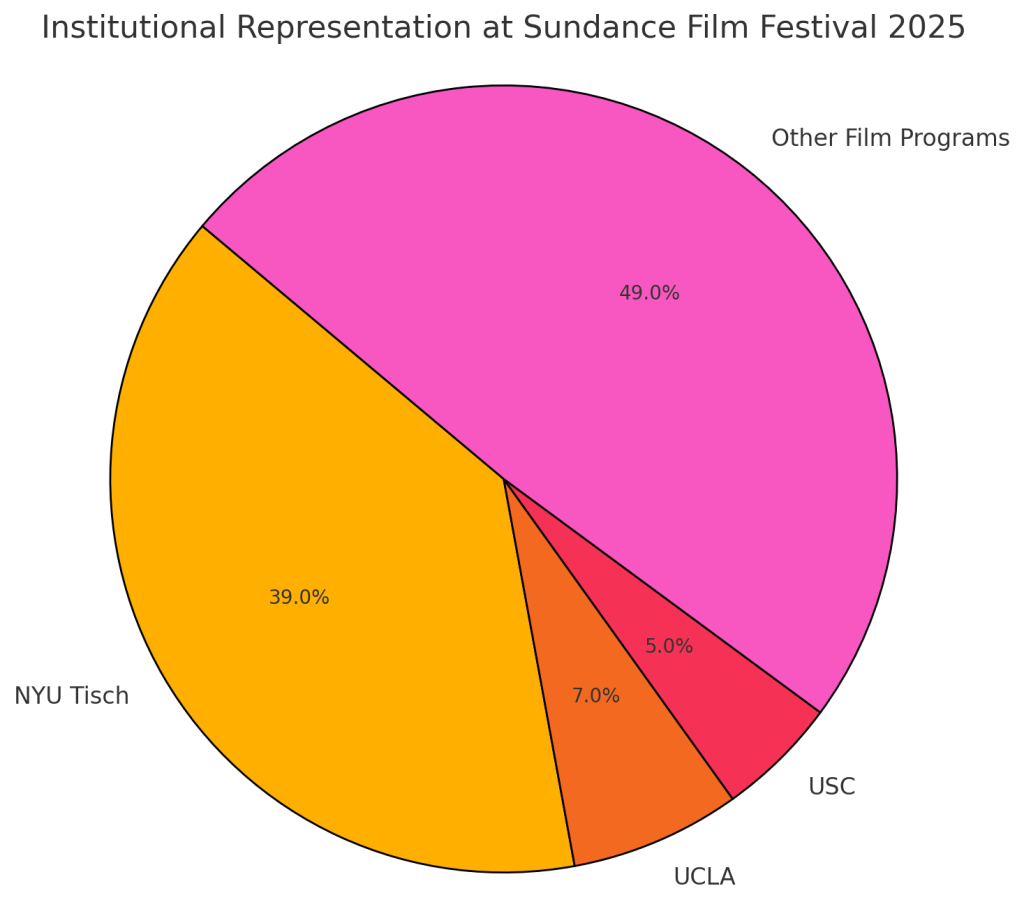
Compare that to other top schools: UCLA managed ties to 25 projects in 2025, while USC boasts alumni involvement but lacks the same blanket coverage. This isn’t organic success, it’s systemic favoritism. Sundance’s labs and intensives, meant to nurture emerging talent, routinely handpick Tisch alums; five were selected for the 2025 Screenwriters Lab alone. In a landscape with 828 colleges offering film and photography degrees, why does one school, representing a tiny fraction of the total, hoard such a massive slice? It’s not merit; it’s networking on steroids, turning Sundance into an extension of NYU’s campus rather than a national showcase.
- The “40%” or “39%” numbers refer to the share of total Sundance projects (all sections) with at least one NYU Tisch-affiliated team member.
- For U.S. Dramatic Feature directors alone, the true NYU grad percentage is 20–30% per year, since around 2015.
- The numbers in the article reflect total alumni participation across many roles and program categories, not only directing credits.
- 2011 was a notable outlier with a reported 90% NYU presence – a surge not replicated in subsequent years.
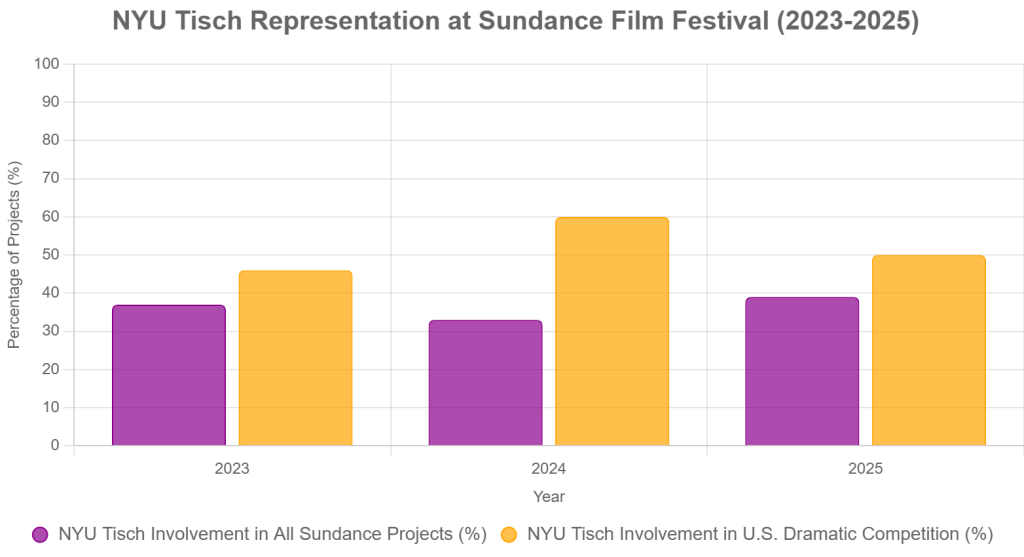
Selection Shenanigans: Transparency as Thin as Park City Air
Sundance rakes in 14,000-16,000 submissions yearly, charging fees up to $125 per entry, yet whispers from the industry suggest, allegedly – OF COURSE – not every film gets a fair shake. Filmmakers report entries going unwatched or only partially viewed, with selections skewed toward those with insider recommendations, often from elite networks like NYU. In forums and industry chats, creators decry a process where low acceptance rates (under 1% for features) mask biases, prioritizing pedigreed projects over raw innovation.
This opacity fuels the elitism: With NYU’s “Tisch on Main” events turning the festival into a schmoozefest, anonymous submissions from non-elite programs stand little chance. Critics on platforms like Reddit lambast this as a “pay-to-play” illusion, where expensive educations buy not just skills but festival fast-tracks. The result? A homogenized indie scene that echoes New York’s urban elite, ignoring the heartland voices from hundreds of overlooked schools. Is there any wonder that the art of film is dead and cinemas are empty?
The Revolving Door: How Influence Recycles Itself
The ties run deeper than alumni stats. Shared events and overlapping paths create a cozy loop: NYU hosts Sundance-adjacent gatherings, while Tisch grads like Sean Baker (Tangerine, a Sundance breakout) cycle back as mentors or influencers. Broader critiques highlight how top schools rotate talent into festival roles, fostering perceptions of favoritism. Though no outright scandals surface, this interconnected web, where academic credentials trump outsider ingenuity, undermines Sundance’s indie ethos, making it complicit in perpetuating class divides.
“Diversity” That’s Skin-Deep
Sundance pats itself on the back for demographics – over 40% women directors and strong POC representation in recent lineups, bolstered by initiatives like stipends for diverse journalists. But this progress is hollow when so many “diverse” filmmakers hail from the same pricey, coastal enclave. USC Annenberg studies praise Sundance as a pipeline for underrepresented groups, yet they also underscore the need for broader access beyond elite hubs. With thousands of programs nationwide churning out talent from diverse regions and backgrounds, NYU’s grip ensures “indie” often means “institutionally approved,” not truly independent.
This concentration isn’t just unfair – it’s absurd, a punchline in a country rich with cinematic potential from coast to coast. Sundance must dismantle its elite dependencies: Mandate lab spots for non-top-tier schools, publish full selection stats, and scout beyond NYC networks. Until then, the festival remains a rigged game, crushing the dreams of countless filmmakers while propping up a privileged few. Independent cinema deserves better than this echo chamber.
Such Concentration of Power is No Accident
Just this week, we spotlighted the Jerusalem Film Festival, where 5 out of 8 films in competition were helmed by directors with direct ties to the Sam Spiegel Film School or its affiliated labs – a telling example of how festival clout is hoarded by a single institution closely linked to the event’s management. Yet, as problematic as that is, the comparison with Sundance makes the American case all the more indefensible. Israel, after all, is a nation of just 9.7 million people with a handful of film schools; a degree of centralization, while not healthy, is at least structurally plausible in such a tiny ecosystem. But in the United States – a nation of 340 million, with over a thousand film programs – the stranglehold that NYU Tisch exerts over Sundance defies every norm of diversity, fairness, and open access.
This pattern is well-documented in social science literature, where elite closure and institutional capture are recognized as mechanisms that perpetuate inequality and stifle mobility. Pierre Bourdieu’s seminal concept of “cultural capital” explains how privileged groups monopolize not only material resources, but also access to taste, credentials, and social networks—ensuring that cultural fields like cinema reproduce existing hierarchies rather than disrupt them (Bourdieu, 1977). In Bourdieu’s framework, the prestige of schools like NYU or Sam Spiegel functions as a gatekeeping device, conferring legitimacy and opportunity disproportionately to insiders.
From an economic perspective, this dynamic mirrors what Robert Michels termed the “Iron Law of Oligarchy”: in any organization or industry, control and decision-making invariably become concentrated in the hands of a few, regardless of formal commitments to democracy or openness (Michels, 1911). This self-reinforcing concentration is further exacerbated by what Michael Useem describes as the “Inner Circle” of interconnected elites, whose reciprocal exchanges of opportunity and endorsement reinforce their dominance across institutions (Useem, 1984).
Contemporary research in network theory by scholars like Mark Granovetter further underscores how “the strength of weak ties” paradoxically fuels exclusion: in closed, high-trust circles, jobs and opportunities circulate through referral and informal ties, systematically excluding those outside the dominant clique (Granovetter, 1973). This is especially acute in creative and cultural sectors, where subjective assessment and informal recommendation play a central role in gatekeeping.
Together, these theories reveal that the present condition at Sundance – and in similar festivals and across the entire film industry ecosystem – reflects not random happenstance, but predictable, well-studied patterns of institutional behavior. Until explicit intervention disrupts these entrenched feedback loops, the promise of independent cinema as a truly open field will remain unfulfilled.
How Does the Corruption Work in Real Terms?
Corruption within this system isn’t usually a matter of explicit bribery or criminal conduct – it’s about the quiet machinery of informal favoritism, institutional inertia, and back-channel recommendation. If Sundance truly practiced what it preaches – openness, discovery, diversity – its lineup would naturally feature filmmakers from the vast array of educational programs throughout the United States. Yet, as the chart below makes clear, an incredible 51% of Sundance’s program is monopolized by alumni from just three elite film schools. In a nation with more than a thousand accredited film programs, this isn’t just a statistical glitch – it’s a structural feature.
Here’s how the machinery operates on the ground: most filmmakers don’t stand a chance because their films are not even watched by the real decision makers. As we’ve documented extensively – and as the case of high-profile outsiders like Obama’s daughter demonstrates – submissions don’t receive honest consideration. The vaunted “open call” is largely illusory. Only a tiny fraction of the 14,000 annual entries ever makes it to a programmer’s laptop, while the others are watched by volunteers or low paid students, so the festival can later claim that all films are being watched and considered. Certain films, probably no more than 200-300 per year, are “floated” to decision-makers not on merit, but by virtue of personal connections – friends, family, and, most crucially, colleagues and mentors from the same closed network of elite programs. To believe that every submission is scrupulously viewed is as naïve as believing in lunar real estate schemes. The reality is a process engineered for exclusion and plausible deniability. (If you don’t believe us – please contact us. We have a wonderful plot of land to offer you in an excellent location on the dark side of the moon which is now going for 45% off.)
The outcome is inevitable: year after year, Sundance becomes a mirror not of the nation’s artistic breadth, but of the entrenched, incestuous circles that orbit a handful of privileged institutions. The pipeline is not only narrowed by design – it is actively policed, ensuring that only those already holding the right keys even approach the gate. This isn’t just a distortion of opportunity. It’s a system of manufactured scarcity and institutional favoritism, masquerading as meritocracy – a “corruption” far deeper and more routine than the industry cares to admit.
We want to thank the filmmaker who had tipped us about this issue. Please continue to contact us about any wrongdoing in the industry, anywhere in the world.
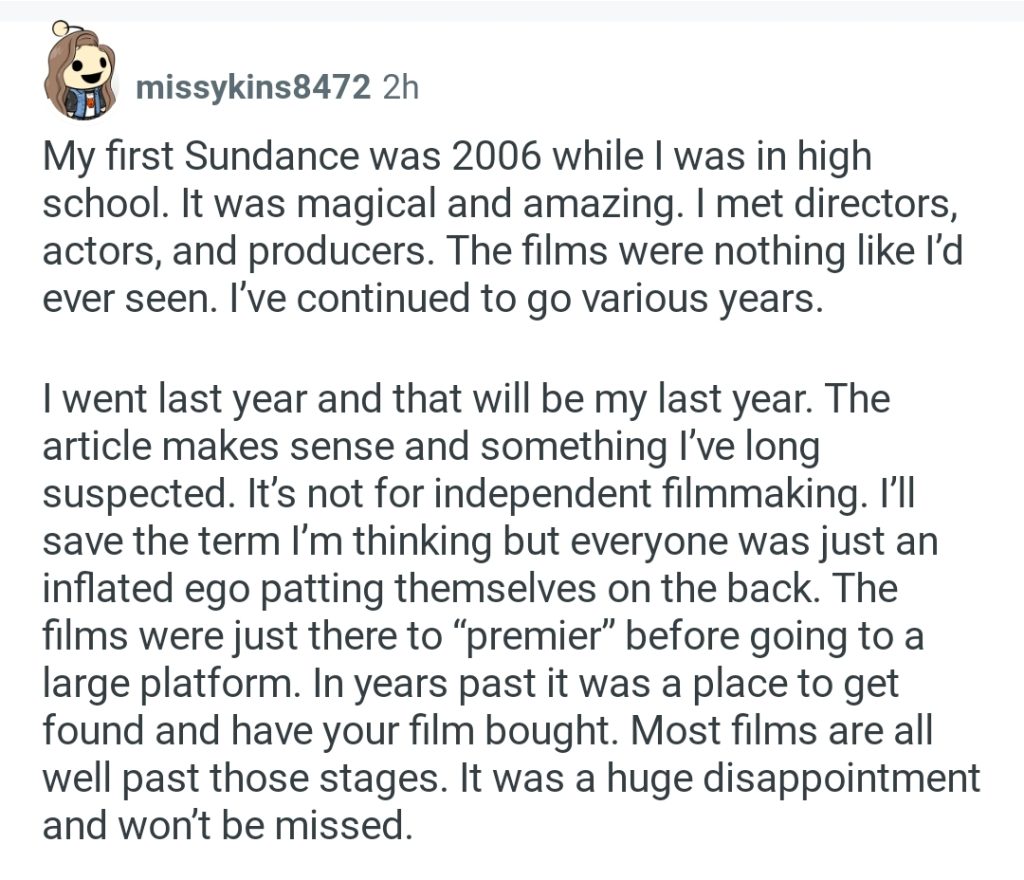
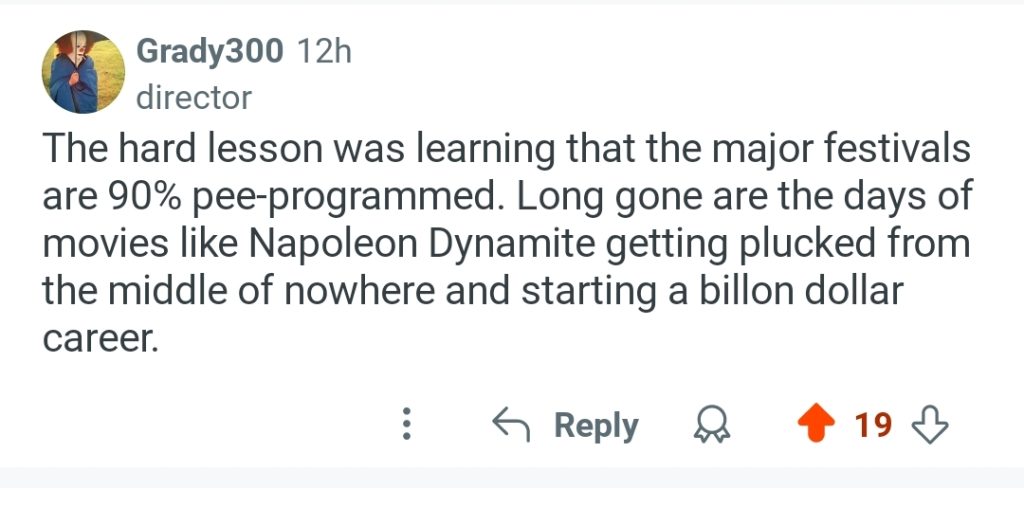
Reactions to the article
Sources & Further Reading:
- https://www.nyu.edu/admissions/financial-aid-and-scholarships/cost-of-attendance.html
- https://en.wikipedia.org/wiki/List_of_film_schools_in_the_United_States
- https://www.niche.com/colleges/search/best-colleges-for-film/
- https://filmmaking.net/film-schools/
- https://tisch.nyu.edu/alumni/tisch-at-sundance/2025-tisch-at-the-sundance-film-festival/alumni-affiliations.html
- https://tisch.nyu.edu/grad-film/news/2024/grad-film-at-2025-sundance.html
- https://www.tft.ucla.edu/tft-at-sundance-2025/
- https://cinema.usc.edu/festivals/sundance/index.cfm
- https://tisch.nyu.edu/alumni/alumni-news/tisch-alumni-2025-sundance-screenwriters-lab-and-intensive.html
- https://www.sundance.org/festivals/sundance-film-festival/submit/
- https://nofilmschool.com/who-watches-your-film-film-festivals
- https://www.reddit.com/r/Filmmakers/comments/175me0v/the_dos_donts_and_uncomfortable_truths_of_film/
- https://filmthreat.com/uncategorized/rejected-from-sundance-you-may-be-angry-but-that-doesnt-mean-youre-right/
- https://tisch.nyu.edu/alumni/events/tisch-at-sundance-2025.html
- https://www.vox.com/culture/2017/1/19/14267740/sundance-film-festival-explained-robert-redford
- https://indiefilmhustle.com/sean-baker-tangerine-iphone-filmmaking/
- https://assets.uscannenberg.org/docs/aii-study-sundance-institute-jan2019.pdf
- https://www.vox.com/2016/1/29/10866582/sundance-diversity-film-festival
- https://www.reddit.com/r/Filmmakers/comments/wucfja/what_are_the_pros_and_cons_of_usc_ucla_and_nyus/
- https://www.quora.com/What-is-your-opinion-on-film-schools-like-USC-NYU-AFI-UCLA-etc-Do-you-think-they-are-worth-it-for-future-filmmakers-Why-or-why-not
Further reading:
Pierre Bourdieu, “Cultural Reproduction and Social Reproduction.” In Power and Ideology in Education, 1977.
Robert Michels, Political Parties: A Sociological Study of the Oligarchical Tendencies of Modern Democracy, 1911.
Michael Useem, The Inner Circle: Large Corporations and the Rise of Business Political Activity in the U.S. and U.K., 1984.
Mark Granovetter, “The Strength of Weak Ties,” American Journal of Sociology, 1973.