Film Industry Watch recently received the following anonymous email:
Dear Editors,
As this year’s edition is Hungarian Friss Hus Budapest Short Film Festival’s first as an Oscar-qualifying festival, it might be important to shed some light on a conflict of interest that has been building up for 10 years around a producer whose shorts have been winning awards in nearly half of the festival’s 13 year run.
This same producer is the managing director of the festival and in earlier years, the international programmer, so has a lot of formal and informal power to influence the reception of his works.
The awarded films at Friss Hus, produced or co-produced by him (Gabor Osvath) are the following, in release order:
https://www.imdb.com/title/tt4190832/fullcredits/
https://www.imdb.com/title/tt5653084/fullcredits/
https://www.imdb.com/title/tt8155196/fullcredits/
https://www.imdb.com/title/tt8150654/fullcredits/
https://www.imdb.com/title/tt13021784/fullcredits/
https://www.imdb.com/title/tt37125086/fullcredits/(the one now eligible for the Oscar shortlist)
There were other shorts connected to him that were selected in or out of competition but not awarded, thus not mentioned here.
Wishing you the best to continue the important work that you do,
“Filmethics”
A statistical abnormality
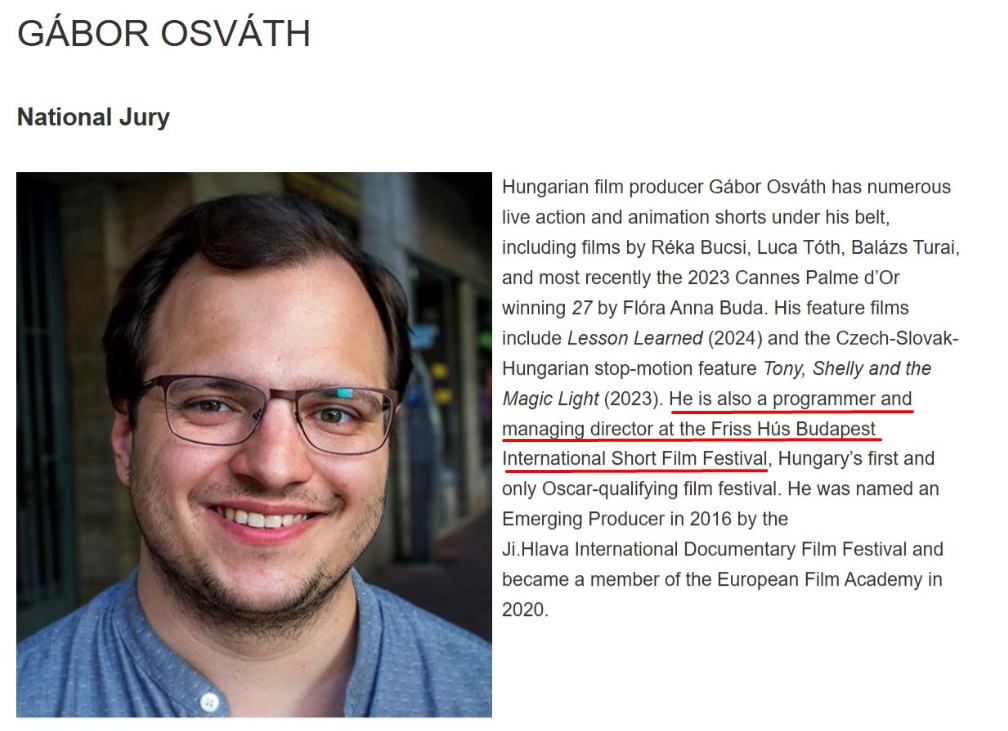
Statistically, a single producer’s films sweeping almost half of the editions over 10 years, in a festival where 29-36 Hungarian shorts vie for two top prizes each year, is extremely rare without some systematic advantage. That “advantage” could be pure filmmaking excellence, but when the same person also happens to be Managing Director (and former programmer) of the festival, the data fit the conflict-of-interest hypothesis far better than random luck. First, let’s examine the facts. Gábor Osváth is indeed “programmer and managing director at the Friss Hus Budapest Film Festival” as can be seen below:
Claim-by-claim breakdown
| # | Statement in the letter | Accuracy | Evidence |
|---|---|---|---|
| 1 | “This year’s edition is the festival’s first as an Oscar-qualifying festival.” | True – the Academy granted qualifying status in Oct 2024; the 13th edition (29 May – 4 Jun 2025) is the first to take place under that status. | (frisshusbudapest.com, frisshusbudapest.com, welovebudapest.com) |
| 2 | The festival has a 13-year run. | True. 2025 is promoted as the 13th edition; the first was held in 2013. | (filmfreeway.com) |
| 3 | Gábor Osváth is Managing Director (and earlier international programmer) of Friss Hús. | True. Multiple profiles list him as Managing Director or Programmer since 2016. | (pragueshorts.com, hu.linkedin.com, pragueshorts.com) |
| 4 | Osváth-backed shorts have won prizes in nearly half editions. | True. They won in 6 editions (2016, 2017, 2018, 2019, 2023, 2025). | See table below |
| 5 | The six IMDb links list all Osváth-produced/co-produced shorts that won at Friss Hús. | True. Each film is both Osváth-produced and a Friss Hús Hungarian-section winner. | detailed per-film citations below |
Per-film check
| Festival year | Film (IMDb link) | Award at Friss Hús | Osváth’s role | Evidence |
|---|---|---|---|---|
| 2016 (4th) | LOVE – tt4190832 | Best Hungarian Short Animation | Producer | (frisshusbudapest.com, filmmoon.com, magyar.film.hu) |
| 2017 (5th) | Superbia – tt5653084 | Best Hungarian Short Animation | Producer | (en.wikipedia.org, ceeanimation.eu) |
| 2018 (6th) | Last Call – tt8155196 | Best Hungarian Live-Action Short Film | Co-producer | (frisshusbudapest.com, imdb.com) |
| 2019 (7th) | Mr. Mare – tt8150654 | Best Hungarian Short Animation | Producer | (frisshusbudapest.com, letterboxd.com) |
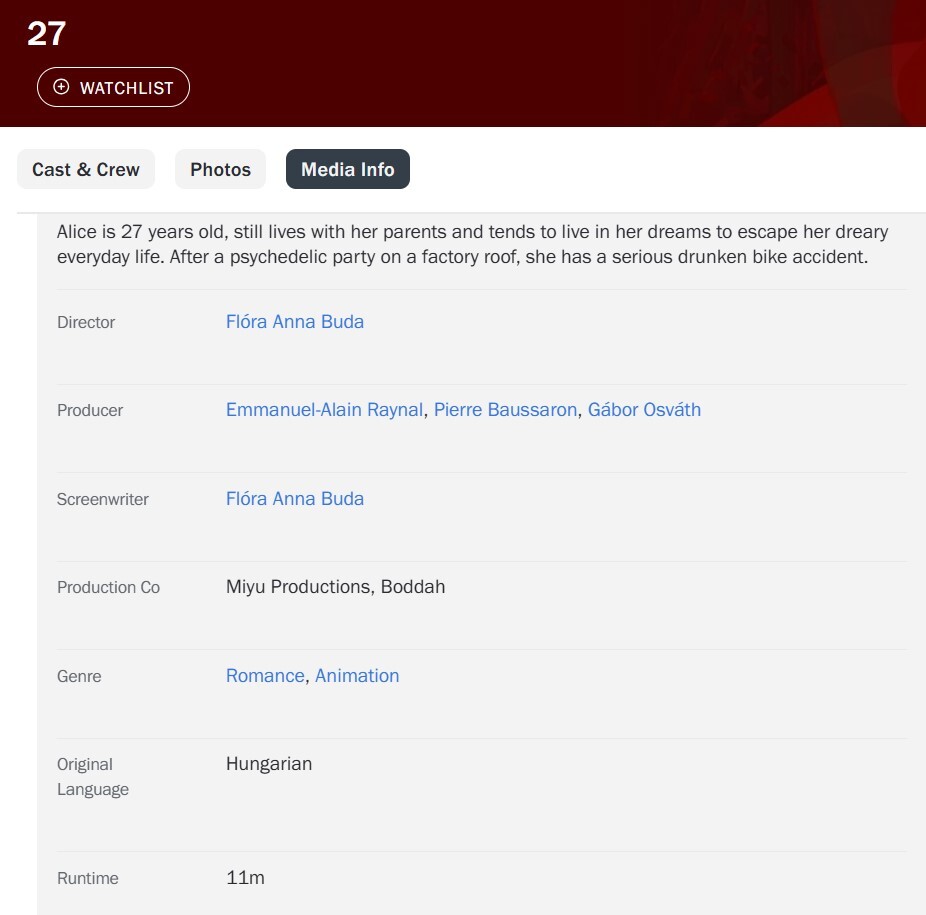
| 2023 (11th) | 27 – tt13021784 | Best Hungarian Short Animation | Producer | (frisshusbudapest.com, 2024.itfs.de) |
| 2025 (13th) | Deadweight / Dögsúly – tt37125086 | Best Hungarian Live-Action Short Film | Producer | (fidelio.hu, instagram.com) |
What Are the Chances This Is Not a Conflict of Interest?
The Friss Hús Budapest Short Film Festival has had 13 editions in total. Out of those, films produced or co-produced by Gábor Osváth won major Hungarian awards in 6 separate years. That represents approximately 46% of all editions. What’s notable is that all 6 wins happened during the period starting in 2016, the same year Osváth joined the festival’s leadership – first as a programmer and later as managing director. This overlap, nearly half of the festival’s lifetime, occurred while he held influence over programming decisions. Even with conservative assumptions the odds of Gábor Osváth’s films winning six times in 13 editions by sheer luck hover between one in 100 000 and one in a billion. Statistically, the pattern is hard to explain without some kind of inside edge.
the film industry isn’t a meritocracy
Is it possible that Gábor’s films were simply the best in the festival and won purely on merit? Absolutely—it’s possible. And yes, a festival is a private entity and can technically do whatever it wants. But is it more likely that his films benefited from his position within the festival, perhaps by inviting jurors who were friends or colleagues, and even if not friends, filmmakers who then felt a sense of loyalty or obligation after being flown in, hosted, and welcomed by someone they know? That’s the more realistic question.
What readers should understand is that this isn’t some scandalous exception in the film industry, it’s often how things work. No-one involved thinks that they’re doing anything wrong – the film industry isn’t a meritocracy. It’s a web of relationships, favors, political agendas, gender wars, and informal influence – not a meritocracy. This happens everywhere, festivals big and small, and we previously reported on such cases at Cannes, Toronto and Sundance. Is it any wonder that so many films are mediocre, most TV shows feel like parodies of themselves, and Hollywood is in free fall? Just like in global politics – and nearly every other corner of society – moral standards are eroding. If a U.S. president can accept a $400 million plane as bribe, why would anyone expect a small film festival in Budapest to be immune from favoritism? Of course awards can be handed out based on friendships, loyalties, or quiet understandings. Why wouldn’t they be?
Not a bug but a feature of the system
As we argued elsewhere, this pattern is not a glitch but the default operating system of any field where resources are scarce. Political sociologist Robert Michels called it the iron law of oligarchy: as soon as a group controls a coveted resource—money, awards, festival slots, media oxygen – it tends to close ranks and circulate those goods internally. Admitting outsiders may enlarge the “pie” culturally, but it shrinks each insider’s share of influence, so boundary-keeping becomes rational self-defense.
This is where “soft power,” in Joseph Nye’s sense, takes over. Nye stresses that power is often exercised not through overt coercion but through attraction, hospitality, and the ability to make others want to say yes. Pierre Bourdieu refines the idea: cultural capital (prestige, festival laurels, press coverage) converts smoothly into economic capital, provided you stay inside the charmed circle that controls it. The exchange rate is invisible—but everyone in the network feels it.
Because the currency is access, corruption rarely looks like a suitcase of cash. Classic philosophers of power – Foucault on micro-discipline, Steven Lukes on the “third face” of power, even Mancur Olson on distributional coalitions agree that the most effective control is subtle, wrapped in mutual gratitude. A juror flown in, wined and dined, may feel no overt pressure, yet the social psychology of reciprocity (see Gouldner’s norm of the gift) whispers: return the favour. Gouldner’s norm of reciprocity is a social rule that dictates people should return favors or kindnesses they receive. It’s a core concept in sociology, suggesting that individuals feel obligated to repay beneficial actions with similar acts of kindness or support, leading to a more fair and smooth social exchange.
The cases we report on are predictable by-products of a scarce-resource ecology. Influence is accumulated by performing generosity – curating panels, sponsoring travel, handing out festival lanyards – while quietly expecting the soft return on investment. In a genuine meritocracy, the payoff from such favour trading would approach zero, because quality alone would decide outcomes. In a scarcity-driven, relationship-based system, however, the smartest strategy is not to make the best film, but to become indispensable to the people who decide what “best” means.
The Reality of Film Festival Selection: What Aspiring Filmmakers Need to Know
If you’re an aspiring filmmaker outside the inner circle of industry connections (and if you were in it, you’d probably already know), it’s important to understand how many major film festivals operate. In most large festivals, every selected film often owes its spot to personal connections – whether it’s a producer who’s friends with someone on the selection committee, an employee who knows a director personally, or an actor’s child turned director whose father’s agent has reached out to influential decision-makers. In the case of Friss Hus – the producer IS part of the selection team, which happened even in Cannes.
What makes this even more challenging is the sheer number of well-connected filmmakers competing for a very limited number of slots—usually just a dozen or two per festival. Many of these slots are already taken by films that have been selected at other festivals through similar networks. So, even if your film is outstanding, without the right contacts, it’s unlikely to be seen by the selection committee. Festivals like Sundance, Locarno, and Warsaw – just to name a few – aren’t worth the submission fee unless you already have a strong connection within the festival.
New Oscar-qualifying status
The festival’s new Oscar-qualifying status raises the stakes. In October 2024 the Academy of Motion Picture Arts and Sciences added Friss Hús to its official list of Oscar-qualifying festivals; from the 2025 edition onward, the winners of Best Hungarian Live-Action and Best Hungarian Animated Short are automatically eligible for Oscar consideration. This upgrade multiplies the soft-power value of each prize: an award now opens a direct pipeline to Hollywood visibility. When the gatekeeper who helps decide those winners is also a producer with films in the race, the potential conflict isn’t just local festival politics. We are aware that the Academy of Motion Picture Arts and Sciences was made aware of this situation, and we do not expect them to do anything about it, as this is simply “business as usual” in the film industry. In fact, it makes more sense that festivals that award prizes or make selections based on merit would be “punished” as they would be completely out of line with how the system works and would pose a threat to the entire industry.
We’d like to thank “Filmethics” for reaching out and remind our readers that they are welcome to contribute anonymously by getting in touch with us.
As always we invite the festival to contact us for a response and ask our readers to point out any mistakes or errors. Please share this article with all your filmmaking friends.

Sources: