From a country of 285 million, the same handful of names keep resurfacing across labs, juries, co-productions, and Cannes-linked selection pipelines.
By FIW staff
Film Industry Watch recently received an email from an anonymous industry source about Next Step Studio Indonesia, the new initiative tied to La Semaine de la Critique in Cannes. The source did not want to be identified. The reason was blunt:
“I am not writing this to be published as I am scared for my life and my career.”
FIW cannot independently verify the source’s personal fears. But the message captures something many filmmakers describe privately and almost never publicly: a system so small, so networked, and so punitive that even asking basic questions about favoritism can feel dangerous.
On paper, Next Step Studio Indonesia sounds like an admirable initiative. Critics’ Week says the program brings together eight emerging directors, four local and four international, to co-write and co-direct four short films in Indonesia. Those films are then presented in world premiere at Critics’ Week in Cannes as part of a dedicated “Next Step Presents” screening. The directors also pitch their first or second features to buyers, broadcasters, distributors and co-producers. Critics’ Week adds that the films are produced and financed locally, and that the 2026 Indonesia edition is co-produced by Yulia Evina Bhara and Dominique Welinski, funded by local institutions and the Jakarta government, in partnership with the French Embassy and the Institut Français in Indonesia. In other words, this is not a casual workshop. It is a publicly backed access platform with obvious market value.
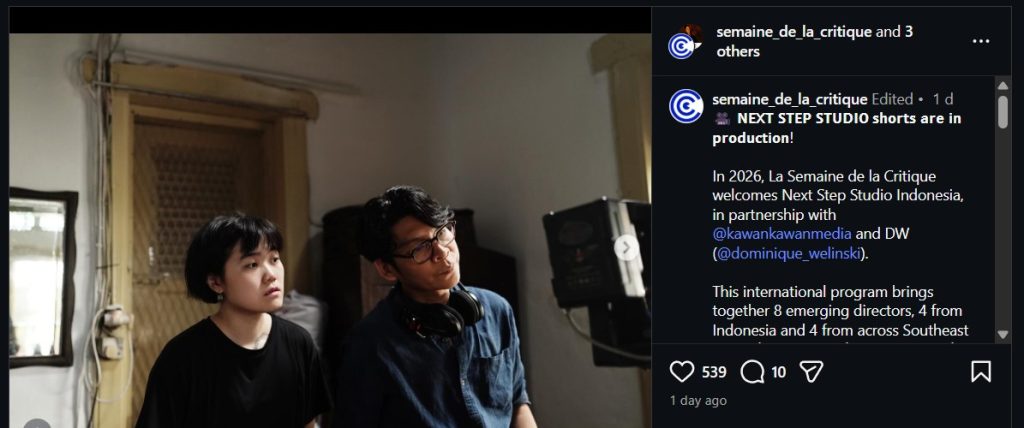
That is exactly why the selection process matters. And that is exactly where the official material becomes strangely quiet. In the Critics’ Week announcement and the public Next Step materials reviewed by FIW, the institution explains what the program offers, how prestigious it is, and how it can launch careers. What FIW could not locate in those public-facing materials was a clearly stated application route, selection criteria, or recusal policy for this Indonesia edition. The announcement even notes that some of the international filmmakers involved in Next Step Studio come from the wider Next Step workshops orbit, which only deepens the sense of an already circulating pipeline rather than a clearly open field.
That absence would already be a problem. It becomes a much bigger one when one looks at the participants and the professional ties surrounding them.
In the official social-media announcement shared with FIW, Critics’ Week named the four Indonesian directors as Shelby Kho, Khozy Rizal, Reza Rahadian and Reza Fahriansyah, paired respectively with Sein Lyan Tun, Lam Li Shuen, Sam Manacsa and Ananth Subramaniam. The question FIW then asked was simple: how many of these names are already professionally connected to Yulia Evina Bhara, one of the co-producers of the program?
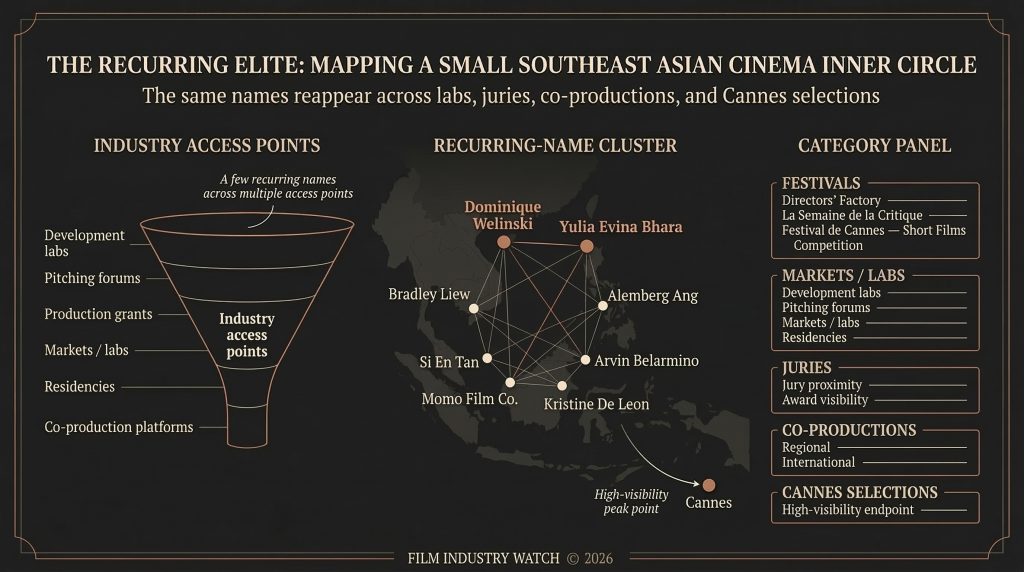
The answer is: enough to make this impossible to dismiss as bad optics alone.
Reza Fahriansyah has a publicly listed project, (Un)Holy, with Yulia Evina Bhara named as one of the producers, and KawanKawan Media listed as the production company. That is not a vague industry adjacency. That is a direct producing relationship.
Sein Lyan Tun also has a direct public project connection. Berlinale Talents lists The Beer Girl in Yangon with Yulia Evina Bhara as producer and Kawankawan Media among the production companies. Again, not rumor. Not gossip. A documented professional tie.
Sam Manacsa has likewise been publicly linked to a project involving Yulia. Variety reported that The Void is Immense in Idle Hours, directed by Sam Manacsa, is a Filipino-Indonesian co-production involving Yulia Evina Bhara.
The Shelby Kho connection is one step removed, but still revealing. Red Sea’s 2024 project materials list Shelby Kho’s Terbakar with Si En Tan as producer. Separately, official market and festival materials for Don’t Cry, Butterfly list Tan Si En and Yulia Evina Bhara together as producers on the same film. So even where the tie is not directly between the selected director and Yulia, it still runs through the same professional cluster.
This is where defenders of the system always reach for the same line: maybe these filmmakers are simply talented. Maybe the producer knows them because good producers work with strong people. Maybe there is nothing improper here.
That is not an answer. It is an evasion.
The issue is not whether these filmmakers have talent. The issue is whether a Cannes-linked, publicly backed, career-accelerating platform should be allowed to operate without clearly disclosed public safeguards while multiple selected participants already have direct professional ties to one of its co-producers. In any serious system, that is exactly when transparency should increase, not disappear.
And the incentives here are not abstract. Critics’ Week itself says these films get a Cannes premiere, professional events, unique visibility, meetings with international buyers and co-producers, and a possible trajectory beyond Cannes through festivals such as Sundance, Toronto and Clermont-Ferrand, with films often acquired by international television channels and platforms. This is not only cultural capital. It is economic capital. It creates future deal flow. It shapes who gets financed, who gets invited into the next lab, who gets introduced to sales agents, and who gets positioned as an “emerging voice” worth betting on.
This is also why FIW keeps returning to the same larger argument. The film industry’s deepest corruption problem is often not a suitcase of cash. It is network conversion: turning public credibility, institutional branding, taxpayer-backed prestige, and festival platforms into private career acceleration for the same recurring circles. The names change a little. The country changes. The language changes. The mechanism remains remarkably familiar.
FIW has documented versions of this pattern before. In Kosovo, we described an ecosystem in which the same people appeared to train, curate, judge and win within a publicly funded circuit. In previous reporting on Dominique Welinski, FIW examined how one person could simultaneously occupy influential roles around talent programs, curation and production. Critics’ Week itself now describes Welinski as the creator and curator of Next Step Studio, while FIW has previously raised questions about how such overlapping positions can distort fair access. This Indonesia edition does not appear from nowhere. It fits a pattern FIW has already been tracking across territories and institutions.
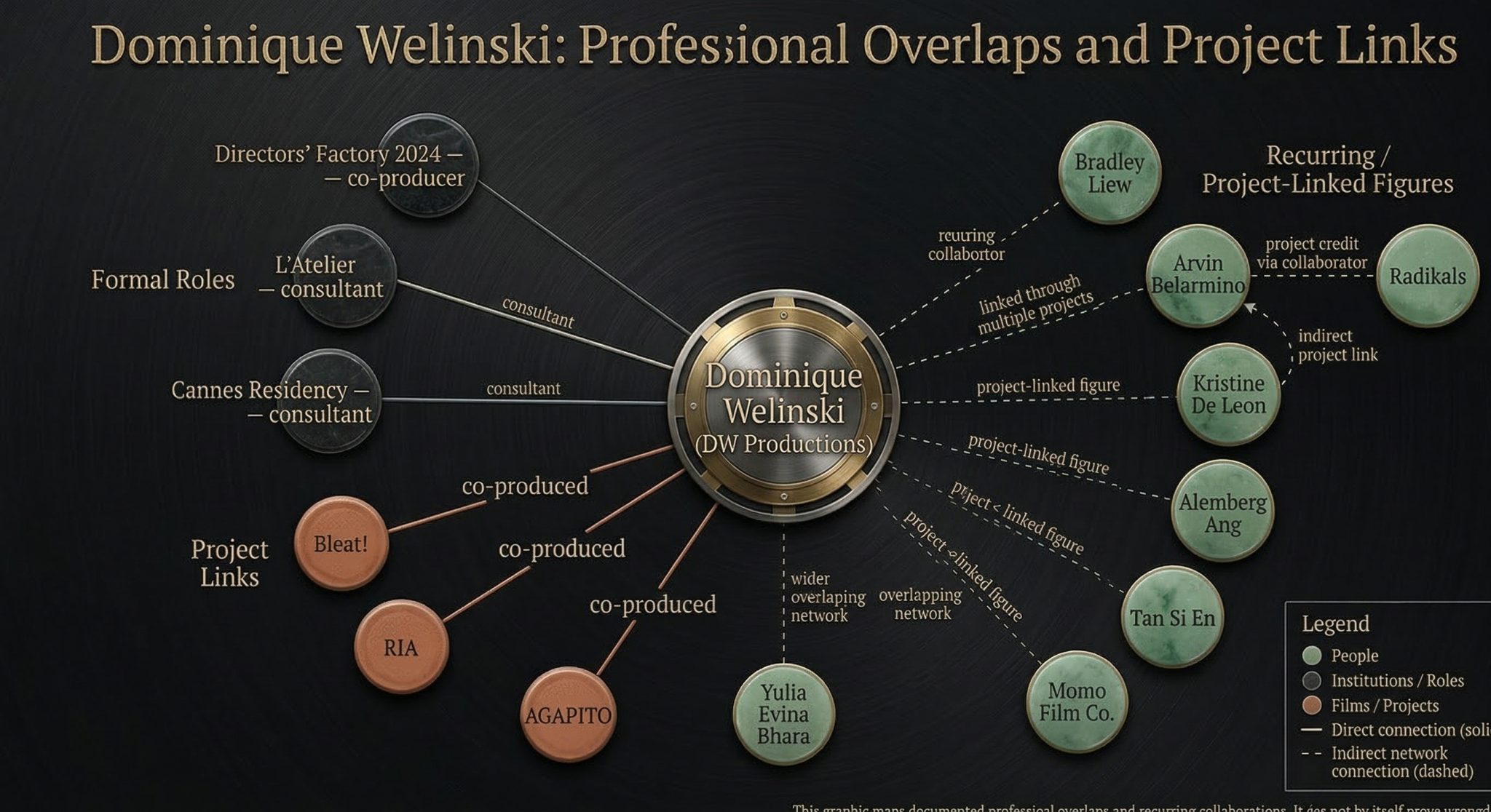
The concentration of influence around repeating names looks even more troubling when viewed in a broader gatekeeping context. Yulia Evina Bhara was a member of the Critics’ Week jury in 2025, and later served on the Busan International Film Festival competition jury. None of that proves wrongdoing in Next Step Studio Indonesia. But it does show how quickly festival power, producer status, jury visibility and career-launch infrastructure can accumulate around the same figures. The issue FIW keeps highlighting is not that successful people exist. It is that the same people keep appearing across selection, endorsement, production, mentoring and market access, while institutions provide too little public information for outsiders to assess where merit ends and network privilege begins.
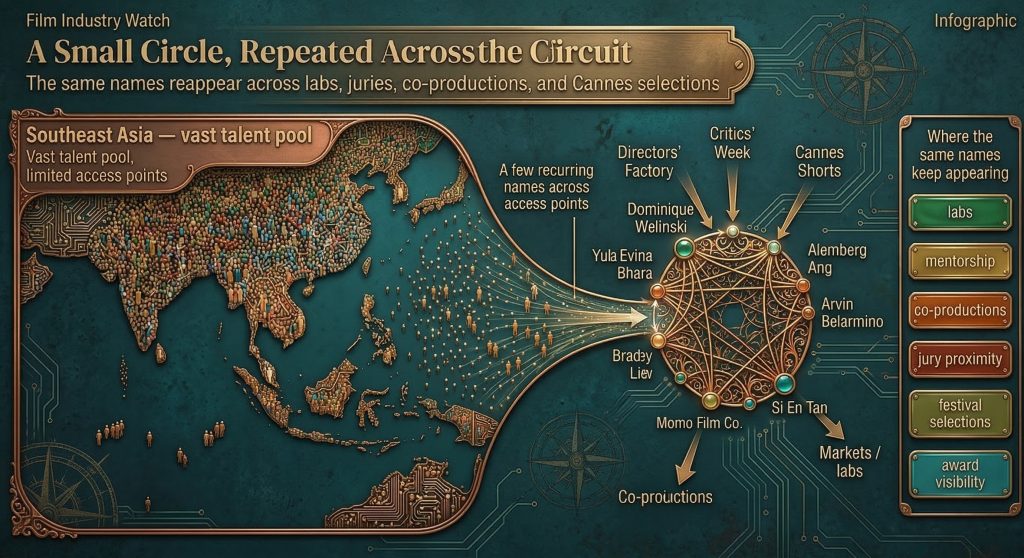
The anonymous source who wrote to FIW described “blatant nepotism & favouritism” and a system in which many filmmakers are left “huffing and puffing trying to have a ‘shot’ or just get a tiny bit of ‘support’.” Those are allegations, not proven facts. But the documented overlaps are facts. The public funding is a fact. The Cannes exposure is a fact. The market benefits are a fact. The lack of clearly published selection safeguards in the materials FIW reviewed is also a fact. Put together, they are more than enough to justify public scrutiny.
So the answer from Critics’ Week should be simple.
Was there an open call?
If there was no open call, how were candidates identified?
Who made the final selections?
What recusal rules applied?
Were recent collaborators of the co-producers considered, and if so, under what safeguards?
What exactly were the public institutions funding: a transparent talent platform, or a relationship-driven pipeline whose key decisions remain largely invisible?
Until those questions are answered, Next Step Studio Indonesia looks less like a discovery platform than a familiar industry machine: publicly celebrated, softly defended, privately networked, and structured in a way that once again risks converting institutional legitimacy into insider advantage.
The film industry loves the word discovery.
Too often, what it actually means is internal promotion inside a closed loop.
Same logic. Same incentives. Same names.
New country. Same machine.