

The War on Men: How Cinema Became a Weapon in the Cultural Backlash Against Men & Masculinityt
Guest post by a concerned filmmaker & FIW staff
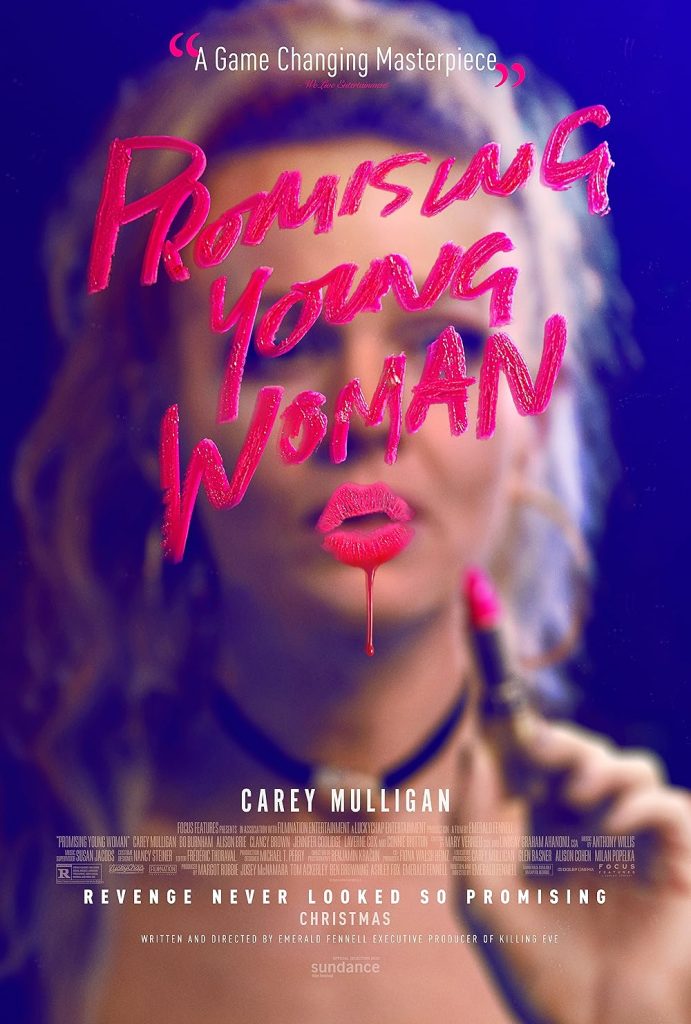
In one jarring scene of Promising Young Woman (2020), a young man gently lays an apparently drunk woman on a bed and begins unbuttoning her dress. “Shhh… you’re okay, you’re safe,” he whispers – a grotesque reassurance even as he pulls down her underwear without consent. Suddenly, she sits bolt upright, stone-cold sober: “I said: what are you doing?” she demands, fixing him with an icy stare. The predator freezes, terrified at being caught. This moment of tables-turning shock encapsulates a striking new archetype in today’s critically acclaimed cinema: men as predatory or pathetic figures, and women as their righteous reckoners or survivors. From indie festival darlings to Hollywood blockbusters, a growing roster of films is casting masculinity in a harsh light – depicting men as abusive, weak, absent, or broken, while positioning women as victims-turned-avengers or the moral centers of the story. And of course, the world is nothing if not ‘Black & White.’ Why wrestle with the messy complexity of gender dynamics when you can flatten it into the simplest cliché imaginable?
Abusive, Weak, or Absent: The New Male Stereotype on Screen
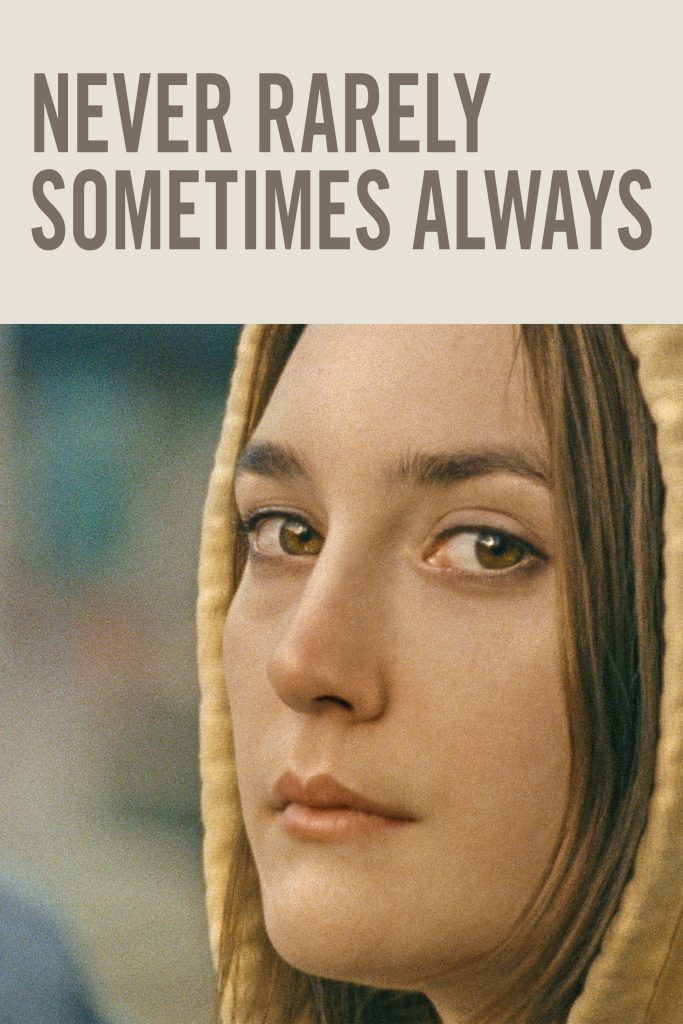
Recent award-winning and festival-circuit films have not been subtle about the state of their men. In Eliza Hittman’s drama Never Rarely Sometimes Always (2020), the men orbiting 17-year-old Autumn are ALL, with no exception, either useless or predatory. At her supermarket job, the sleazy manager dismisses Autumn’s illness and leers “It’s really just a few more hours… You can do it. Besides, I’d get lonely if you left” – a line dripping with inappropriate undertone. Later, as the girls turn in their registers, he even kisses Autumn’s hand through a money slot in a furtive act of harassment. Far worse has happened to Autumn behind the scenes: during a counseling session, she’s asked if her partner ever “made [her] have sex when [she] didn’t want to.” Autumn cannot even speak – the script notes “Autumn’s flood gates open. She breaks down” in tears. Pressed further – Has anyone forced you into a sexual act? – she finally chokes out, “Yeah,” confirming that a boy in her life raped her. The men in Autumn’s world, all of them, are either absent when needed or the source of trauma, whereas the moral agency lies entirely with Autumn and her female cousin who supportively accompanies her on a secret trip to get an abortion.
Film after film paints its male characters in a similarly dismal hue. Emerald Fennell’s acid-tinged thriller Promising Young Woman (2020) takes direct aim at “nice guys” who are anything but. Its parade of men are rapists or enablers: from the group of college bros who assaulted the heroine’s friend, to the former friend (now a doctor) who laughed it off, to the seemingly sweet new boyfriend who is ultimately revealed to have been complicit. The film’s biting opening illustrates this dynamic in miniature: Cassie, pretending to be obliterated by alcohol, is “rescued” by a man who coos assurances while attempting to take advantage of her incapacitation. Cassie suddenly drops her ruse, eyes clear and voice firm, scaring the hell out of him as she forces him to recognize his predatory behavior. In Promising Young Woman, men’s misdeeds are the central evil, and the avenging angel is a woman driven to drastic ends to expose them. Even basically decent men are portrayed as cowardly or culpable. “The message is that every man is guilty – if not of rape, then of complicity or willful ignorance – and it’s the women who bear the pain and seek justice,” writes one reviewer in summary of the film’s provocations.

In this new cinematic landscape, even when men aren’t outright villains, they are depicted as feckless, foolish, or fragile. Take last year’s Cannes Palme d’Or winner, Justine Triet’s Anatomy of a Fall (2023). The drama centers on a wife accused of killing her husband, Samuel, under murky circumstances. As the trial unspools, a damning portrait of the late husband emerges: Samuel was a frustrated writer suffering professional envy and depression, prone to paranoid behavior. He had been secretly recording his wife Sandra’s every word for months and grew “jealous” of her literary success. In a climactic court scene, the prosecution plays an audio recording of the couple’s final argument, in which Samuel’s composure collapses and an “explosion of violence” is heard. It’s suggested that he physically attacked Sandra (she was left with bruises), leading to the fall that killed him. The subtext is clear: Samuel is depicted as emotionally broken and volatile, a man who literally couldn’t handle being eclipsed by his wife. Sandra, by contrast, is portrayed as complex but ultimately more sympathetic – an intellectual and mother who maintains poise under pressure, effectively the moral center as the court (and audience) weigh her fate.
Anatomy of a Fall isn’t clever; it’s entry-level bait-and-switch. The script stacks obvious “she did it” breadcrumbs, loaded anecdotes, conveniently incriminating fragments, a neatly arranged trail of marital rot, and then smirks, “Gotcha! Misogyny!” as if the audience’s suspicion were proof of their bias rather than the direct result of the film’s own engineering. That’s not depth; it’s a cheap card trick where the magician palms the queen and then lectures you for noticing the deck.
The courtroom scaffolding promises rigor but mostly recycles surface-level ambiguity: pose a question, gesture at complexity, refuse resolution, call it profound. We’re never invited into genuine psychological opacity, just toggled between “look how guilty this looks” and “shame on you for thinking that.” The movie confuses withholding with nuance and moralizing with insight. It’s ambiguity for beginners, the kind that flatters the viewer for passing a test with only one answer: you’re problematic for believing the clues the film planted. Palme d’Or material? More like freshman workshop week: a draft that’s proud of its conceit, allergic to consequence, and convinced that wagging a finger at the audience equals complexity. If the standard is “structure that manipulates, then scolds,” congratulations, mission accomplished. If the standard is real ambiguity, genuine moral texture, and characters who exist beyond the needs of a thesis, this is a pass. Anatomy of a Fall indeed – that of European deep complex and nuanced cinema.
Even ostensibly lighthearted films reinforce the theme. Greta Gerwig’s blockbuster Barbie (2023) garnered attention for its candy-colored feminist subtext. In the film’s satirical reversal, Barbieland is a matriarchy where Barbies run everything and Kens are decorative sidekicks. But when Ken (played by Ryan Gosling) discovers the concept of “patriarchy,” he promptly leads an over-the-top male takeover that plunges Barbieland into a goofy dystopia of horse-inspired macho posturing. The depiction of Ken and his brethren is pointedly comical: vain, simple-minded, and easily manipulated by their own fragile egos. To defeat the Kens, the Barbies execute a clever plan – “We’ll distract them by pretending to be helpless and confused. Kens can’t resist a damsel in distress” one Barbie explains. The Barbies feign cluelessness to flatter the men, who immediately fall for it. In one scene, a brainwashed Ken leans over a Barbie to mansplain the difference between stock market CDs and music CDs: “Oh sweetheart, you are just so cute when you’re confused… CD stands for Certificate of Deposit,” he lectures while she bats her eyelashes in feigned awe. The ruse works perfectly – the duped Kens relinquish their grip on power without the women ever needing to use force. Barbie’s gleeful message is that when men do have power, they don’t know what to do with it besides impose absurd chauvinism – and savvy women can easily outsmart them. The film pointedly makes its heroine the moral and emotional anchor, while the men learn a lesson in humility.
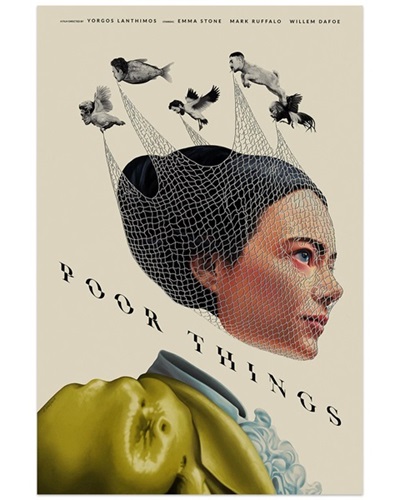
And then there is Yorgos Lanthimos’s surreal feminist fable Poor Things (2023), which flips the Victorian Frankenstein trope to sly effect. The protagonist, Bella (Emma Stone), is a resurrected woman finding her independence in a world of leering or controlling men. Her “creator,” Dr. Baxter, is a grotesque but kind man who nonetheless literally keeps Bella under lock and key “for her own good.” When a slick male lawyer, Duncan Wedderburn, encounters Bella, he is so intrigued by this uninhibited woman that he spirits her away on a tour of debauchery across Europe. Duncan styles himself a liberator – upon meeting her, he dramatically declares, “You are a prisoner and I aim to free you… There is something in you, some hungry being, hungry for experience, freedom, touch”. But his version of “freedom” is to indulge in hedonistic sex and thrill-seeking on his terms. In one scene, after Bella enthusiastically beds him, Duncan can’t resist boasting about his sexual prowess. “At the risk of being immodest, you have just been thrice fucked by the very best,” he brags to her with smug self-satisfaction. Eventually, Duncan’s self-centered antics (including gambling away Bella’s money) prove him to be a shallow cad. Poor Things casts its men as either paternalistic “protectors” or libertine exploiters – and skewers both. Bella ultimately asserts her autonomy, rejecting the cages both kinds of men offer. The film’s feminist lens makes its sympathy clear: the men are foolish and corrupt; the woman is the one discovering authentic moral agency.
Sean Baker’s Anora turns a stripper’s Cinderella story into a demolition of male authority. Ani (Mikey Madison) marries Vanya, a pampered rich kid who proposes mostly to spite his parents. He is feckless, spineless, and quickly disappears once his oligarch family intervenes. In his place arrive thugs led by Toros, who bind Ani, sneer “this is the property of the Zakharovs,” and threaten to erase her pregnancy. Ani’s desperate scream of “RAPE!” forces the men to gag her with a scarf – a disturbing metaphor for silencing women in the #MeToo era.
Ani remains the only figure of moral clarity, publicly scorning Vanya for marrying her only to defy his mother. Even at the end, as she is forced into annulment, she reclaims dignity by naming the violence done to her. Every man in Anora is either abusive, cowardly, or complicit, while Ani alone has integrity. Unsurprisingly, critics rewarded this excoriation of masculinity with the Palme d’Or and Oscars – proof that vilifying men remains a reliable ticket to festival glory.
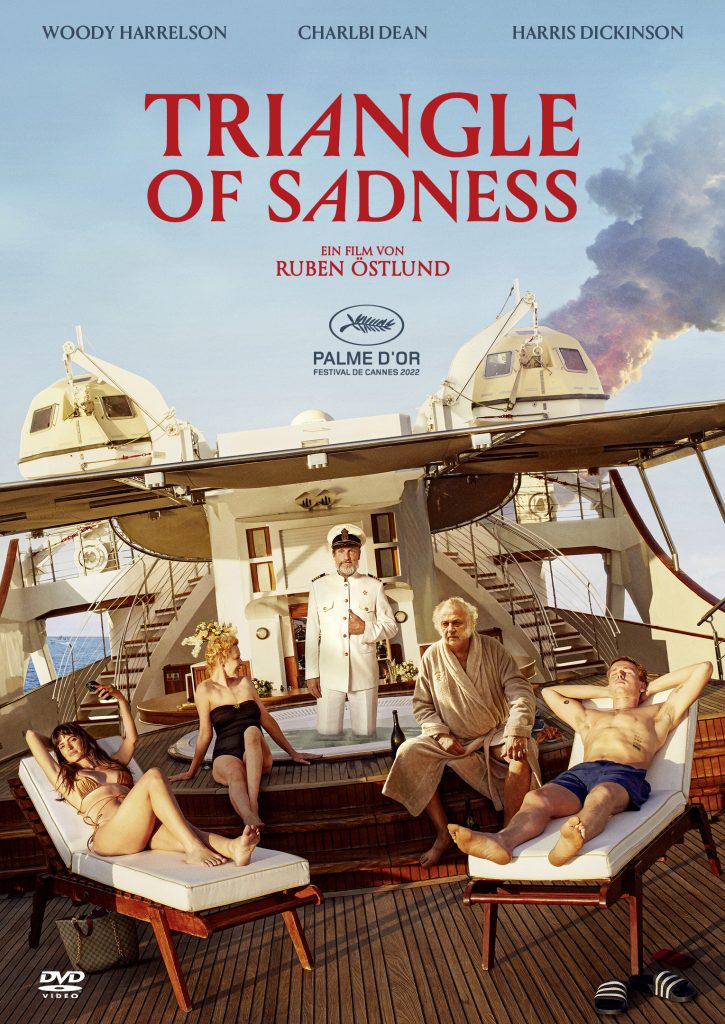
Ruben Östlund’s Triangle of Sadness gleefully dismantles masculinity from start to finish. Carl, a fragile male model, bickers over dinner bills and is later reduced to Abigail’s boy-toy in exchange for food. On the luxury yacht, rich men – from the drunken Marxist captain to the fertilizer tycoon – are grotesques, vomiting through storms or ranting drunken politics over the PA.
The final act on a deserted island flips power completely: Abigail, once the ship’s toilet-cleaner, declares herself “Captain,” doling out food while billionaires and influencers – especially the men – meekly comply. Carl prostitutes himself for pretzels, embodying male emasculation as comedy. The film won the Palme d’Or and Oscar nominations precisely because it revels in humiliating men and celebrating female dominance, a perfect fit for post-#MeToo festival tastes.
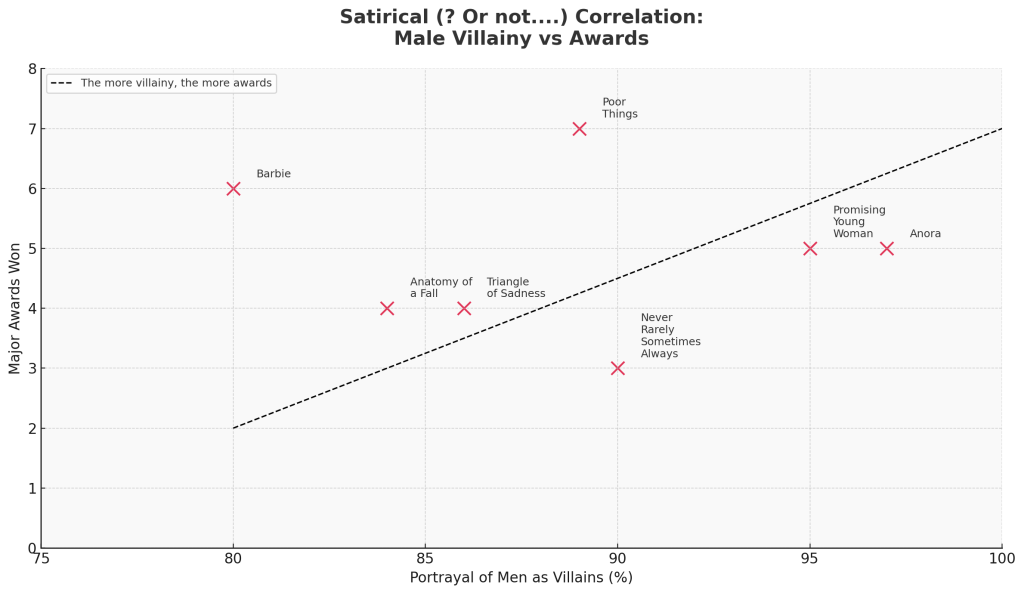
Across these examples – Never Rarely Sometimes Always, Promising Young Woman, Anatomy of a Fall, Barbie, Poor Things, Anora and Triangle of Sadness – a common pattern emerges. Men, in these stories, are overwhelmingly sources of harm or hindrances to women. They are rapists, abusers, overgrown boys or insecure wrecks. Women, by contrast, are victims who find strength, or caretakers who clean up the mess, or avengers delivering comeuppance. This trend is especially pronounced in prestige cinema and festival favorites, the very films that garner Oscars, Palmes d’Or, and critical acclaim. It’s as if Hollywood and the art-film circuit, in the wake of #MeToo, have collectively decided that the time of the heroic or even just complex, sympathetic male protagonist is over. Instead, filmmakers are holding up a mirror to the ugliness of “toxic masculinity” – and often making sure that mirror shatters on screen.
Contextualizing real-world statistics against the exaggerated portrayals of men in contemporary cinema
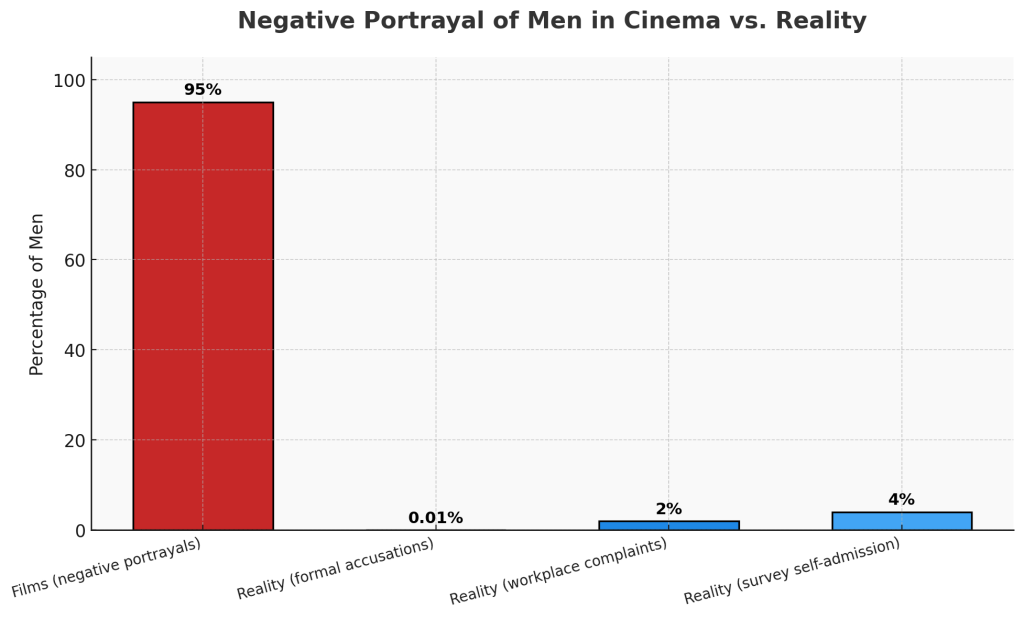
The gap between cinematic narrative and social reality is staggering. In the films surveyed above, male characters are overwhelmingly cast as predators, abusers, or enablers of violence, as though every man is complicit in misogyny. Yet hard data tells a very different story. Globally, only a small fraction of men are ever accused of sexual harassment, whether formally or informally. In the United States, for example, the Equal Employment Opportunity Commission (EEOC) received around 7,600 sexual harassment charges in 2018, the first full year of #MeToo, representing less than 0.01% of the U.S. male population. Even when looking at a four-year span (2018–2021), the total number of men formally accused through EEOC charges remains well under 0.1% of American men.
Workplace HR complaints are more common than lawsuits but still affect only a small minority of men, research suggests perhaps 1–2% of employed men over several years will face such an allegation. Anonymous surveys cast a wider net: about 4% of men in a 2017 survey admitted to behavior they considered harassment. Even if we take the higher estimates, this still means the overwhelming majority of men, upwards of 90–95% worldwide, are never accused of harassment at all.
Now place those percentages beside the reality of male victimhood. Around 60–70% of the homeless in the U.S. are men, a silent crisis rarely dramatized in prestige cinema. Men also account for about 78% of homicide victims, and globally, men die by suicide at roughly three to four times the rate of women. They also make up the vast majority of workplace deaths, overdose fatalities, and combat casualties. In other words, men are not only disproportionately the accused in cultural narratives, but also disproportionately the victims in real life.
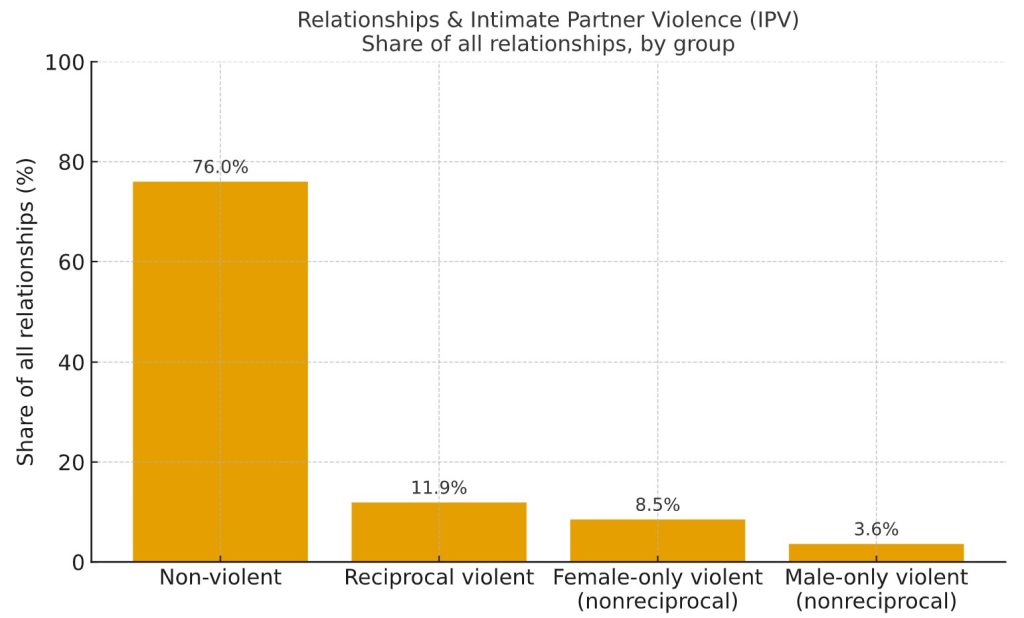
Now let’s look at relationships and Intimate partner violence – A large U.S. study of young adults found that about 24% of relationships had some violence; about half of those were reciprocal (both partners violent). But here is the real shocker – when Intimate partner violence was one-sided, women were the perpetrator in more than 70% of those cases – since this data goes against everything you’ve heard your entire life, here is the source, because we know you’re not going to believe us.
Contrast these statistics with the cinematic landscape. In Promising Young Woman, every man Cassie encounters is either a rapist, an accomplice, or a coward. In Never Rarely Sometimes Always, every male figure is absent, lecherous, or abusive. In Anora, Ani is surrounded entirely by exploitative or spineless men. Even comedies like Barbie and satires like Triangle of Sadness revel in reducing men to clowns, predators, or parasites. The cumulative effect is a vision of society where male toxicity is universal and male innocence nonexistent.
This disjunction matters. When films repeatedly suggest that men as a class are dangerous, complicit, or broken, they risk cementing a cultural script that far outstrips reality. Yes, harassment and abuse are serious problems, but they are perpetrated by a minority of men, often repeat offenders. Cinema, however, portrays them as the majority if not the entirety. Meanwhile, the real vulnerabilities of men, homelessness, suicide, homicide, are erased from the screen. The result is a distortion: audiences are invited to see “the problem” not as a subset of bad actors, but as masculinity itself.
In real life, not on screen, it’s actually safer to be a woman than a man
Bottom line (absolute numbers) – When you tally deaths and serious injuries, homicide, suicide, fatal work injuries, and ED-treated violence, men are harmed and killed in greater numbers overall. Women do suffer more sexual and partner/family violence, usually from a partner, ex partner, or family member, with only about 20-30% of sexual violence is done by strangers. Taking the full ledger into account, it’s clear that, on balance, it is much much safer to be a woman than a man, and they live, on average, five years longer too. In other words, these so-called “brave realist social dramas” are anything but. In truth, according to the hard facts, they’re closer to science fiction, fit to be shelved alongside Ad Astra, Inception, and Blade Runner. Turns out sci-fi movies can win Palme d’Ors after all.
All sources for this section at the end of this article.
Post-#MeToo Revenge and the Ideological Shift in Hollywood
These portrayals are no accident of individual storytelling but part of a broader ideological shift in Hollywood after the #MeToo movement. In late 2017, the Harvey Weinstein scandal and the #MeToo reckoning exposed the prevalence of sexual misconduct by powerful men, not just in entertainment but across society. The response from the creative community was swift and continues to reverberate: more films centering women’s perspectives, more brutal examinations of gender power imbalance, and unmistakably less patience for glorifying or excusing bad men. In fact, Hollywood has arguably turned cinema into a vehicle for advocacy, determined to dramatize the wages of male sin.
“Hollywood is now becoming its own loudest voice in helping to call out what a bad thing this is,” observes Robert Thompson, professor of popular culture at Syracuse University, referring to sexual harassment and abuse. By embedding #MeToo’s lessons into scripts and characters, filmmakers have essentially institutionalized the cultural reckoning within popular narratives. “The #MeToo movement was at the front lines… Then it becomes institutionalized by these films and TV shows which people will continue to watch years later,” Thompson notes, pointing out that fiction can serve as a long-lasting record of the era’s lessons. In other words, long after the news headlines of predatory bosses fade, movies like The Assistant or Promising Young Woman will remain to remind future viewers of the period when society finally said “enough” to men’s abuse of power.
Many creators are openly intentional about this mission. Kitty Green, writer-director of The Assistant (2019), based her film’s grim portrayal of a Weinstein-like boss on real testimonies and has said she wanted male viewers to feel a tad uncomfortable. “A lot of men come out feeling very uncomfortable,” Green noted of audience reactions, adding, “I think a little bit of discomfort is what we need right now if we want things to change.” Emerald Fennell, who wrote and directed Promising Young Woman, has similarly explained that her film is a pointed response to decades of endemic sexism. She deliberately filled it with situations drawn from real life: “There’s nothing in it that isn’t extremely commonplace,” Fennell said, emphasizing that the predatory behaviors depicted are all too familiar and widespread. That commonality is precisely the point – her film suggests the problem is all around us, in every nice guy at the bar.
The surge of female-led vengeance tales and social satires is so notable that even mainstream media began to notice a new subgenre. “In a post-#MeToo world: How better to find escapist fun than by ruthlessly dispatching awful men at the multiplex?” quipped the Washington Post’s Ann Hornaday, commenting on the wave of films inviting audiences to revel in women getting payback against brutish men. From stylish rape-revenge thrillers like Promising Young Woman to action flicks with female assassins mowing down male abusers, vengeance is presented as cathartic justice. These movies have a clear emotional aim: deliver satisfaction (or at least grim vindication) by punishing or overcoming the on-screen avatars of so called “toxic masculinity”. Hornaday noted that as gratifying as this can be, it has also become formulaic: a “dubious cycle of abusive men and the women savagely getting their own back” – to the point where it’s feeling “monotonous” and even “like its own form of toxicity.” In short, flipping the gender script – making women the heroes and men the villains – may redress an age-old imbalance, but if every story is framed as Women Good, Men Bad, even some feminists worry it creates a new kind of caricature.
Still, it’s clear that for now, Hollywood (and the independent film world) sees itself as having a moral mandate. The entertainment industry was, after all, ground zero for #MeToo; now it is using the tools of storytelling to reinforce the movement’s message. As one Reuters report put it, post-Weinstein, “Hollywood is… helping to call out” bad male behavior and embed these cautionary tales into the culture. We are essentially watching a form of cultural revenge play out on screen – a backlash against generations of male-dominated narratives. If the old Hollywood exalted the suave leading man, the new Hollywood often subjects him to a trial by fire (sometimes literally). No misdeed by a male character goes unpunished by the final reel; no female character’s suffering goes unavenged. In a sense, cinema itself has become a battleground in the gender wars, with filmmakers as the activists and each film a case study in the wages of “toxic masculinity.”
“Toxic Masculinity”: From Pop Psychology to Hollywood Gospel
Central to this ideological shift is the rise of the concept of “toxic masculinity.” Coined in academic and therapeutic circles decades ago, the term entered the popular lexicon in the 2010s and has since become a catch-all in media and Hollywood for the stereotypical behaviors of men that are deemed destructive – aggression, sexual entitlement, emotional repression, violence, you name it. Feminists have adopted “toxic masculinity” as shorthand to characterize the misogynist, abusive or emotionally stunted behaviors common in men. In public discourse (and often in these films), “toxic masculinity” doesn’t refer to individual bad actors so much as it indicts an entire system of social conditioning. It’s the idea that traditional norms of manhood – the old “boys don’t cry,” “might makes right,” “sow your wild oats” mentality – create a poison that spreads through men’s psyches and, by extension, hurts women and society.
Hollywood’s new narratives have embraced this concept with zeal. In film after film, the worst male characters are practically case studies in toxic masculinity: domineering, violent, unable to empathize – and ultimately pathetic. The Barbie movie outright name-checks “patriarchy” as Ken’s newfound religion, lampooning its absurdity. Promising Young Woman all but uses the phrase toxic masculinity in its premise (the lead character feigns helpless drunkenness precisely to expose men’s ingrained predatory responses). And behind the scenes, this viewpoint has been validated by mainstream institutions. In 2018, the influential American Psychological Association (APA) released its first-ever guidelines for therapists working with boys and men, and it pointedly declared that “traditional masculinity is psychologically harmful.” The APA warned that socializing boys to be stoic, competitive and aggressive leads to a host of problems– from mental illness to violence. In effect, the APA distilled “toxic masculinity” into an official stance: the time-honored traits of manhood (strength, stoicism, dominance) were recast as risk factors or pathologies to be curbed.
Critics have noted that this concept, once fringe, is now virtually orthodoxy in liberal media and entertainment. The term “toxic masculinity” itself might not be spoken within these films’ dialogue, but its ethos undergirds them. In press junkets and interviews, creatives frequently talk about examining or deconstructing toxic masculinity through their work. For many, it’s seen as a necessary re-education of the audience. But others argue it has become a blunt instrument, pathologizing all things male. “For conservatives, the concept of toxic masculinity knocks down the virtues and ways of life they hold dear: strength, honor, duty, and bravery,” one observer writes, noting how this rhetoric essentially recasts positive male attributes as negatives. Indeed, when every traditionally masculine trait is viewed with suspicion, culture edges toward implying that masculinity itself is a disease.
Nowhere was this cultural clash more evident than in the reaction to a certain shaving razor commercial in 2019. Gillette’s now-famous advertisement, launched in the heat of #MeToo, directly invoked the phrase “toxic masculinity” and urged men to be better – to intervene against harassment, to shed the old “boys will be boys” excuses. The ad showed scenes of bullying, catcalling, and boardroom sexism, asking pointedly: “Is this the best a man can get?”, a twist on the company’s classic slogan. The backlash was immediate and ferocious. Many men (and some women) blasted the ad as an unfair generalization that “implied most men were sexual harassers or violent thugs” and was merely virtue-signaling corporate pandering. Prominent conservative actor James Woods accused Gillette of “jumping on the ‘men are horrible’ campaign”. On YouTube, the commercial’s dislikes quickly far outnumbered likes. The Gillette saga is instructive: it revealed how polarized the concept of toxic masculinity had become. To one side, it was a long-overdue call for accountability; to the other, it felt like an all-out attack on male identity.
Hollywood’s current crop of films decidedly take the former stance – they presume toxic masculinity is real and pernicious, and they set out to critique or lampoon it. The result, intentionally or not, is that a lot of traditional male behavior now shows up on screen coded as “toxic.” Stoic, emotionally distant father figure? Likely he’ll be portrayed as failing his family (The Banshees of Inisherin and The Whale in recent years both depict lonely, taciturn men whose inability to communicate leads to personal tragedy). A man who loves flirting or womanizing? He’s probably going to be either a clown (the Kens in Barbie) or a villain (the charming date-rapists of Promising Young Woman). Even righteous anger or physical courage in a man – traits that for decades were the backbone of hero archetypes – are now often shown as double-edged or outright dangerous. This isn’t to say there are no positive male characters anymore; but in the films drawing the most buzz, those characters tend to be supporting players or deliberately non-traditional men (for example, Ken in Barbie only earns sympathy once he breaks down in tears and admits his insecurities – essentially when he relinquishes the performative “alpha male” mask).
It’s a remarkable cultural pivot. We’ve gone from James Bond seducing women and saving the day with nary a thought to his macho antics, to a landscape where a character like Bond is presented as a problematic relic or subverted as an object of critique. In essence, masculinity itself has been put on trial in our movies. And the verdict from the creative class, more often than not, is guilty as charged
Gender Politics and the Culture War on Masculinity
This cinematic trend doesn’t exist in a vacuum – it mirrors and feeds into a wider sociopolitical context. In American culture especially, gender has become intensely politicized terrain in recent years, with masculinity often in the crosshairs. The “war on men” that some commentators decry is in large part a reaction to the kind of messaging Hollywood is now amplifying, messaging that aligns closely with progressive, feminist-informed politics. Indeed, the U.S. Democratic Party’s messaging and left-leaning media in the Trump and post-Trump years have frequently portrayed traditional masculinity as something suspect or needing reform. Meanwhile, conservatives have seized on this to rally men to their side, arguing that the left is demonizing half the population.
The numbers suggest a growing gender divide in political affiliation. Young men have been veering rightward, while young women have trended even more to the left, creating a stark polarization. As of 2020, fewer than 4% of U.S. marriages were between one Republican and one Democrat – Americans are increasingly even choosing romantic partners along political lines. This hints at a deeper cultural split: many young women identify with feminism and social liberalism, whereas a lot of young men, feeling attacked or alienated by that rhetoric, are gravitating to more conservative or contrarian spaces. In an era when “the personal is political,” as the saying goes, one’s stance on masculinity has practically become a litmus test. Progressives often spotlight “toxic masculinity” as a societal ill – a problem to be addressed through education, corporate initiatives, and yes, representation in media. (For example, President Biden’s administration convened a Gender Policy Council, and while its focus is largely on women’s equality, it implicitly calls for reshaping male behavior too, such as engaging men to prevent gender-based violence.) Liberal cultural outlets like The New York Times and The Atlantic have run a slew of pieces on the “problem with men” in modern dating, education, and work – implying that men need to change or face being left behind. One viral NYT essay in 2025 described a “noticeable absence of men” in public life and dating, asking plaintively, “Men, where have you gone?”. Another introduced readers to the term “heterofatalism,” the bleak notion that straight relationships are doomed by men’s inadequacies, as single women vent about the dearth of “good men” willing to commit or even date earnestly. This media drumbeat paints a picture of masculinity in crisis – but crucially, it often frames it as a crisis men themselves have caused by not adapting to modern norms. In reality, many men, feeling unfairly blamed for crimes they did not commit, have chosen to ‘check out’ of dating in a society they increasingly perceive as hostile toward them.
On the other side of the aisle, conservative politicians and pundits have leaned into defending traditional masculinity, accusing the left and Hollywood of collectively waging a “war on men.” They see the constant critiques – in ads, op-eds, Oscar-winning films – as an unfair generalization at best, and at worst, an attempt to erase what they view as healthy masculine virtues. The outrage over the Gillette ad was one flashpoint. Another is the popularity of figures like psychologist Jordan Peterson and populist senators like Josh Hawley who openly talk about a “masculinity crisis” – albeit their concern is that men are being emasculated by a feminist, liberal culture. Hawley, for instance, gave a speech in late 2021 arguing that America’s men are in decline because of “the left’s attempt to deconstruct males” and has urged a return to traditional male virtues of strength and providership. Right-wing media often mocks or lambastes Hollywood productions that it perceives as emasculating men or unduly elevating women at men’s expense (the discourse around the Barbie movie on social media was a prime example, with some conservative commentators calling it “anti-man propaganda” for its satirical jabs at the patriarchy).
This tug-of-war rhetoric filters into the entertainment itself. It’s not a coincidence that Barbie included cheeky nods to real-world gender battles – the film knew it would be divisive and leaned into it humorously (e.g. having Ken literally discover patriarchy by name). Likewise, Promising Young Woman prompted heated debates between those who saw it as an empowering feminist fantasia and those (some male, some female) who felt it portrayed all men as monsters. The cultural backlash against masculinity that our film title references is very much part of a broader culture war, one in which the Democratic-leaning camp tends to view the elevation of women and critique of men as progress, and the Republican-leaning camp sees it as demonization and folly. After #MeToo, many Democratic politicians proudly aligned themselves with the “Believe Women” mantra and put forward policies to combat “toxic masculinity” in contexts like campus sexual assault and military training. Republicans, in turn, often scoff at the term “toxic masculinity” – some have even introduced resolutions to celebrate “National Masculinity Day” to honor positive male role models, implicitly pushing back on the notion that masculinity is inherently problematic.
The result of this political and cultural climate is that young men today receive mixed messages at best. Popular culture (movies, shows, ads) may tell them that their gender is suspect and they need to reform (be more sensitive, less aggressive, relinquish power). At the same time, countervailing voices tell them they are victims of a feminist agenda, and they should hold fast to traditional manhood or risk losing themselves. It’s no wonder that many men feel bewildered or embattled. They’re hearing both, “Step aside, you’ve had your turn,” and “Stand up, don’t let them beat you down.” And nowhere is this schizophrenic messaging more evident than in the realm of entertainment and media.
Lonely, Single, and Left Behind: The Real-World Consequences for Men
Amid this cultural crossfire, men are living through a quiet crisis. By numerous statistical measures, men in Western societies are struggling – in education, in relationships, in mental health – and the timing coincides with (though is not solely caused by) the post-#MeToo cultural climate. The portrayal of men as broken in films like Anatomy of a Fall or the hapless Kens of Barbie has uncomfortable echoes in real-world trends among males. Consider some of the data:
- Young men are increasingly single and socially disconnected. A recent Pew Research Center survey found that a whopping 63% of U.S. men under 30 report being single, nearly double the share of women in the same age group (34%). In generations past, young men were more likely to have a steady partner than young women (in part due to earlier marriage norms); now the script, pun intended, has flipped. Even more striking, most single young men aren’t even looking for relationships or dates. Between 2019 and 2022 – precisely as cultural messages about men’s toxicity grew louder – the percentage of single men under 30 who say they are actively seeking a romantic partner plummeted from 61% to 50%. In essence, half of young single men have just opted out of dating entirely. Social scientists tie this to a mix of factors: economic woes, porn and video game escapism, fear of rejection or #MeToo-style allegations, and an overarching sense of alienation. By contrast, single women’s interest in dating did not decline nearly as much in that period.
- Marriage and family formation have sharply declined for men. In the late 1970s, less than 10% of American men reached age 40 without ever being married. By 2021, that figure had tripled to 28%. Marriage rates are falling across the board, but again men seem to be pulling back more. Many men, especially working-class men, express uncertainty about their economic viability as husbands or disillusionment with the institution of marriage. The rise of voices disparaging men as inherently problematic might play a psychological role: some men question whether they’re wanted or valued in a committed partnership beyond their paycheck. We also see declining birth rates and fewer men becoming fathers, correlating with the marriage drop. It’s as if a large chunk of a generation of men is bowing out of the traditional adult milestones – some by choice, others by feeling unwelcome or unworthy.
- While loneliness affects both sexes, certain measures show men falling behind in social connection. An oft-cited statistic: In 1990, only 3% of men in the U.S. said they had no close friends. By 2021, 15% of men – five times as many – reported having no close friendships. This suggests modern life has become more isolating for everyone, but men have had a harder time maintaining support networks. Men also report fewer people they can confide in about personal problems compared to women. A Gallup poll found a quarter of young men (ages 15–34) say they feel lonely “a lot”, higher than the rate for young women (18%) in that survey.
- Educationally and economically, men are lagging. Women now earn about 70% of university degrees, leaving a growing cohort of undereducated young men. To a large extent this is the result of affirmative actions which was instituted in the 1970s, when the numbers have been reversed. But of course, today, nobody is calling to pause these advantages that women receive, not to mention on reversing them. Boys have higher dropout rates and lower college enrollment, and this education gap then feeds the dating gap (college-educated women often don’t want to “date down” educationally, leaving non-college men with fewer partner options – a dynamic some of those frustrated NYT essays allude to). On the job front, men have seen declines in labor force participation. A smaller proportion of “prime age” men (ages 25–54) are working today than in previous generations, in part due to the loss of manufacturing jobs and other traditionally male-dominated industries, but also because they know that they face unfair “reversed” discrimination and DEI policies.
- Mental health and suicide disparities are alarming. Men worldwide (and in the U.S.) die by suicide at roughly four times the rate of women. They also comprise the vast majority of overdose deaths and are disproportionately victims of alcohol-related illness – suggesting self-medicating behaviors. Part of this is long-standing (men have always had higher suicide rates, likely tied to methods used and societal pressures). But the concern is that as men’s social and economic prospects diminish, and as they internalize society’s messages about men being “problems,” their mental wellbeing may further erode. The APA warned that socializing boys to suppress emotions leads to damage, and indeed one could argue we are seeing it: a generation of young men who feel lost, angry, or without purpose. Some retreat into nihilism or resentful online subcultures (e.g. “incel” forums or anti-feminist Reddit channels), which only reinforces their alienation. Others simply check out of ambition and relationships, opting for a quiet life of minimal responsibilities – a trend documented in Japan (“hikikomori” hermits) and increasingly noted in Western countries too. The recent assassination of Charlie Kirk, by a young man who could easily be described as someone suffering from all of the above, is a case in point.
How much of this male malaise can be blamed on the “cultural backlash against masculinity” is up for debate. Certainly, economic and technological forces are huge factors. But it’s hard to ignore the feedback loop between cultural narratives and individual self-concept. If young men constantly encounter stories where men are brutish or superfluous, might it shape how they see themselves? When every role model in media seems to either be a flawed antihero who must be humbled or a doofus in need of correction, some men may just disengage rather than fight a tide that portrays them as the problem. The data on dating, for instance, suggests a resignation: many young men are not even trying to form relationships, possibly out of fear of rejection or of doing the “wrong” thing. (Notably, after #MeToo, surveys found a percentage of men – and women – felt less comfortable with casual flirting at work or approaching strangers, worried that behavior could be misinterpreted. One often cited effect of #MeToo was that men became reluctant to approach women in public for fear of crossing a line, being called “a creep”, or ending up as a TikTok video viewed and tens of millions of times.
This might be a net positive for women’s comfort, but it also could contribute to a chilling effect on men’s social initiation. Meanwhile, some of the more dire consequences hit not only men but society at large. For example, the loneliness and aimlessness of men can have political fallout – disaffected young men are often drawn to extremist ideologies or demagogic leaders who promise to restore their pride. There’s evidence of this in the rise of online misogynist movements, but also in broader politics: the gender gap in voting is at historic highs, with men more likely to support populist or right-wing candidates who explicitly push back on liberal social trends. This can further polarize and fragment communities. And on a very personal level, the struggles of men cascade onto the women and children around them: a generation of women faces a shortage of economically stable and emotionally available male partners, and millions of children are growing up with minimal or no involvement from their fathers (since unmarried, disengaged men often end up detached from family life).
In short, the “war on men” is not just a metaphor playing out in think-pieces and movies – it has flesh-and-blood consequences we can measure. Marriage rates down, male college attendance down, mental distress up, life satisfaction down. Whether one believes these outcomes are largely self-inflicted (men failing to adapt to a changing world) or exacerbated by a culture that gives young men few positive scripts to aspire to, the end result is the same: a lot of men are not thriving. They are, to borrow the title of a recent book by economist Nicholas Eberstadt, “men without work,” and perhaps without love or solidarity, too.
Recently even CNN has dedicated a whole hour to the subject with Rahm Emanuel, a member of the Democratic Party, who represented Illinois in the U.S. House of Representatives for three terms from 2003 to 2009 and was also White House chief of staff from 2009 to 2010 under President Barack Obama. He also served as Mayor of Chicago from 2011 to 2019. In the interview, Rahm raised the following points:
Median age of first-time home buyers rose from 28 in the 1990s to 38 today – making traditional milestones harder for young men to reach.
In 2021, 28% of 40-year-old men had never been married, compared to 22% of women – up from just 6% in 1980.
Emanuel’s mentoring initiative in Chicago, Becoming a Man (BAM), grew from 100 to 8,000 boys, and became the inspiration for Obama’s My Brother’s Keeper initiative.
“Girls graduate from high school on time at higher rates than boys. Women now outnumber men in college enrollment. In the spring of 2025, 58% of all undergraduate students in the U.S. were women. Boys face significantly more behavioral and developmental issues than girls. Teenage boys have fewer close friendships; only 15% of young men say they have no friends at all—a figure that has quintupled since 1990.
Male suicides have risen faster than female suicides in recent decades. Today, men take their own lives at more than four times the rate of women.
Men’s participation in the labor force has been declining for decades, while women’s has steadily increased. Among men ages 20 to 24, one in ten is neither in school nor employed—twice the rate from 1990. This is just a sample of the data pointing to a downward trajectory for boys and men. Meanwhile, society celebrates young women’s success, but young men are more likely to receive lectures on “toxic masculinity.”
Women also suffer by extension when so many men are off track. We owe it to women to help men.
The consequences are becoming tragically clear in the news. Thomas Matthew Crooks, who shot President Trump at the Butler, Pennsylvania rally, was 20 years old. Luigi Manion, 26, allegedly killed UnitedHealthcare CEO Brian Thompson. Robin Westman, 23, killed two and injured 21 at Annunciation Catholic Church before taking his own life. Tyler Robinson, 22, is suspected in the assassination of Charlie Kirk.
Each news cycle brings more evidence that something is going wrong. That is why today we are devoting this program to the crisis facing young men.
We had planned this program before the Charlie Kirk assassination, but in some ways, it felt inevitable—not that particular crime, but that something would happen between planning and broadcast. If anything, Kirk’s death, a young man himself, whose life before it ended perhaps pointed toward a solution, makes this issue more urgent than ever.”
a Plea for Balance
The current narrative, wherein masculinity is so often equated with toxicity or inadequacy, poses the question: what vision of masculinity are we offering for the future? If boys and young men are told everything associated with traditional manhood is bad, do we risk creating a self-fulfilling prophecy of disengagement and resentment? Conversely, if we ignore the very real issues of sexism and abuse that #MeToo has highlighted, we risk sliding backwards into silence and complicity. The challenge – for filmmakers, for society – is to find a balance: to continue calling out and rejecting the genuinely toxic behaviors of a very small minority of men without tipping into a blanket vilification of men as a class.
For now, the films on our screens act less like a mirror than a hammer – striking at masculinity as though it were the root of society’s problems. They portray men primarily as aggressors and women as survivors, rarely pausing to acknowledge that men themselves are also hurting. The real-world data is stark: men make up the majority of the homeless, the majority of suicides, and nearly 90% of murder victims. Yet in culture and media, these realities are muted, while the narrative of male guilt is amplified.
A healthier cultural conversation would separate bad behavior from manhood itself. It would recognize that condemning violence or abuse is necessary, but that vilifying masculinity as a whole is destructive and misleading. The current zeitgeist leans too heavily on accusation and too little on compassion.
In the meantime, the “war on men” in cinema reflects a broader hostility in society – a warning that traditional manhood is no longer celebrated, but caricatured. The challenge ahead is not to polarize further by painting one gender as oppressor and the other as victim, but to redefine relationships between the genders in a way that values both men and women.
Reactions to THE article
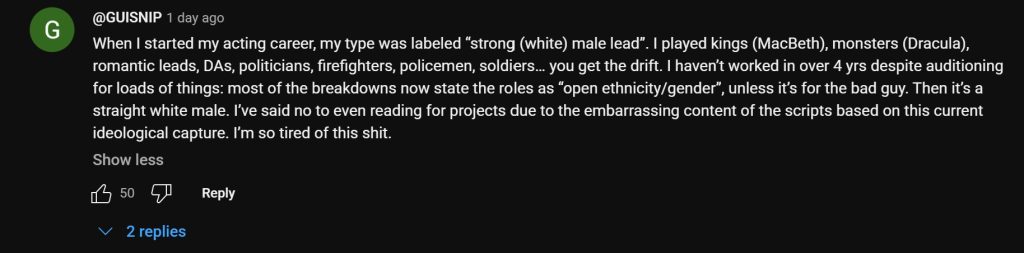
The popular YouTube channel Film Threat covered this article, and we’d like to highlight some of the more disheartening comments from its viewers.





The Film Threat cover of this article:
Sources:
https://ajph.aphapublications.org/doi/full/10.2105/AJPH.2005.079020
https://www.unodc.org/documents/data-and-analysis/gsh/2023/GSH23_ExSum.pdf
https://www.unodc.org/documents/data-and-analysis/gsh/2023/Global_study_on_homicide_2023_web.pdf
https://www.who.int/publications/i/item/9789240110069
https://www.bls.gov/news.release/pdf/cfoi.pdf
https://www.cardiff.ac.uk/__data/assets/pdf_file/0006/2910480/Serious-Violence-in-England-and-Wales_Violence-Research-Groups-24th-Annual-Report_2024.pdf
https://ourworldindata.org/why-do-women-live-longer-than-men
https://www.unodc.org/unodc/data-and-analysis/world-drug-report-2024.html
https://www.ons.gov.uk/peoplepopulationandcommunity/crimeandjustice/articles/natureofsexualassaultbyrapeorpenetrationenglandandwales/yearendingmarch2020


Related Posts

6 Comments
-
Clara Voss
What’s most disheartening is the astonishing intellectual shallowness of these so-called artists, festival programmers, and the entire apparatus surrounding them. Their engagement with these complex subject matters is remarkably superficial. The films mentioned above are not profound explorations of the human condition but rather the opposite, hollow displays of ideological dogma, showcasing a fundamental lack of genuine insight into the depth and nuance of human experience. Still, they are celebrated by the mainstream as the highest form of the art, what a complete farce.
-
ROBERT IOLINI
Thank you for this important essay. As a filmmaker working outside the 'industry', and thus not bound by the rules of the game, I have the freedom to portray each human in my films as having a nuanced multi faceted personality. In the end, I guess it's up to each individual actor, filmmaker, director, or producer to make the necessary moral choice.
-
Bill Blass
Amazing essay, I wish more people would have the patience/attention/reasoning skills to read it. One thought though, your reference to the NYT article "Men, where have you gone?" actually supports the theme of your article. It mentions how boys/mens intuitions have been broken down, like the yMca is co-ed and Boy Scouts throttled etc., where the Girl Scouts and the yWca remains only for females etc. True that the NYT article may be a lonely voice in the darkness for their org as a whole, but it was a welcomed article that pointed to various reasons and possible solutions to turn this sinking ship around without intentionally enraging/polarizing "influencers" be part of the solution. Saving this article...soooooo many good data points in it TYVM!
-
Valeriya
Excuse me, sirs, is it allowed for women’s perspectives and experiences to make it on screen? Or nothing that may hurt your feelings? How would you like to be profoundly pictured if you (not all of you, some of you) are never weak, flaky, rude, aggressive, abusive, disrespectful, taking your privileges for granted and so on, but always flat gorgeous in every way? Do you mean it’s time for filmmakers and up to them to polish your shining armor now?
-
Film Industry Watch
Thank you for your comment. First - women’s perspectives absolutely belong on screen, full stop. The critique isn’t “don’t let women shine.” It’s that too many buzzy titles get there by flattening men into predators, cowards, or punchlines. That shortcut doesn’t make women stronger; it just swaps one cartoon for another. Second, strength doesn’t require a foil made of straw. Women can be powerful, complicated leads without the men around them being uniformly weak or vile. When movies treat “masculinity” itself as the problem, stories shrink: women become symbols, men become case studies. Third, complexity is the real win. Let women be brilliant, wrong, tender, ruthless full spectrum human. Let men be the same. We can call out genuine harm (and we should) without turning half the human race into set dressing for a thesis. If the only way a film knows to elevate women is to humiliate men, it’s admitting it doesn’t trust its own heroine. No one’s asking to “polish men’s armor.” We’re asking for better writing: stories where women shine as themselves and where male characters aren’t sanded down to a single, tedious note. That’s not protecting feelings, that’s protecting cinema.
-


Davit Ghvaladze
Very thoughtful take on a hot topic where the mass media reluctantly stands with a blindfold, denying to shed a light on the real consequences of this vile culture and like a parrot only talking about one side of the story. A brave voice has created this post for all and I stand in support for both men and women to take 1 hour to slowly digest this post and understand where we are today and wish to be tomorrow.