

Thanks to reader’s contribution we’ve been made aware that the Romanian Film Awards, commonly known as the Gopos, have recently come under scrutiny for practices that raise questions about conflicts of interest within the local film industry. Tudor Giurgiu, a key figure in Romanian cinema, won multiple awards for his film Freedom (Libertate), securing 10 awards. This film triumphed over notable contenders such as films directed by Cristi Puiu and Radu Jude.
The conflict of interest arises as Giurgiu’s roles in the Romanian film scene are multifaceted. Not only is he a director, but he is also the founder and leader of the organization that oversees the Gopos. His influence extends further as the president of the Transilvania International Film Festival (TIFF), Romania’s largest film festival, which routinely features his own films, both as director and producer. Notably, Freedom (Libertate) and other productions from Giurgiu have been included in TIFF program, potentially generating profit.
Further illustrating the depth of Giurgiu’s influence, a film he produced, Moromeții 2, dominated the Gopos in 2019 by winning 9 awards. Additionally, two documentary features produced by his former partner and producer, Oana Giurgiu, won the award for best documentary in both 2016 and 2023.
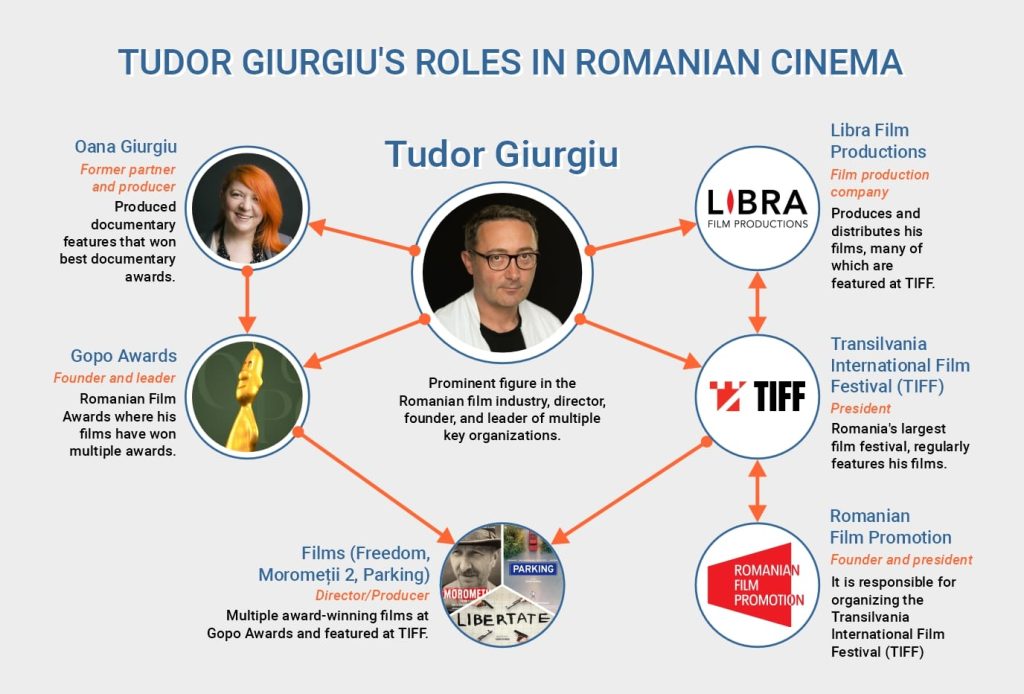
The distribution and production of these films are closely linked to Giurgiu’s other business interests. Most films produced under his company, Libra Film, are distributed through the same channels, and many international titles in their roster have been featured at TIFF. Remarkably, each of Giurgiu’s productions has been included in TIFF’s selections: in 2019, Parking, directed by Giurgiu, was the festival’s opening film, and in 2012, his feature Of Men and Snails also served as the opening film. This creates a sort of monopoly, dominating the local industry, making it harder for smaller producers and films to gain funding, attention or awards.
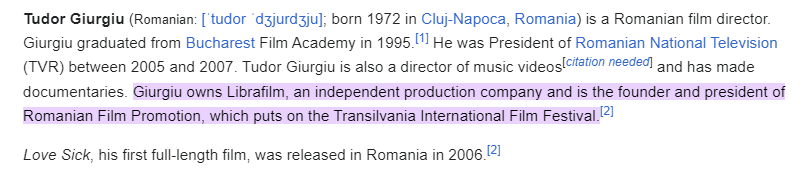
This vertical integration from film production through to festival presentation, distribution, and the local awards, are all or mostly financed with public funding, a fact that has not escaped the attention of industry observers.
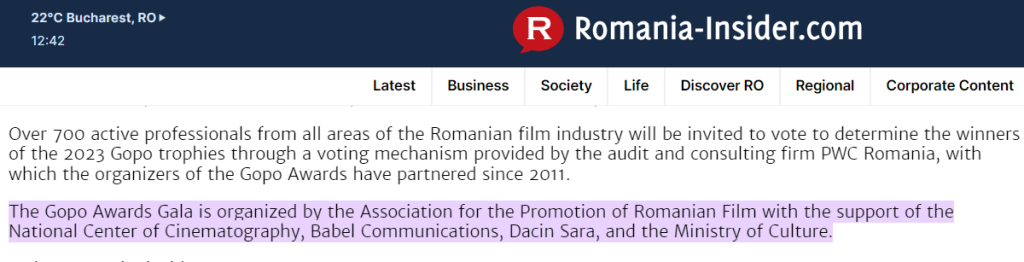
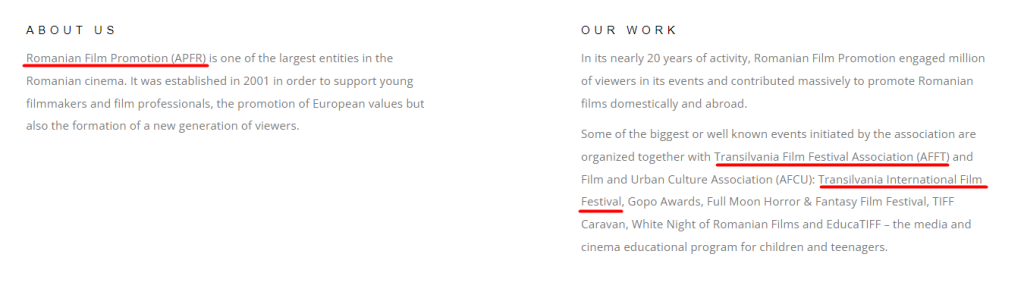
This sequence of film production, festival screening, and distribution is financed by public funding. Despite the apparent conflict of interest, such practices have become normalized within the Romanian film industry, with limited public discussion or critique. This situation is further supported by the behavior of other influential figures in the industry.
Sources: Official websites of the Gopo Awards, TIFF, Libra Film, and Transilvania Film, along with IMDb. Screenshots will be added shortly.

Related Posts
2 Comments
-
-
Film Industry Watch
Thank you for your comment. It seems like an ambitious film, likely funded primarily through public support, we assume? However, we believe you may have missed the main point of the article. When a festival or award founder is also an active director winning awards at events they help organize, it creates a clear conflict of interest. This isn’t about the quality of the film, which we haven’t watched, it’s about transparency and fairness. Those unwilling to face such scrutiny can step down from roles in organizations to eliminate potential conflicts. Abuse and protection of power are human tendencies, and it’s our role to report on these practices, regardless of the individual or country involved. The information we’ve shared came from Romanian filmmakers who approached us, highlighting a concern within the local industry. We urge the film industry to de-normalize such practices, fostering fairness and transparency in what is, sadly, a dying art form.
-

Albineț Vasile
All this blah-blah of a disgruntled author hiding behind keyboards and activist sounding texts is useless in this case. Freedom, Giurgiu's film really deserves all these awards. It is truly one of the best films of recent years, not just because it was extremely hard to make, dozens of actors and hundreds of people, but also because it is extremely hard to capture the atmosphere of those controversial days in December 1989, and the film managed to do it brilliantly.