

Science Exposes the Film Industry’s Echo Chamber
In her recent video “Scientific research has big problems, and it’s getting worse,” physicist Sabine Hossenfelder delivers a devastating critique of modern scientific research. Her analysis reveals how economic incentives have inverted the relationship between merit and success, creating what she calls “the natural selection of bad science.” Hossenfelder identifies three critical problems: occasional outright fraud, growing organized scams, and most pervasively, a broken incentive structure that rewards researchers for producing easily citable but ultimately useless work rather than meaningful breakthroughs.
What makes Hossenfelder’s critique particularly illuminating is not just its accuracy about science, but how perfectly it maps onto the film industry’s own systemic corruption. Her observation that “the ‘winning strategy’ in science has become to be useless” could just as easily describe both Hollywood’s sequel addiction and European cinema’s thematic mandates. When she notes that “most scientists don’t see what they’re doing as wrong; they’ve been taught it’s standard practice,” she unwittingly diagnoses the same mentality that has normalized risk aversion, formulaic content, and ideological compliance throughout the global film industry.
The physicist’s analysis provides an unexpected roadmap for understanding how business-as-usual corruption degrades not just individual careers, but entire cultural systems, turning institutions meant to advance human knowledge or artistic expression into vehicles for channeling resources toward predetermined formulas, safe commercial bets, and approved social themes.
The Fashion Problem: How Trends Corrupt Both Science and Film
Hossenfelder identifies a crucial problem in scientific research: the tendency for “sexy” and “fashionable” topics to receive disproportionate funding, regardless of their scientific merit. Research projects are shaped less by intellectual merit, more by the chance to ride the latest trends and attract grants. As one researcher in her analysis notes: “Funding calls for ‘sexy projects'” that “skew/select specific trends, and then everyone jumps on the bandwagon”, creating bubbles that “suck funding away from other directions.”
The film industry exhibits identical “fashion” phenomena across both commercial Hollywood and art-house European cinema. Both systems have become systematically constrained by trending formulas that guarantee funding and recognition while crowding out genuine innovation.
Hollywood’s Commercial Fashion: The Superhero Industrial Complex
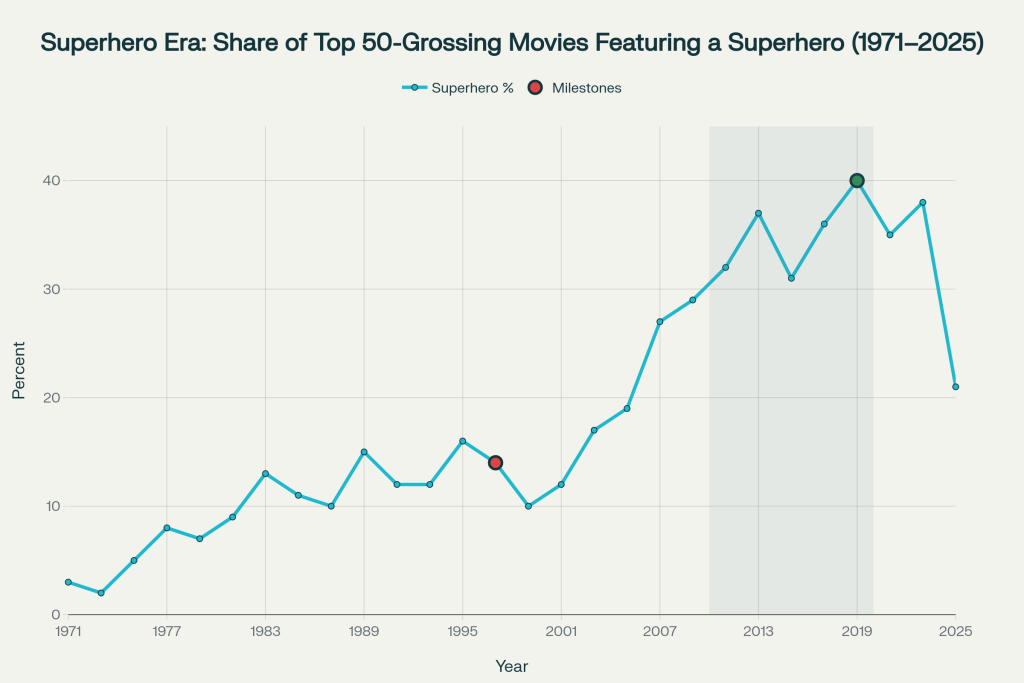
Hollywood exhibits this trend-following to an extreme through its endless remake cycle of superhero films, reliance on established intellectual property, and production of sequels and prequels. These are filmic equivalents of the “sexy research topics” Hossenfelder warns about: easy to sell, easy to justify, guaranteed to fit market expectations, and virtually guaranteed to absorb resources at the expense of original voices. The numbers tell the story of systematic creative degradation:
- The percentage of top-grossing films that are sequels or prequels more than doubled from 9% in 2005 to 22% in 2014
- By 2025, the vast majority of Hollywood’s box office is built on reboots, prequels, sequels, and spin-offs
- Of the 50 highest-grossing movies of all time, 41 are sequels, reboots, or remakes
Superhero movies and franchises like Marvel and DC have dominated Hollywood for decades, delivering reliable profits and merchandising opportunities but crowding out space for original works. Even as recent failures and “superhero fatigue” emerge, the industry clings to these formulas as safety nets, mirroring how unfalsifiable scientific trends persist for years despite declining returns.
This represents pure exploitation rather than innovation, closely paralleling science’s drift away from bold, challenging research toward “safe,” trendy topics that guarantee citations.
European Cinema’s Thematic Fashion: The Social Justice Mandate
If superhero franchises represent Hollywood’s commercial “scientific fashion,” European cinema has developed its own systematic trend-following through institutionalized diversity, equity, and inclusion (DEI) requirements and social justice mandates.
Major European cultural institutions now operate explicit thematic preferences:
- The Academy Awards’ “Representation and Inclusion Standards” mandate specific diversity criteria for Best Picture consideration, requiring central storylines about underrepresented groups including women, racial minorities, and LGBTQ+ communities
- European funding agencies through Creative Europe programmes prioritize projects dealing with predetermined social themes
- Festival programming increasingly emphasizes social justice narratives over artistic innovation
- Women-focused funding streams and gender quotas across Nordic countries channel resources toward female-centric films, sometimes resulting in female directors receiving higher average production budgets than their male counterparts
The result mirrors exactly what Hossenfelder describes in corrupted scientific research: resources flow overwhelmingly toward predetermined categories rather than genuine innovation, creating the same “bubble effects” that crowd out authentic artistic exploration.
Gender Takes Center Stage With 40–60% of Grand Prize winners: Trending Themes in Major Film Festival Awards
This industry-wide “fashion” for trending topics is reflected in how the world’s leading film festivals have selected their top prize winners over the last several years. Just as Hossenfelder points out science’s susceptibility to bandwagons, the film world is equally drawn to current themes, in particular, gender, identity, and social justice. A substantial and increasing share of Grand Prize or “Best Film” winners at the top ten international festivals now feature gender as a central theme, whether through women’s stories, LGBTQ+ identity, or direct engagement with issues of gender justice.
- At Cannes, Berlin, Venice, Locarno, Sundance, Toronto, San Sebastian, and beyond, major awards in recent years have frequently gone to films centered around female protagonists, feminist narratives, or broader gender and identity concerns.
- Examples include “Anatomy of a Fall” (Cannes), “Dreams (Sex Love)” and other gender-focused stories (Berlin), “Toxic” (Locarno), “Seagrass” (Toronto), and a succession of Sundance winners foregrounding women’s or LGBTQ+ themes.
- By sampling recent awards and jury statements, most film industry observers estimate that 40–60% of Grand Prize winners at major festivals since 2022 feature a gender or social justice theme, sometimes even more in certain years.
This pattern demonstrates how, much like in science, filmmakers now tailor their work for maximum festival and funding appeal—not simply for creative originality, but to align with prevailing themes of the moment.
To be clear, Film Industry Watch supports authentic stories about gender, social justice, and all underrepresented communities, and recognizes the vital importance of expanding opportunities for historically marginalized artists. However, we oppose any form of top-down censorship, mandated themes, or institutional requirements that force filmmakers to conform to predetermined narratives. True diversity and creative progress arise not from quotas or fashion, but from the freedom of artists to pursue their unique visions without pressure to align their work with external agendas. Championing social causes must never come at the cost of artistic independence or the wide spectrum of human experience that cinema exists to reflect. It is impossible to quantify how many compelling films exploring, for example, men’s experiences or fatherhood were never written, funded, or programmed simply because their themes did not align with prevailing trends. The same could be said for works examining rural life, aging, or apolitical human dilemma, stories that may be artistically vital but do not fit current institutional fashions. The chilling effect is real: when support and visibility are reserved for certain themes, countless original and meaningful projects are abandoned at the concept stage, depriving audiences of a true diversity of perspectives and stories.
The Echo Chamber Effect: When Formula Replaces Creativity
Both Hollywood’s commercial formulas and European thematic mandates create what Hossenfelder identifies as echo chamber effects, systems where the same ideas circulate endlessly without genuine innovation.
| In Commercial Cinema: | In European Art Cinema: |
| IP-based filmmaking, sequels, and prequels function as the creative equivalent of “bandwagon” scientific research, guaranteeing immediate audience recognition while reducing creative risk The chase for box office “sure things” mirrors how scientists design projects “to get the grant” rather than break new ground This endless recycling crowds out artistic innovation and disincentivizes risk-taking | Thematic mandates concentrate funding on a narrow band of “approved” subjects and social messaging Festival programming priorities create systematic bias toward predetermined narratives Creative compliance becomes more important than artistic excellence |
The consequences are identical across both systems: merit displacement and creative homogenization, where qualitative excellence and risky vision are sacrificed for formula, compliance, and instant recognition.
European Cinema: Different System, Similar Constraints
European cinema offers a partial counterpoint to Hollywood’s pure market logic through public funding bodies, tax incentives, and regional support that theoretically prioritizes creative diversity over commercial returns. The European model supports hundreds of smaller-scale productions and encourages cross-border co-productions, allowing for artistic exploration that commercial systems would reject.
However, European systems increasingly suffer from their own systematic constraints:
- Rising thematic quotas and festival mandates create new forms of creative limitation
- Gender-based funding requirements can restrict storytelling diversity
- Social justice programming priorities may exclude innovative work that doesn’t fit predetermined categories
- The prioritization of specific demographic narratives makes it harder to fund politically neutral or experimental content
As European agencies adopt quota-based and thematic models similar to Hollywood’s commercial formulas, the space for genuine artistic risk and innovation narrows across both systems.
The Business-As-Usual Normalization
Just as in corrupted scientific research, these distorting incentives have become completely normalized across the film industry. Decision-makers from studio executives to public funders justify risk-aversion and formulaic constraints as responsible, politically progressive, or economically necessary.
| The normalization process mirrors exactly what Hossenfelder describes in science: | Industry professionals rationalize these constraints through identical logic: |
| Practitioners participate because they want to keep working and earning money Creative constraints become survival strategies, then professional norms, then invisible assumptions Merit becomes secondary to system-gaming abilities Innovation is suppressed because original thinking becomes financially unviable | Commercial formulas as “understanding audience demand” (while ignoring how supply shapes demand) Thematic mandates as “addressing historical inequities” (while ignoring how quotas limit creative diversity) Both systems as “professional reality” rather than structural corruption |
The Cultural Degradation
When systematic constraints dominate creative industries, the damage extends beyond individual careers to cultural degradation. Both science and film lose their essential social functions when constrained by trending formulas rather than authentic exploration. Science exists to advance human knowledge; cinema exists to reflect diverse human experiences and expand cultural understanding. When both become vehicles for following predetermined trends, whether commercial formulas or social messaging, rather than pursuing these core missions, society loses critical sources of genuine discovery and authentic artistic expression. The parallel is exact: just as corrupted scientific research misleads the public about genuine discoveries, systematically constrained cinema misleads audiences about the full spectrum of human experience and cultural possibility.
Breaking the Trend-Following Cycle
Hossenfelder’s analysis offers a roadmap for addressing systematic corruption in both fields:
Eliminate Trending Requirements: Just as scientific funding should prioritize research quality over fashionable topics, film funding should prioritize artistic merit over commercial formulas or thematic compliance.
Diversify Beyond Single Metrics: Moving beyond box office projections in commercial cinema and demographic checkboxes in art cinema toward holistic assessment of long-term cultural value.
Create Merit-Based Alternatives: Establishing funding and distribution pathways that evaluate projects on creative excellence rather than conformity to trending categories.
Transparency in Decision-Making: Requiring disclosure when programming and funding decisions prioritize trending considerations over artistic quality.
The Choice Between Authentic Art and Systematic Following
The most crucial insight from both critiques is that systematic trend-following destroys the diversity it claims to create. When Hollywood mandates superhero formulas and European institutions mandate social justice themes, they create identical constraints on creative expression, just with different trending requirements.
The choice is not between commercial success and artistic integrity, or between social progress and creative freedom. The choice is between systems that allow authentic voices to emerge naturally and systems that mandate what those voices must say or sell.
Both science and cinema suffer when institutional systems reward conformity to predetermined trends rather than authentic exploration of unknown territory. Whether those trends are commercial (superhero franchises) or ideological (social justice narratives), the systematic effect is identical: the suppression of genuine innovation in favor of safe, predictable, trend-following formulas.
People will continue wanting to make films and earn money, just as researchers want to conduct research and secure funding. The question is whether these legitimate career aspirations will be channeled through systems that reward authentic creativity and discovery, or through systematically corrupted networks that serve only trending formulas and connected insiders.
Understanding the parallel between scientific research’s trend-following corruption and the film industry’s systematic constraints offers hope: if the same problems afflict both fields, then solutions that restore merit-based evaluation might work across both systems. But this requires acknowledging that trending requirements, whether commercial or ideological, represent corruption of creativity, not progress toward genuine diversity or innovation.
The corruption of creativity through systematic trend-following isn’t inevitable, it’s a choice we make every time we prioritize fashionable formulas over authentic exploration. Both Hollywood’s superhero addiction and European cinema’s thematic mandates represent the same fundamental problem: systems that reward conformity to trending requirements rather than courage to explore unknown creative territory.

SOURCES:
- https://www.youtube.com/watch?v=9yPy3DeMUyI
- https://www.politicalpandora.com/post/enshittification-superhero-movies
- https://stephenfollows.com/p/hollywood-sequels-by-the-numbers
- https://www.imd.org/research-knowledge/economics/articles/deja-vu-is-the-film-industrys-sequel-and-remake-addiction-a-sign-of-the-end/
- https://www.oscars.org/awards/representation-and-inclusion-standards
- https://ec.europa.eu/info/funding-tenders/opportunities/docs/2021-2027/crea/wp-call/2022/call-fiche_crea-media-2022-codev_en.pdf
- https://www.nfvf.co.za/wp-content/uploads/2022/02/Gender-Matters-in-the-SAFI-Report.pdf
- https://www.wmm.com/resources/film-festivals/
- https://www.europarl.europa.eu/RegData/etudes/BRIE/2014/545705/EPRS_BRI(2014)545705_REV1_EN.pdf
- https://www.cined.com/europe-vs-us-film-funding-game-go-episode-85/


Write a Comment