Disney’s desperate pivot to win back young men exposes a decade of systematic audience alienation
When Variety published “Disney’s Boy Trouble: Studio Seeks Original IP to Win Back Gen-Z Men” this week, it read like an inadvertent confession. After years of messaging that male audiences were passé, that “male and pale is stale” and “the future is female”, Disney now finds itself desperately courting the very demographic it spent a decade marginalizing.
The article, by Matt Donnelly, reveals Disney leadership “pressing Hollywood creatives in recent months” for projects specifically targeting young men, while offering the comfortable explanation that Gen-Z males are simply a “lonely, gaming-obsessed group hampered by COVID-19 lockdowns.” It’s a telling deflection that studiously avoids the more obvious cause of male audience abandonment.
YouTube commentator The Critical Drinker wasted no time dismantling this narrative in his response video, delivering a characteristically blunt assessment: “You might utterly despise men and everything they represent. But when it comes to that increasingly uncomfortable meeting with the accountants every few months, well, it turns out that you kind of need them.”
His provocative analysis exposes a fundamental market reality that Hollywood has been reluctant to acknowledge: systematic audience alienation has measurable financial consequences.
The Pattern: Deconstruction as Creative Strategy
As we has documented in our previous gender-related investigations, the entertainment industry’s approach to male characters over the past decade represents a systematic pattern rather than isolated creative choices. The Critical Drinker’s inventory of “cultural assassinations” provides a stark illustration:
Luke Skywalker transformed from heroic mentor to “suicidal hermit” in The Last Jedi, a creative decision that triggered years of fan backlash and required repeated public explanations from director Rian Johnson. Even Mark Hamill has since shared alternative backstories he wished had informed Luke’s arc.
Thor repositioned as comic relief (“Fat Thor”) in Endgame, trivializing trauma for laughs in a way that sparked mainstream criticism about the normalization of body shaming, even from outlets typically supportive of Marvel’s creative choices.
Indiana Jones portrayed as a diminished, aging figure in Dial of Destiny, completing what many fans saw as the systematic de-mythologizing of cinema’s most beloved adventurer.
None of these choices is inherently wrong – heroes can and should face failure and growth. But the systematic nature of these deconstructions suggests institutional policy rather than organic storytelling evolution.
The Double Standard Test -Sex and the City Gender Swap
The Critical Drinker’s most piercing observation comes through a thought experiment that exposes Hollywood’s asymmetrical approach to gender representation. Imagine, he suggests, rebooting Sex and the City where half the female characters are gender-swapped, the glamour of Manhattan social life is replaced with muscle cars and gun ranges, and every episode includes lectures about “the challenges of modern life for men.”
The universal recognition that such a reboot would be ridiculed reveals the double standard at play. Studios treat male-focused storytelling as something that must be corrected or diluted, while female-focused content is allowed, rightfully, to remain true to its core audience.
This isn’t about opposing women’s stories or diverse representation. It’s about recognizing that segmented audiences are how successful entertainment works, as proven by both Top Gun: Maverick and Barbie, films that succeeded precisely because they embraced rather than apologized for their core demographics.
Industry-Wide Institutional Bias
Disney’s predicament reflects broader patterns Film Industry Watch has been tracking across the industry. Our previous investigations have documented similar systematic approaches to gender representation: our reporting on Israel’s Jerusalem Film Festival revealed an institutional climate where male filmmakers alleged systematic exclusion from programming and funding opportunities.
Similarly, our analysis of Israel’s Ophir Awards highlighted unusual demographic disparities, 11 female nominees to one male in key categories, that fueled perceptions of ideological considerations overriding merit-based selection.
These aren’t isolated incidents but manifestations of what we’ve identified as the systematic corruption of fairness in cultural institutions. When ideological signaling drives creative and curatorial decisions, audience trust inevitably erodes, and eventually, so do box office receipts.
The “Girl Boss” Problem and Universal Audience Rejection
The Critical Drinker’s analysis of the “girl boss” archetype reveals another dimension of Hollywood’s systematic miscalculation. These characters, invincible, untested, narratively frictionless, failed to resonate with any demographic, including the women they were ostensibly designed to attract.
The problem wasn’t strong female characters but checkbox character design. As we’ve documented in our previous analysis of thematic mandates in filmmaking, audiences can identify when characters exist to serve messaging rather than story. The resulting rejection spans gender lines because good storytelling transcends demographic categories.
Market Reality Meets Ideological Programming
The Variety article’s acknowledgment that Disney is actively soliciting “original IP” to court Gen-Z men represents more than creative repositioning, it’s an admission that ideological programming has market limits. When audience abandonment becomes measurable, studios face an uncomfortable choice between ideological consistency and commercial viability.
The article’s attempt to blame external factors, COVID lockdowns, social isolation, gaming culture, while ignoring content choices reveals the industry’s reluctance to acknowledge its own role in audience alienation. This mirrors patterns we’ve observed in other cultural institutions that prefer to attribute criticism to external factors rather than examine internal practices.
Three Rules for Audience Recovery
Based on both The Critical Drinker’s analysis and Film Industry Watch’s broader investigation of industry practices, effective audience recovery requires straightforward acknowledgments:
Allow demographic preferences without apology. Top Gun: Maverick succeeded by delivering on its promises to its core audience. Barbie worked because it embraced rather than diluted its perspective. Segmentation isn’t discrimination, it’s how entertainment markets function. Stop systematically diminishing legacy heroes. Writing compelling female characters doesn’t require demolishing male archetypes. The pattern of Luke, Thor and Indiana Jones represents institutional policy, not creative coincidence.
Restore aspirational masculinity as a legitimate archetype. The Critical Drinker’s call for “masculine heroes” doesn’t mean returning to one-dimensional stereotypes, but rather characters who are “smart, capable, assertive, confident, complex, and maybe even a bit dangerous”, the classic mentor/warrior/rogue spectrum that made multiple generations fall in love with cinema.
Merit Over Mandates
We supports authentic stories featuring all demographics and recognizes the importance of expanding opportunities for historically underrepresented voices. However, we maintain that genuine diversity emerges from creative freedom rather than institutional mandates. The systematic exclusion of certain perspectives, whether male experiences, traditional values, or politically neutral storytelling, represents the same corruption of fairness we’ve documented in festival programming and funding decisions. When institutions prioritize demographic representation over narrative excellence, they serve no audience well.
It is impossible to quantify how many compelling stories about male experiences, fatherhood, or traditional masculine virtues were never developed because they didn’t align with institutional preferences. The same creative constraints that exclude authentic male perspectives also limit the full spectrum of human experience that cinema exists to explore.
The Audience Speaks
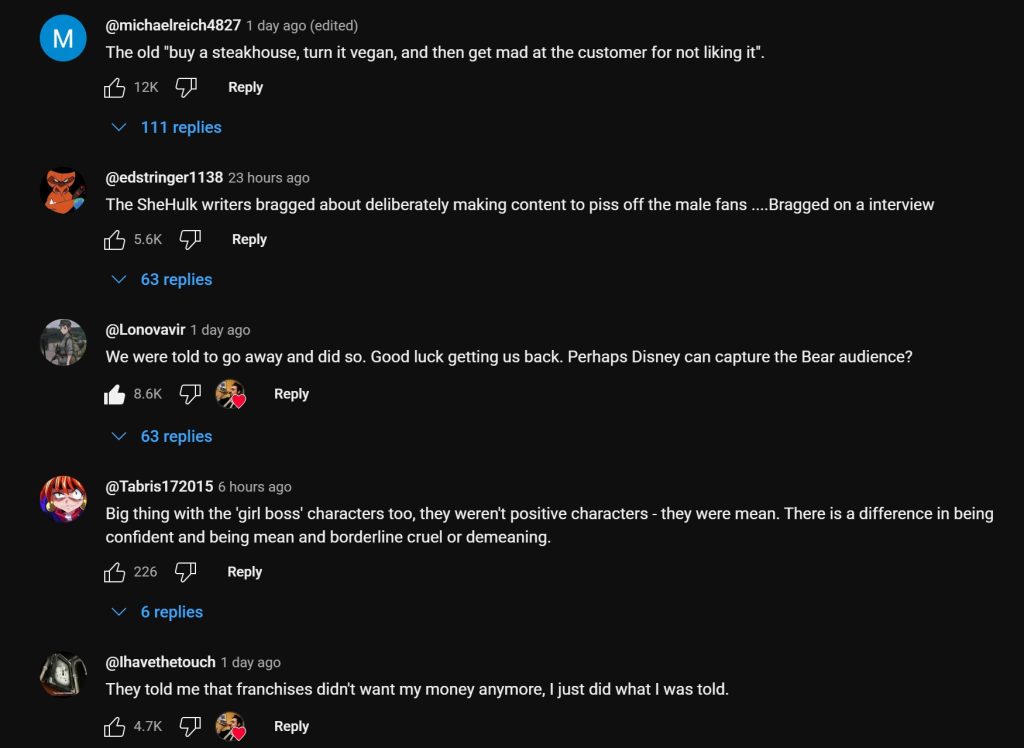
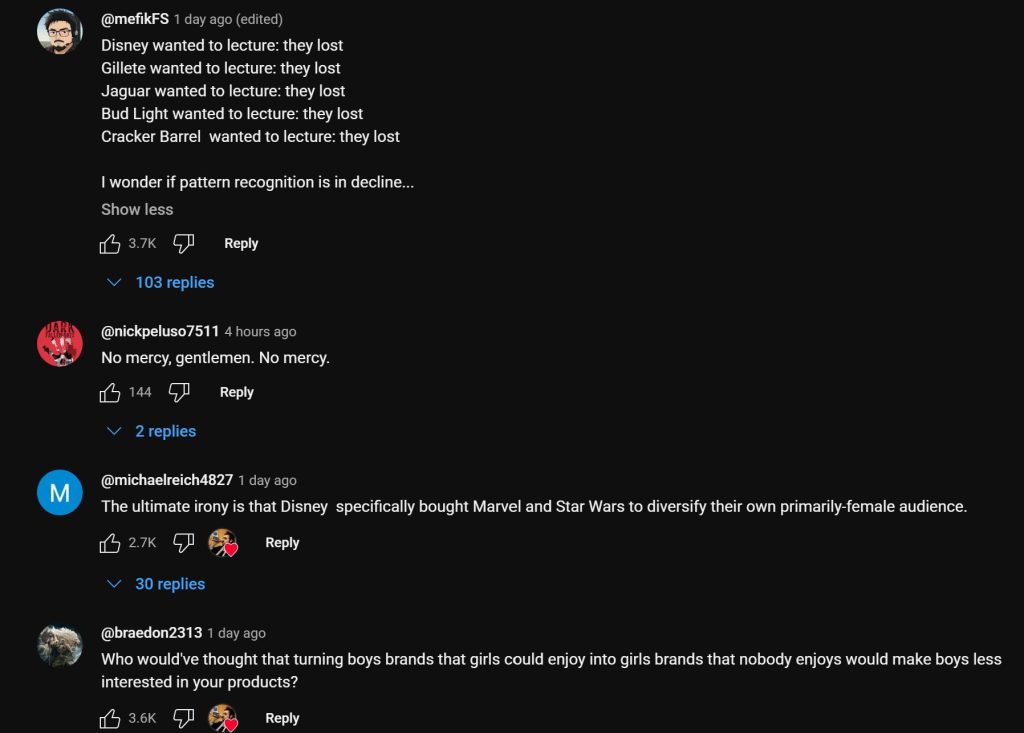
The reaction to The Critical Drinker’s video underscores how deep the alienation runs. Top-voted comments describe the shift in blunt economic terms: “buy a steakhouse, turn it vegan, and then get mad at the customer for not liking it.” Others highlight how creators openly bragged about provoking male fans (“The She-Hulk writers bragged about deliberately making content to piss off male fans”), or note the simple calculus of disengagement (“They told me that franchises didn’t want my money anymore, I just did what I was told”).
Several comments echoed the broader trend beyond Disney: “Disney wanted to lecture, they lost. Gillette wanted to lecture, they lost. Bud Light wanted to lecture, they lost.” The recurring theme is not resistance to female characters or social change, but frustration with being lectured, ridiculed, or deliberately excluded. As one commenter summarized: “We were told to go away and did so. Good luck getting us back.”
This direct feedback reinforces the Drinker’s central claim: audience abandonment was not caused by external factors like gaming or lockdowns, but by a cultural strategy that treated customers as adversaries.
The Accounting Reckoning
Disney’s scramble to “win back Gen-Z men” isn’t mysterious, it’s mathematics catching up to messaging. When studios spend years reframing male audiences as a pathology and male heroes as punchlines, disengagement becomes the rational response.
The Critical Drinker’s core observation remains undeniable: “When you decide to treat half your audience as the enemy, that’s exactly what you turn them into.” Disney’s current predicament represents the inevitable outcome of systematic audience alienation in service of ideological signaling, with absolutely no merit or quality writing.
The question facing not just Disney but the broader entertainment industry is whether this expensive lesson will produce genuine course correction or merely cosmetic adjustments. Market forces suggest that audience preferences will ultimately prevail over institutional mandates, but the industry’s response to its own accounting crisis will determine whether that correction comes through internal reform or external market pressure.
As The Critical Drinker concludes, “men as a demographic are not all that difficult to please. Treat them with a bit of respect, give them the things that they enjoy, and you’ll be surprised how quickly they come around.” The same principle applies to all audiences: authentic storytelling that respects rather than lectures viewers will find its market regardless of demographic calculations. The entertainment industry’s path forward depends on whether it can rediscover the principle that built these valuable franchises in the first place: serving audiences rather than instructing them.