

Key Figures Connected in Award-Winning Greek Film
Evidence suggests a conflict of interest marred the 2019 Cannes Film Festival’s Official Selection for Short Films, and the award itself. The Palme d’Or went to the Greek short film ‘The Distance Between Us and the Sky,’ directed by Vasilis Kekatos, produced by Eleni Kossyfidou and French producer Guillaume Dreyfus.
Editorial note: The facts made on this page are based on public production credits and information, with sources and screenshots provided at the bottom of this page.
Overview
Evidence indicates that the 2019 Cannes Film Festival Official Selection for Short Films, and the awarding of the Short Film Palme d’Or, may have been compromised by undisclosed conflicts of interest and irregular jury conduct.
The Palme d’Or was awarded to The Distance Between Us and the Sky, directed by Vasilis Kekatos, produced by Eleni Kossyfidou, with French producer Guillaume Dreyfus.
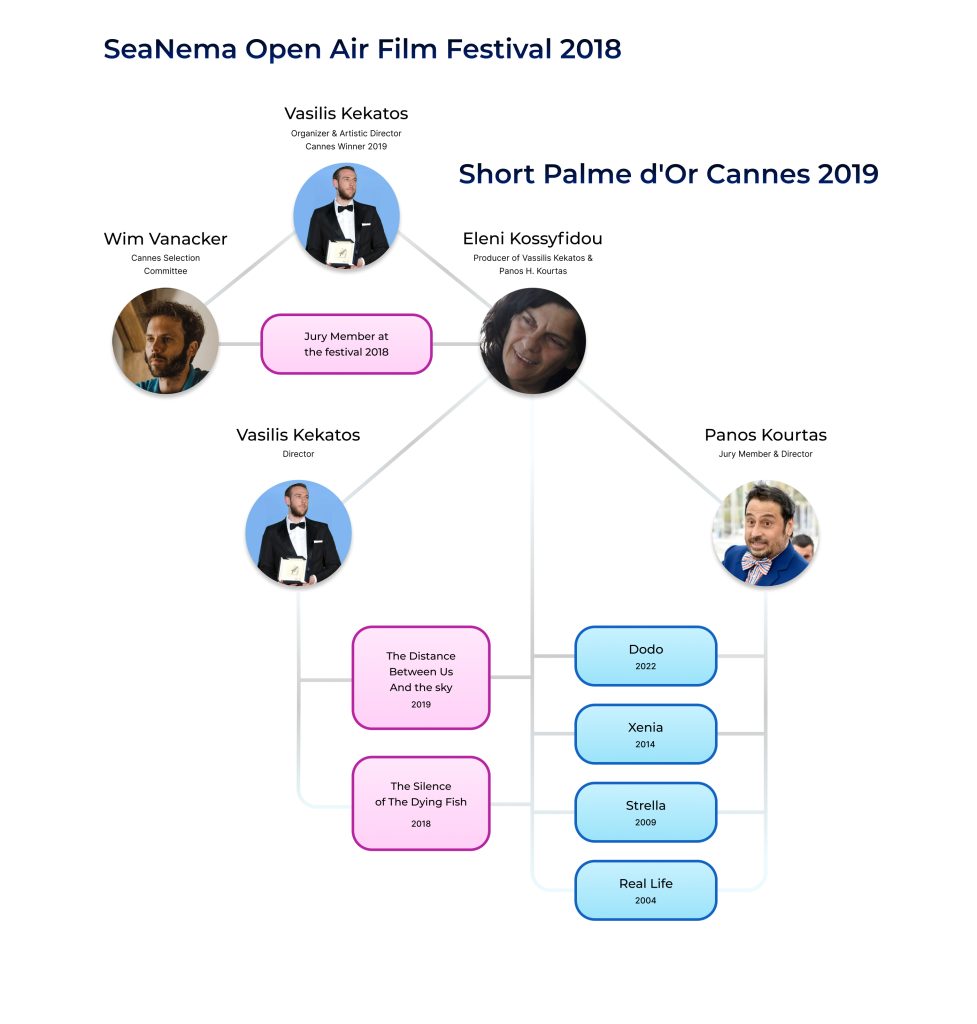
At the center of the concerns is the role of Panos H. Koutras, a member of the 2019 Short Film Jury, who has maintained a long-standing professional relationship with Kossyfidou, the producer of the winning film.
Summary of Key Findings
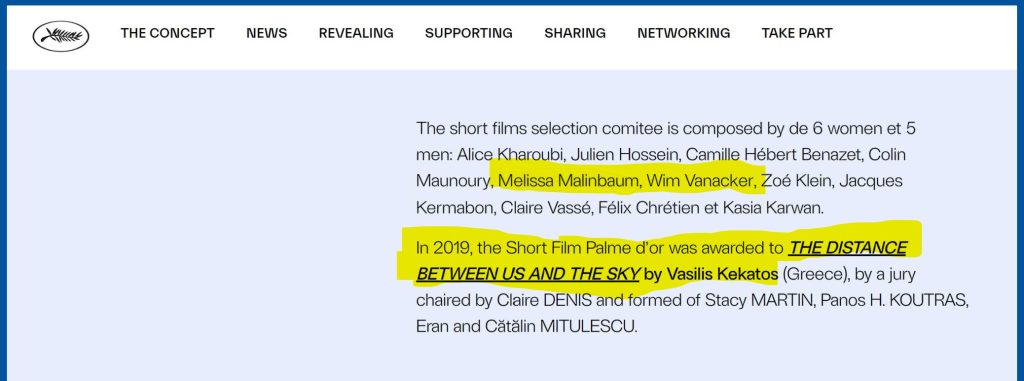
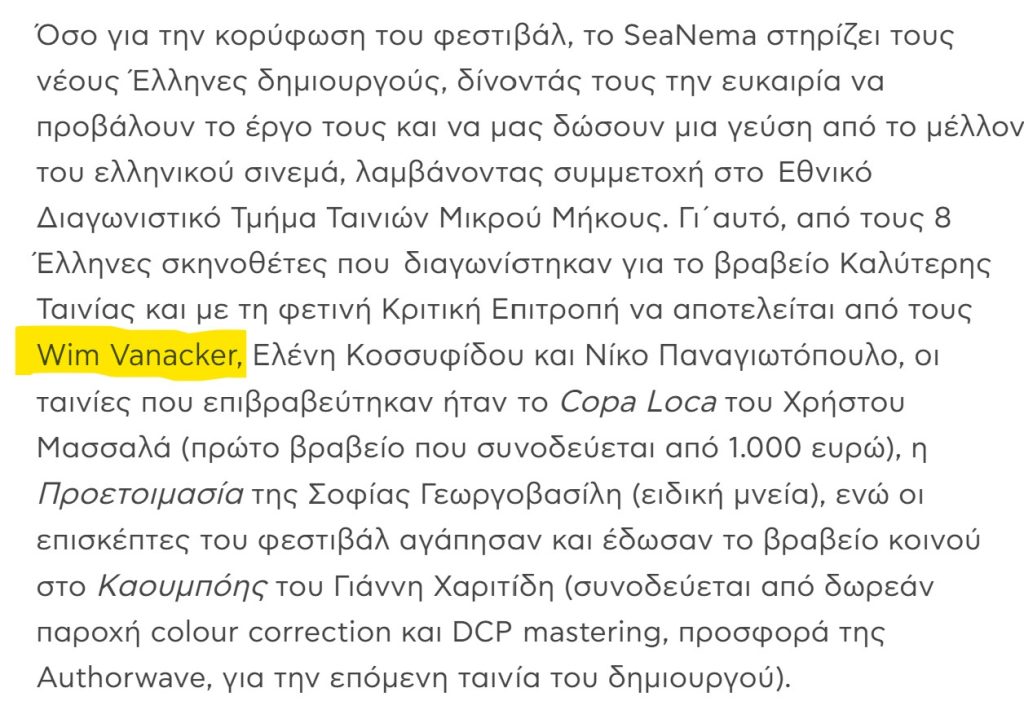
- A multi-year professional relationship existed between Vasilis Kekatos and Wim Vanacker, a member of the Cannes selection committee, dating back to at least 2018. This relationship included reciprocal professional engagements prior to the 2019 selection.
- Eleni Kossyfidou, producer of The Distance Between Us and the Sky, is the long-time producer of Panos H. Koutras, a sitting jury member in the competition that awarded the film.
- Kossyfidou was not introduced at Cannes to other filmmakers as the producer of the film. Her producer credit was added to the film’s Wikipedia page only in 2021, more than two years after the award, raising concerns regarding concealment of material relationships.
- At a post-festival screening event in Paris, Koutras reportedly told several competing directors that he had “pushed [their] films out of consideration” during jury deliberations.
- Audio recordings from the same Paris event document:
- Koutras stating, “as a joke,” that he “could be bribed.”
- Another director replying, “I told you I don’t have my wallet on me,” followed by “I was wearing a dress.”
- Koutras stating that he had been “very opposed” to several films and that he was “alone” in those objections.
- In the same recordings, Koutras explicitly acknowledges opposing other films during deliberations, an admission made in his own voice.
- These statements support an allegation of manipulation by elimination: rather than solely advocating for a preferred film, Koutras allegedly opposed competing entries one by one until only the film produced by his own producer remained viable for consensus.
- A broader pattern of opacity is identified:
- In 2018, a short film (Gabriel) produced by a Cannes selection committee member was selected from over 7,000 submissions.
- In 2019, another selected short film (Parparim) credited a producer who was also an employee of the Cannes Film Festival.
- These incidents suggest repeated governance failures across multiple years.
- Additional concerns involving Wim Vanacker, reported separately, demonstrate recurring issues of transparency involving the same individuals across different institutions and projects.
Conflict of Interest: Jury Member and Producer Relationship
The central undisclosed conflict concerns the relationship between Panos H. Koutras and Eleni Kossyfidou.
Kossyfidou has produced all of Koutras’ feature films since 2004, including:
- Strella
- Xenia
- Dodo
She initially served as production manager on Koutras’ 2004 film Real Life. Their professional partnership spans nearly two decades.
Kossyfidou also produced both of Kekatos’ short films:
- The Silence of the Dying Fish
- The Distance Between Us and the Sky
This creates a direct overlap between:
- a jury member,
- his long-time producer,
- and the winning film.
Such an arrangement presents a clear financial and professional incentive for a jury member to favor a film produced by his own producer, particularly where future funding, prestige, and project development are implicated.

Recorded Statements and Jury Conduct
At a post-Cannes screening event in Paris, Koutras addressed several competing directors. According to witnesses and audio recordings:
- Koutras stated that he had “pushed [their] films out of consideration.”
- He told attendees that he had been “very opposed” to certain films and that he was “alone” in these objections.
- In jury practice, a strong objection by a single juror often renders a film non-viable, as juries tend to converge on consensus rather than confrontation.
In the same recordings:
- Koutras is heard saying that he “could be bribed,” described by him as a joke.
- Another director replies, “I told you I don’t have my wallet on me,” followed by “I didn’t have my phone either.”
These recordings are cited as direct evidence of Koutras’ own account of his actions during deliberations.
Mechanism of Influence: Elimination Rather Than Promotion
There are two recognized ways to influence jury outcomes:
- Active promotion of a favored film.
- Systematic elimination of competing films through objection.
The recordings support the latter. By opposing multiple films, Koutras allegedly narrowed the field until consensus could only form around The Distance Between Us and the Sky.
This conclusion is based not on inference, but on Koutras’ own recorded statements.
CRelationship Between Kekatos and Wim Vanacker
Further reporting establishes that the professional relationship between Kekatos, Kossyfidou, and Wim Vanacker predates Cannes 2019.
In 2018:
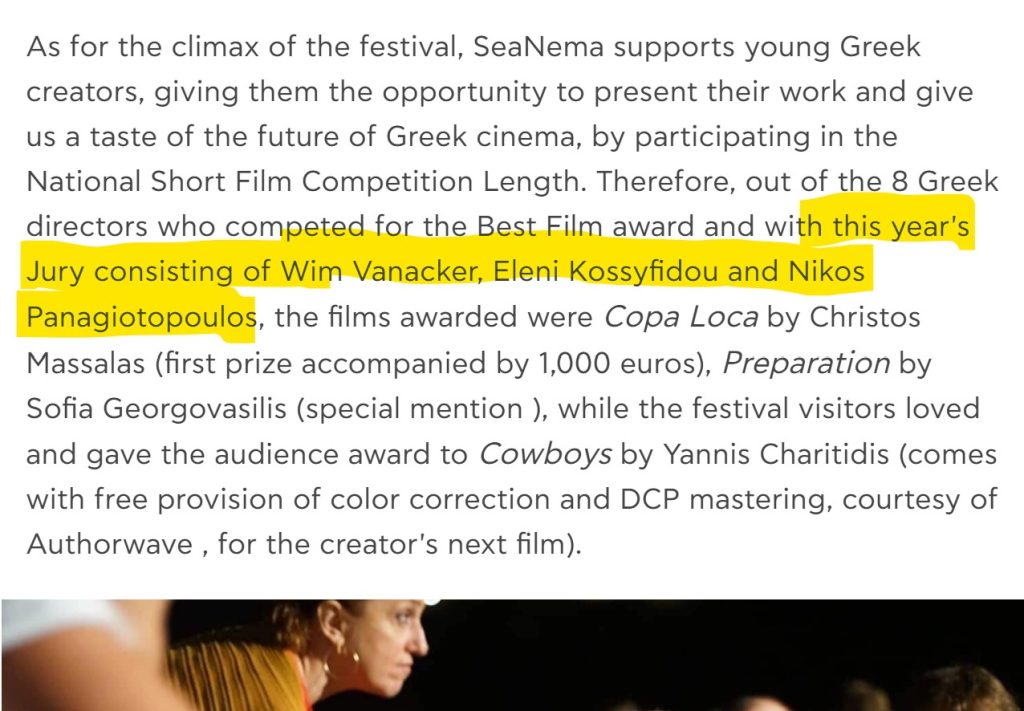
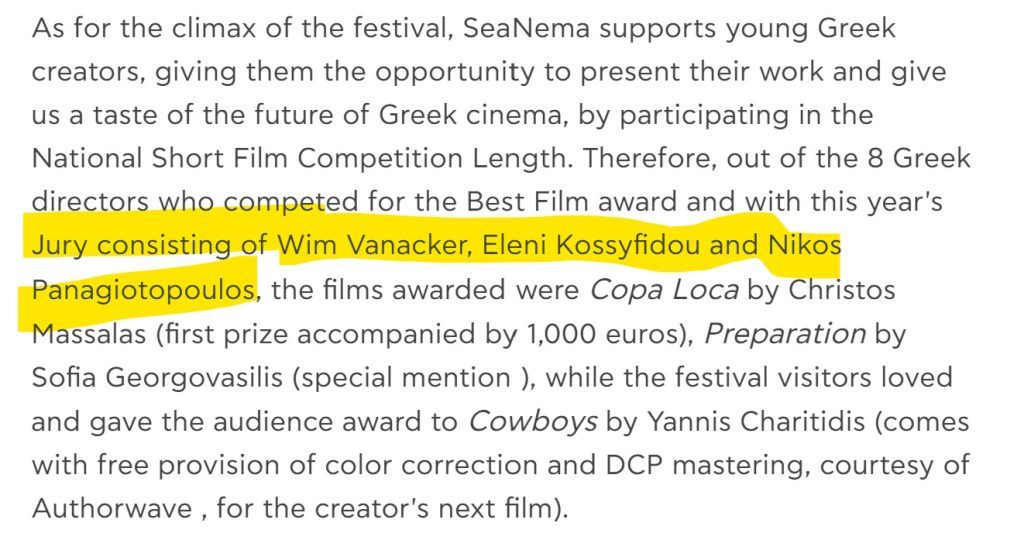
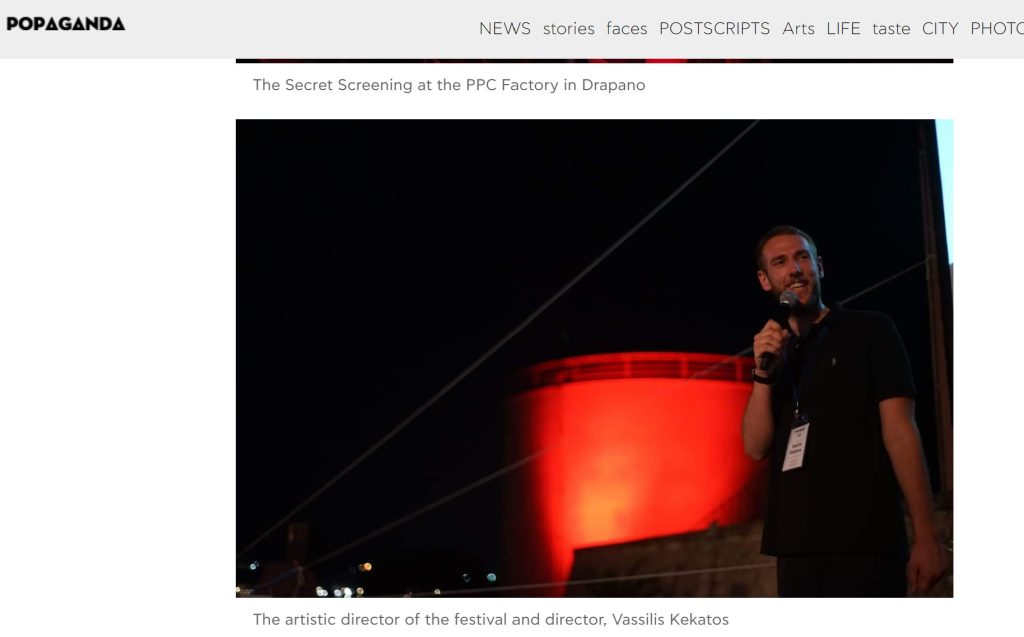
- Kekatos invited Vanacker to serve as a jury member at the SeaNema Open Air Film Festival, organized by Kekatos on Kefalonia.
- Kossyfidou also participated in the same event.
- Vanacker was at the time Artistic Director of NISI MASA, where Kekatos’ film The Silence of the Dying Fish was presented.
Festival jury participation typically involves compensation, travel, and accommodation. This establishes a material professional benefit conferred one year prior to Cannes 2019.
Industry Context and Broader Implications
According to a European Union survey, 98 percent of Greek citizens believe corruption is widespread in Greece. While this statistic does not establish guilt, it contextualizes public sensitivity to conflicts of interest.
Comparable cases at Cannes include:
- Mélissa Malinbaum, a selection committee member whose produced short film was selected.
- Dominique Welinski, who holds overlapping roles as producer and decision-maker.
These examples reinforce concerns regarding structural governance failures rather than isolated incidents.
Final notes:
The undisclosed relationships, recorded admissions, delayed credit disclosures, and recurring selection irregularities raise serious questions about the integrity of the 2019 Cannes Short Film competition. The evidence presented does not rely on anonymous accusations or speculative interpretation. It consists of:
- documented production histories,
- contemporaneous statements by involved parties,
- and audio recordings in which a jury member describes his own conduct.
Together, these elements warrant scrutiny by the festival, the industry, and the public.

Vasilis Kekatos Biography
Vasilis Kekatos is a Greek film director and screenwriter recognized for his 2019 short film The Distance Between Us and the Sky, which won the Palme d’Or and Queer Palm for best short film at the Cannes Film Festival. His body of work includes The Silence of the Dying Fish (2018) and Retrograde, with his films featured in festivals such as Locarno, Sundance, and Telluride. In addition to filmmaking, Kekatos has worked in art photography, including a cover for Greek Vogue. In 2023, he released the teen drama series Milky Way, and he is in production on his debut feature film Our Wildest Days.
SOURCES:


Our organization is dedicated to unveiling the true decision-making processes and power dynamics within the film industry. The chart below provides a comprehensive summary of these elements. Our goal is to democratize access and provide talented, emerging young filmmakers with the opportunities they rightfully deserve to succeed in the industry.
Feedback and Corrections
If you believe your or company’s name was listed on this website unjustly, please CONTACT US.
With unwavering support from our community, Film Industry Watch proudly announces the creation of a $25,000 Whistleblower Fund. This pivotal initiative is devoted to identifying and exposing nepotism and misconduct in the film industry. Our aim is to cultivate an atmosphere of transparency and accountability, ensuring an equitable and principled environment for all industry members. We encourage anyone aware of criminal activities or misconduct to reach out to us confidentially. Rest assured, your identity will be protected. Reports leading to articles posted on this website, significant organizational changes or legal proceedings will be eligible for a financial reward for between $100 to $5000 for each report.
We hold a special focus on Film Festivals, Screenwriting Labs, various awards, and public Film Funds. It’s important to remind our readers that these entities are predominantly supported by public funding, which necessitates a standard of fairness and transparency in their operations.
Stand with us in our quest for integrity in the film industry – your voice matters.
Sources:
Wikipedia article history (Difference between revisions) showing how the names of the producers were added only in 2021:
All screenshots takes from public resources:
https://www.imdb.com/title/tt10214916/
https://www.imdb.com/title/tt8791506/
https://www.imdb.com/name/nm3187519/
https://www.imdb.com/name/nm3267450/
https://en.wikipedia.org/wiki/The_Distance_Between_Us_and_the_Sky
https://greekreporter.com/2022/07/20/greeks-believe-corruption-widespread/
Related Posts

4 Comments
-
-
MickeyNotMouse
These people are the worst of the film industry... and humanity really. Keep doing the good work and exposing these charlatans.
-
-
Tinkerbell
This is peanuts. Tarantino awards Palm d’or for Michael Moore. Who produced? The Weinstein Company. The selection process is always arbitrarian and nepotistic.
-
Maira
Talking about cinema and Greece is a joke...was always a joke..and I ve been working in the industry since 2001..not anymore thank you! I m out of the gang


Chroma
Hi, Keep going guys, that's fantastic, there is way too much scumbag in this industry